At a Glance: Being "overweight" — or what is considered overweight — is clinically defined by a body mass index (BMI) between 25.0 and 29.9, but that number alone cannot tell you whether your weight poses a health risk. This guide explains the official BMI threshold, when the overweight label misclassifies muscular individuals, how waist circumference changes the equation, and the health implications you should actually pay attention to.
The number that classifies you — and the context it is missing
At a routine checkup, a physically active 42-year-old woman steps on the scale. She is 5'5", 170 pounds. Her BMI is 28.3 — technically overweight. She trains for half-marathons year-round, her waist measures 31 inches, and routine blood work shows all metabolic markers clean. Yet she leaves with a note that says "lose weight."
Three exam rooms down, a 44-year-old with a BMI of 23.8 — comfortably "normal" — has a waist measurement of 41 inches, elevated fasting glucose, and triglycerides creeping upward. The chart says he is fine. His waist says otherwise. Neither chart told the full story. That's the problem with using BMI alone.
The Centers for Disease Control and Prevention (CDC) defines overweight as a BMI between 25.0 and 29.9 for adults aged 20 and older. This threshold comes from decades of population data correlating BMI with health outcomes, and it remains a valuable screening tool. But BMI does not distinguish between fat and lean mass, it does not see where you carry your weight, and it does not read your blood work. A BMI calculator tells you which category you fall into. It does not tell you whether that category accurately describes your health.
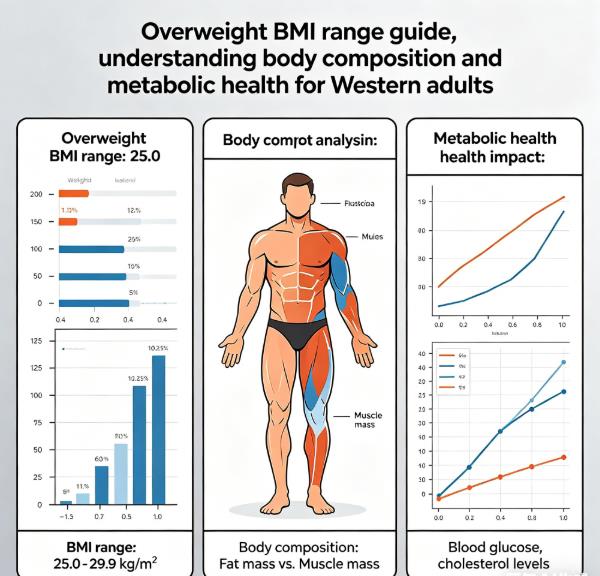
What the overweight BMI range actually means
What is considered overweight?
For adults, overweight is defined as a BMI between 25.0 and 29.9. This threshold is established by the CDC and WHO and applies to adults aged 20 and older.
For adults, the CDC and WHO use the same classification system. Here is how the numbers break down:
Underweight: BMI below 18.5
Healthy weight: BMI 18.5 to 24.9
Overweight: BMI 25.0 to 29.9
Obese: BMI 30.0 and above
The overweight range sits between the lowest-risk weight zone and the category where health risks become more pronounced. A BMI of 25 is not a sharp cliff where health suddenly declines — it is a point on a continuum where epidemiological data shows risk factors beginning to rise across large populations. But "population-level risk" and "individual health" are not the same thing.
Wondering exactly what weight counts as overweight for your height? This quick table shows boundary values for common heights:
| Height | Overweight Weight Range (lbs) | Overweight Weight Range (kg) |
|---|---|---|
| 5'2" (62 inches) | 137 – 163 lbs | 62 – 74 kg |
| 5'5" (65 inches) | 150 – 180 lbs | 68 – 82 kg |
| 5'8" (68 inches) | 164 – 197 lbs | 74 – 89 kg |
| 5'11" (71 inches) | 179 – 215 lbs | 81 – 98 kg |
| 6'2" (74 inches) | 195 – 234 lbs | 88 – 106 kg |
Someone at the low end of this range who strength trains regularly may have a body fat percentage in the fitness zone. Someone at the high end who is sedentary may face elevated metabolic risk. Same BMI category, completely different health implications.
When the overweight label gets it wrong — and how to check
The single biggest blind spot of the BMI-based overweight classification is its inability to distinguish between fat and lean mass. A muscular athlete, a physically active tradesperson, or a recreational lifter with above-average muscle mass will frequently land in the overweight category despite low body fat and excellent metabolic health. The formula does not know the difference between a pound of muscle and a pound of fat.
The NIH identifies a waist measurement above 40 inches for men and 35 inches for women as an independent risk factor for metabolic conditions like type 2 diabetes and cardiovascular disease — regardless of BMI. If your BMI says "overweight" but your waist stays under the NIH cutoff, muscle is usually the reason — not harmful visceral fat. When that waist measurement climbs above the thresholds, though, your overweight reading likely points to real metabolic risk.
A body fat calculator that estimates composition from circumference measurements provides a third data point — one that often breaks the tie between weight and waist when the two disagree.
Your overweight risk level — and what to do about it
If your BMI falls in the overweight range, the next step depends on your additional risk factors. Here is a tiered approach based on whether your waist, body fat percentage, and metabolic markers confirm or challenge the BMI classification:
Lower concern (BMI only): Your BMI is 25.0–29.9, but your waist is under the NIH threshold, your body fat percentage is healthy, and your blood work is normal. In this scenario, the overweight label may reflect higher muscle mass or a larger frame rather than excess fat. Maintain your current habits and recheck annually.
Moderate concern (BMI + waist): Your BMI is overweight and your waist exceeds the NIH threshold. This pattern suggests elevated visceral fat. Focus on sustainable lifestyle adjustments: add a 10-minute walk after meals, prioritize protein and vegetables, and reduce sugary beverages. Track your waist circumference monthly — it often responds faster than the scale.
Higher concern (all three indicators): Your BMI, waist circumference, and body fat percentage all suggest excess adiposity, and your blood work shows elevated markers. In this scenario, consider discussing structured support options with a qualified professional. Even modest weight loss — 5 to 10 percent of body weight — produces clinically meaningful improvements in blood pressure, glucose, and lipids.
Your 5-Minute Overweight Reality Check
Step 1: Calculate your BMI. If it is 25.0–29.9, note the number and move to step 2.
Step 2: Measure your waist at the navel (if you have a tape measure available). Compare to the NIH thresholds of 40 inches for men and 35 inches for women.
Step 3: Estimate your body fat percentage. Use the tiered risk framework above to decide your next action.
If the tape measure isn't handy, don't skip the check — a simple waist-to-height ratio using a piece of string works too.
Special populations: when the standard definition shifts
Asian adults
A BMI of 23.0 — not 25.0 — marks overweight for East, South, and Southeast Asian adults. The WHO recommends this lower threshold because metabolic disease risk rises at significantly lower BMI values than in white populations. For these groups, overweight is defined as a BMI of 23.0 to 27.4, with obesity at 27.5 and above. A 2004 WHO expert consultation published in The Lancet established these adjusted cutoffs based on evidence that Asian populations experience elevated diabetes and cardiovascular risk at lower BMIs. An Asian BMI calculator that uses these adjusted thresholds provides a more accurate risk picture than the standard chart.
Seniors (65+)
For a 70-year-old, a BMI of 27 may be protective, not risky. The clinical interpretation of "overweight" shifts as we age. A meta-analysis published in the American Journal of Clinical Nutrition (2014), pooling data from 32 studies and 197,940 older adults, found that individuals with a BMI of 23-30 had lower all-cause mortality risk compared to those with a BMI under 23. A slightly higher weight provides nutritional reserves that protect against frailty, falls, and infection. For this group, the overweight category may not signal elevated risk in the same way it does for younger adults. A senior BMI calculator with age-adjusted interpretation helps make sense of these numbers.
Athletes and highly active individuals
Ever seen a muscular athlete flagged as overweight? Here's why. For people who regularly engage in resistance training, play sports, or do physically demanding work, the standard BMI definition of overweight is frequently inaccurate. High lean body mass pushes BMI into the overweight or even obese range at low body fat percentages. For this group, the consensus recommendation is to prioritize body fat percentage and waist circumference over BMI. An athlete BMI calculator provides helpful context, but body composition testing remains the definitive metric.
Common myths about being overweight
The most persistent myth we encounter is that an overweight BMI automatically means you need to lose weight. If your waist is under the NIH threshold, your body fat percentage is healthy, and your blood work is clean, the label may reflect muscle, not risk. The BMI label alone does not dictate action.
Myth: Being in the "overweight" category means you are unhealthy. Fact: Cardiorespiratory fitness predicts mortality better than BMI category does. An active person with an overweight BMI can out-perform a sedentary person with a "normal" one.
Myth: The definition of overweight is the same for everyone. Fact: The WHO recommends lower BMI cutoffs for Asian populations. Seniors may have lower mortality with a modestly higher BMI. Athletes are frequently misclassified. Context always matters.
Myth: Overweight and obesity are the same thing. Fact: Overweight (BMI 25.0–29.9) indicates a moderate elevation in risk across populations. Obesity (BMI 30.0 and above) is associated with a more pronounced increase in chronic disease risk. The distinction matters for both clinical assessment and personal goal-setting.
Frequently Asked Questions About Overweight BMI
What BMI is considered overweight for adults?
The CDC and WHO define overweight as a BMI between 25.0 and 29.9 for adults of all genders. This range sits above the healthy weight category (18.5–24.9) and below the obesity threshold (30.0 and above).
Can someone with an overweight BMI be healthy?
Yes. BMI alone cannot tell your full health story. A person may fall into the overweight category purely from carrying more muscle mass. To gauge your real metabolic status, check your waist size, body fat percentage, and blood work rather than relying on the number alone.
Is the definition of overweight the same for Asian populations?
No. The WHO recommends a lower BMI threshold for Asian adults. Overweight begins at a BMI of 23.0 rather than 25.0, due to elevated metabolic disease risk at lower BMI values in these populations.
How accurate is BMI for determining if someone is overweight?
BMI is a useful population-level screening tool but has known limitations at the individual level. It cannot distinguish between fat and muscle. Muscular individuals are frequently misclassified as overweight, while some people with a "normal" BMI may have unhealthy levels of body fat. Waist circumference and body fat percentage add essential context.
Does being overweight always mean I have excess body fat?
No. A 6'2" linebacker weighing 240 lbs may have 12% body fat — yet BMI calculates to 30.8, landing in the obese range. Bodybuilders, strength athletes, and people with physically demanding jobs often have BMIs in the overweight or obese range due to higher lean muscle mass, not excess fat. A waist measurement and body fat estimate quickly clarify whether your BMI reflects muscle or adiposity.
Is the overweight category safe for older adults?
Research suggests a modestly elevated BMI may be protective for seniors. A 2014 meta-analysis found that adults over 65 with a BMI between 23 and 30 had lower mortality risk. The clinical focus for older adults shifts toward preserving muscle mass and functional ability rather than achieving a specific BMI number.
References & Sources
WHO Expert Consultation: Appropriate body-mass index for Asian populations. The Lancet. 2004; 363(9403): 157-163. This consultation set ethnicity-specific BMI cutoffs for Asian adults.
Winter JE, MacInnis RJ, Wattanapenpaiboon N, Nowson CA. BMI and all-cause mortality in older adults: a meta-analysis. Am J Clin Nutr. 2014;99:875-890. Meta-analysis of nearly 198,000 seniors showing moderate higher BMI linked to lower mortality risk.
BMI Calculator Blog. This content is provided for educational and informational purposes only. We encourage sharing with proper attribution to our site. Unauthorized commercial use is prohibited. Medical Disclaimer: This content does not replace professional medical advice, diagnosis, or treatment. Always seek the advice of a qualified physician or other licensed health provider with any questions regarding your body composition, weight status, or health goals.