At 5'4" and 145 pounds, your BMI is 24.9 — the top of the healthy range. One more pound flips you into overweight. But your waist size probably matters more than that one-pound difference.
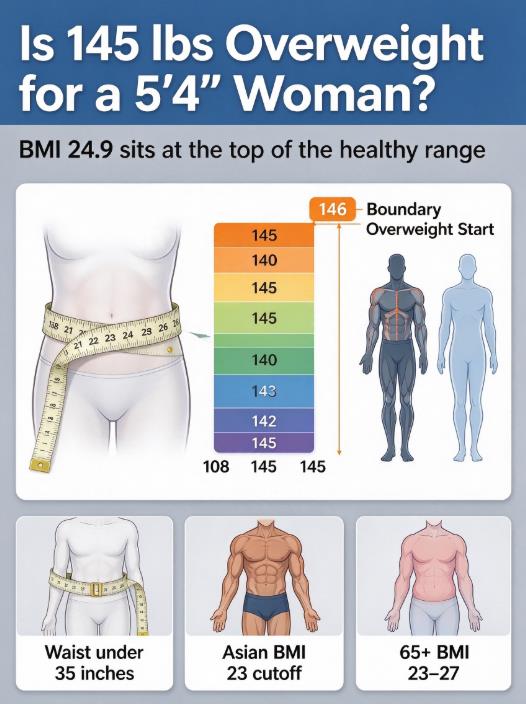
For a 5'4" woman, the CDC healthy range is 108 to 145 pounds. At 145 lbs, BMI is 24.9. Overweight starts at 146 lbs (BMI 25.0). A single pound changes the category, which is exactly why the label measures a trend rather than a health condition.
Your Waist Tells a Better Story
BMI can't distinguish muscle from fat, and it can't see where your body stores fat. A tape measure can. We keep seeing the same note in our calculator comments — readers worried about one pound, but the waist never got measured.
The NIH sets the risk threshold for women at 35 inches. Under that number, metabolic risk is likely low. Over that, it's a stronger signal than any BMI category. Many readers buy high-end scales expecting a full health snapshot, only to overlook this simple, two-dollar measurement. For a deeper read, use a body fat calculator alongside your BMI.
145 lbs: When It's Fine, When It's Not
If you strength train, your waist is 28 inches, and you feel energetic — you're likely fine. Muscle is denser than fat, and a muscular 5'4" woman at 145 lbs can carry a body fat percentage in the low 20s.
If you're sedentary, your waist is 37 inches, and you feel tired most days, the picture changes — even with that identical BMI reading. Same height and scale weight can hide vastly different body composition.
What About Asian Women?
The WHO uses a lower overweight threshold for Asian populations — BMI 23.0 instead of 25.0 — because metabolic risk rises at lower BMI values in these groups. For a 5'4" Asian woman, that starts around 134 pounds. At 145 lbs, you'd be in the overweight category under these adjusted guidelines. An Asian BMI calculator gives you a more accurate read.
What About Age?
If you're over 65, some research suggests a BMI of 23–27 may be protective. For a 5'4" woman, that's roughly 134 to 157 pounds. At 145 lbs, you sit in the middle of that zone. Preserving muscle and mobility matters more at this stage than pushing toward a lower number.
What to Do Next
Measure your waist at your navel. Under 35 inches, you're likely fine. Over 35, that's the signal to watch — not the scale. Check whether you can climb stairs without getting winded; that tells you more than a category. And if you want a baseline, run your numbers through a free BMI calculator. Re-check your waist every few months and keep an eye on energy trends — those two data points will tell you more than any single BMI reading ever will.
Frequently Asked Questions
Is 145 lbs overweight for a 5'4" woman?
No. BMI is 24.9 — the top of the healthy range. Overweight begins at 146 lbs (BMI 25.0).
What if my waist is over 35 inches but my BMI is normal?
That's called normal-weight obesity — BMI looks fine, but waist size signals elevated visceral fat. This pattern is linked to higher metabolic risk, which is why waist measurement matters alongside BMI.
Do Asian women follow different thresholds?
Yes. The WHO uses a lower overweight cutoff for Asian populations, based on evidence that visceral fat accumulates at lower BMI values:
Overweight starts at: BMI 23.0
For a 5'4" Asian woman: about 134 lbs
So 145 lbs: falls into the overweight category
An Asian BMI calculator gives a more personalized reading.
Is 145 lbs still healthy after 65?
Some research suggests BMI 23–27 may be protective for older adults. At 5'4", 145 lbs (BMI 24.9) falls inside that zone. The focus shifts to preserving muscle and mobility rather than hitting a lower number.
Should I try to lose weight if I'm at 145 lbs and 5'4"?
Not based on BMI alone. If your waist is under 35 inches and you feel energetic, there's no BMI-driven reason to lose weight. If your waist is elevated or blood work shows metabolic markers, that's a different conversation — one worth having with a qualified healthcare provider.
Sources
NIH/NIDDK: Adult Overweight and Obesity — Waist Circumference
Winter JE, et al. BMI and all-cause mortality in older adults: a meta-analysis. Am J Clin Nutr. 2014;99(4):875-890.
This article is for informational and educational purposes only. It does not replace professional medical advice. Consider discussing your results with a qualified healthcare provider. The BMI Calculator Blog Team maintains editorial independence.