Quick summary: A 5'4" woman weighing 150 lbs has a BMI of 25.8. That sits in the CDC/WHO "overweight" bracket (25.0–29.9), not obesity. The number alone tells you little until you factor in waist size, body fat, age, and activity level.
Key Takeaways
A 5'4" woman at 150 lbs has a BMI of 25.8, classified as overweight.
The healthy weight window for this height is 108–145 lbs (BMI 18.5–24.9).
Waist circumference under 35 in (88 cm) lowers metabolic risk for women.
Body fat between 21–24% is generally favorable for non-athletic adult women.
For many Asian women, overweight starts at BMI 23 and obesity near 27.5.
BMI measures weight relative to height. For 5'4" and 150 lb, the math is (150 ÷ 64²) × 703 ≈ 25.8. CDC classifies 18.5–24.9 as healthy, 25.0–29.9 as overweight, and 30+ as obese for adults 20+.CDC adult BMI categories apply the same cutoffs to women and men, though two people with the same score can have vastly different health profiles.
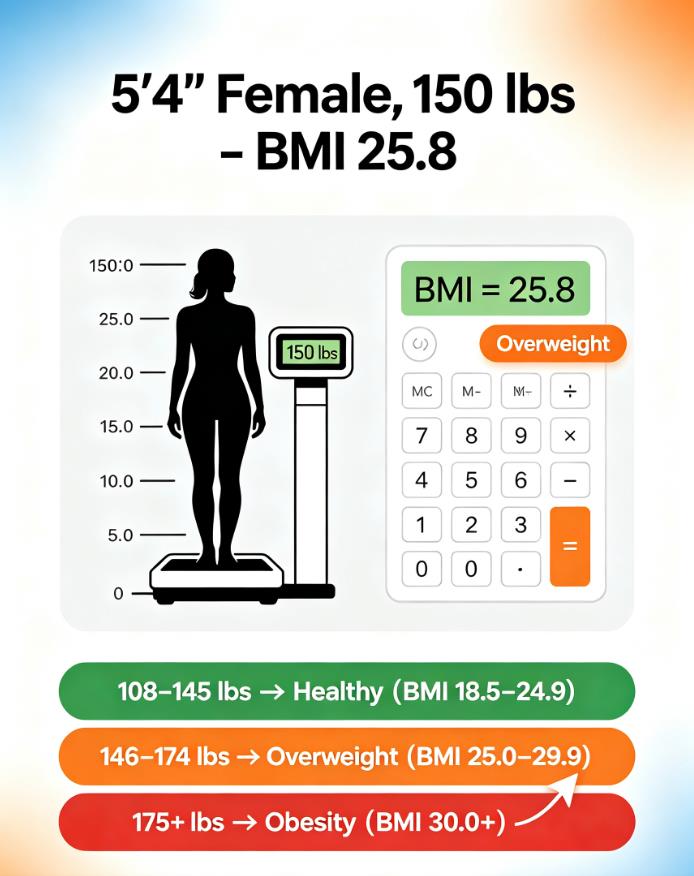
Where 150 lbs sits at 5'4"
| Weight | BMI | CDC/WHO label |
|---|---|---|
| 108–145 lbs | 18.5–24.9 | Healthy |
| 146–174 lbs | 25.0–29.9 | Overweight |
| 175+ lbs | 30.0+ | Obesity |
At 150 lb, you are roughly 5 lbs above the 145 lb healthy ceiling. A woman at this height and weight may expect a scary result, but if her waist is 31 inches and body fat is 23%, her risk profile looks better than the label suggests.
Why the same 25.8 can mean different things
BMI cannot see muscle. Take two 5'4" women at 150 lbs. One has a 31-inch waist and 23% body fat. The other has a 36-inch waist and 34% body fat. Same BMI, very different risk.
Waist under 35 in (88 cm): lower added cardiometabolic flag for adult women.
Waist 35 in or more: you may want to review your daily movement and eating habits, and talk to a healthcare professional to review your personal health markers. Results differ from person to person.
Body fat 21–24% (women): generally favorable for non-athletes. Body-fat benchmarks from exercise physiology groups shift based on your age bracket.
Resistance training 2–3 days/week: often improves waist and body composition before the scale moves much.
Asian cutoffs change the story. WHO expert guidance places overweight for many Asian adults from BMI 23 and obesity around 27.5. At 5'4" and 150 lb (25.8), that is already "overweight" by Asian thresholds but not obesity by the 27.5 line. Use the Asian BMI Calculator as a screening shortcut, then confirm with waist and body-fat estimates.
Get a number that means more
Run your height and weight through the Gender Adjusted BMI Calculator for the raw score. Then open the body fat calculator with waist and age; the combo beats staring at one BMI label. For personalized range goals by age and activity, the healthy-weight tool adds context without promising a single "perfect" pound.
Here's what to do next:
Measure waist at the navel after a normal exhale, morning if possible.
To reach BMI 24.9 at 5'4", target about 145 lbs—roughly 5 lb loss; even 3–5% of body weight can improve risk markers for some people.
Add protein at each meal and 150 minutes/week of moderate walking or similar activity (CDC physical-activity baseline).
Recheck every 4–6 weeks; track waist and energy, not daily scale swings.
We’ve spoken with many women over 50 who see shifts in body composition even when their scale weight stays unchanged. A 25.8 BMI with rising waist matters more than the headline number; discuss bone, muscle, and metabolic labs with a clinician if you have new symptoms.
Small, consistent habits—like a 10-minute walk after meals—often improve body composition before the scale moves.
Frequently Asked Questions
Is 150 lbs at 5'4" obese for a woman?
No. The BMI is about 25.8, which is overweight under CDC/WHO adult cutoffs. Obesity starts at BMI 30, or roughly 175 lbs at 5'4".
Can 150 lbs be healthy at 5'4" if I lift weights?
It can be, depending on waist and body fat. Muscle raises scale weight. A 31-inch waist and 22–24% body fat usually looks very different from a 36-inch waist at the same BMI.
How much weight do I lose to hit "normal" BMI at 5'4"?
BMI 24.9 equals about 145 lbs, so 150→145 is roughly 5 lbs. Smaller losses of 3–5% of body weight (about 4.5–7.5 lbs) may still improve some health markers for certain individuals.
What waist size should a 5'4" woman aim for at 150 lbs?
Under 35 in (88 cm) is the common female risk cutoff used by NHLBI/CDC screening. A waist-to-height ratio under 0.49 (about 31.4 in at 5'4") gives another simple check.
Do Asian women have different BMI limits at 5'4" and 150 lbs?
Yes. Many WHO Asian guidelines start "overweight" at 23 and "obesity" near 27.5. Your 25.8 would be overweight on those cutoffs but not obese by the 27.5 threshold; waist and body fat still decide real risk.
Sources
CDC, Adult BMI Categories — Classification and Weight Ranges: cdc.gov/bmi/adult-calculator/bmi-categories.html
WHO, Obesity and Overweight Fact Sheet — BMI 25/30, waist and health risk: who.int/news-room/fact-sheets/detail/obesity-and-overweight
NHLBI waist circumference risk guidance for adult women.
*This article is for informational and educational purposes only. It does not constitute medical advice, diagnosis, or treatment. Always consult a qualified healthcare provider regarding your individual health and weight goals. Individual results will vary. The BMI Calculator Blog Team maintains editorial independence and does not sell health products.*