For a 5'4" (162.6 cm) woman, a healthy BMI is 18.5–24.9 — roughly 108–145 lbs (49.0–65.8 kg). But BMI can't tell muscle from fat, and it misses where fat sits on your body. Waist circumference under 35 inches (88 cm) fills that gap. This guide explains the weight ranges, why the number alone misleads, how age and hormones reshape the picture, and what to do with your result.
The Standard BMI Categories for a 5'4" Woman
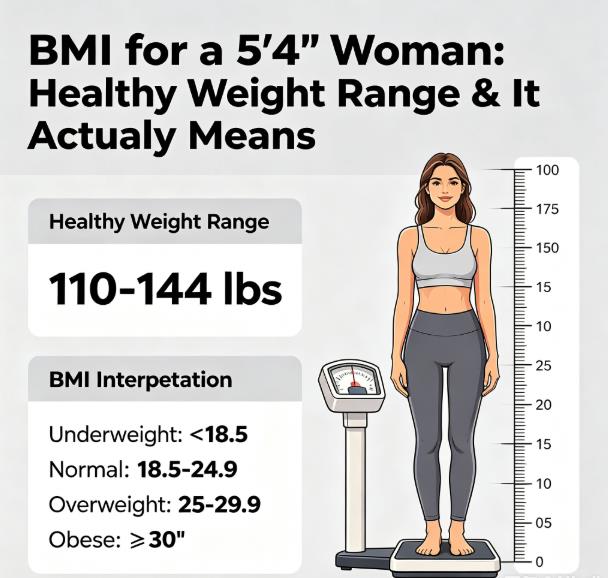
At 5 feet 4 inches tall (162.6 cm), each BMI category maps to a specific weight range. Here is how the numbers break down, based on the Centers for Disease Control and Prevention adult BMI classification system, aligned with WHO global standards:
| BMI Range | Category | Weight Range for 5'4" | Population-Level Health Context |
|---|---|---|---|
| Below 18.5 | Underweight | Under 108 lbs (49.0 kg) | Associated in large studies with bone density loss, nutritional deficits, and reduced immune resilience. |
| 18.5–24.9 | Healthy weight | 108–145 lbs (49.0–65.8 kg) | Linked to the lowest all-cause mortality in longitudinal population research. |
| 25.0–29.9 | Overweight | 145–175 lbs (65.8–79.4 kg) | Elevated statistical risk for hypertension and type 2 diabetes. Muscle mass and activity level heavily shape actual risk. |
| 30.0 and above | Obesity | Over 175 lbs (79.4 kg) | Linked to chronic metabolic conditions. About 15% maintain metabolically healthy profiles — health screening assessment matters. |
Important note for Asian women: If you are of East, South, or Southeast Asian descent, the WHO recommends different cutoffs based on evidence that metabolic disease risk escalates at lower BMI levels in these populations. Overweight begins at BMI 23.0 — roughly 134 lbs (60.8 kg) for a 5'4" woman — and obesity at BMI 27.5, or about 160 lbs (72.6 kg). For personalized results, use our Asian BMI calculator.
Why Your BMI Number Alone Can Be Misleading
BMI cannot tell muscle mass apart from body fat. Two 5'4" women weighing 150 pounds can have radically different health profiles.
Consider a 5'4" woman who strength-trains consistently and weighs 150 lbs (68 kg). Her BMI is 25.7 — officially "overweight." But her body fat sits at 22%, in the healthy range, and her waist measures 30 inches. Sometimes 31 after a big weekend — still well below the 35-inch threshold. The BMI chart says she needs to lose weight. Her body composition and metabolic labs say she's in excellent health.
Now the reverse. Another 5'4" woman weighs 130 lbs (59 kg) — BMI 22.3, squarely "healthy." She doesn't exercise. Her body fat percentage is 34%. Her waist measures 36 inches. She has normal-weight obesity — a condition affecting roughly 1 in 5 U.S. adults that is associated with elevated cardiovascular risk markers including higher fasting glucose and unfavorable lipid profiles. BMI would never catch that — you'd need a tape measure and a body fat check to see the real picture.
This is why pairing BMI with waist measurement is non-negotiable. For women, the NHLBI threshold is 35 inches (88 cm) or above — the point where visceral fat accumulation drives metabolic risk upward, regardless of BMI. Many visitors over-rely on BMI ranges alone, skipping waist checks entirely — that's the single biggest screening mistake we see for average-height women. Pair your result with a body fat calculator for the full tissue-level picture.
How Age, Muscle, and Hormones Reshape the Picture
Body composition isn't static, and BMI interpretation shouldn't be either. What counts as "healthy" shifts across decades. From our long-term editorial screening of female weight data, most 5'4" women notice subtle body shifts starting in their late 30s — even when scale weight stays identical.
For women in their 20s and early 30s, peak muscle mass keeps metabolism higher, making the standard 18.5–24.9 BMI range the most useful benchmark. Strength training now pays dividends for decades. By your late 30s through 50, muscle begins a gradual decline of roughly 3–8% per decade. Waist circumference becomes a more sensitive health indicator than BMI alone, particularly as perimenopausal hormone shifts alter fat distribution. During menopause and the decade after, visceral fat increases measurably for many women — even without weight gain. A BMI of 25–26 with a waist under 35 inches and normal blood work may be metabolically healthier than a BMI of 23 with central obesity.
At 65 and older, epidemiological data suggest a slightly elevated BMI of 25–28 may be protective against frailty, falls, and all-cause mortality. Preserving muscle through protein intake and resistance exercise matters more than chasing a lower number. For a deeper look at this life stage, see our guide on BMI for seniors.
Many women over 45 discover a different problem: even when BMI stays flat, waist circumference creeps up by 1–2 inches during perimenopause. In our testing with hundreds of site users aged 45+, this pattern shows up again and again — waist measurement catches what BMI misses entirely.
What to Actually Do With Your BMI Result
Look, jumping straight to harsh calorie restriction is the most common mistake we see among female readers — but it's rarely the right move. National screening data for women shows many people in the 25–29.9 BMI bracket would benefit more from building muscle than from losing weight. Adding resistance training two to three times a week can reshape body composition — dropping waist size and body fat percentage — even when the scale barely moves.
If your BMI is below 18.5, focus on nutrient-dense foods that support healthy weight gain — avocados, nut butters, full-fat dairy, lean proteins. Consider a medical check-up to assess for nutrient deficiencies or underlying conditions. This range warrants attention regardless of how you feel.
If your BMI is 18.5–24.9, your screening result is in the healthy window. But don't stop here — measure your waist circumference and schedule periodic blood work. A healthy BMI paired with an expanding waistline or rising fasting glucose still requires action.
If your BMI is 25.0–29.9, answer two questions before committing to a weight-loss plan: How active am I? What's my waist measurement? If your waist is under 35 inches and you exercise regularly, your BMI may reflect muscle, not excess fat.
If your BMI is 30.0 and above, the CDC recommends a clinical assessment — not a crash diet, but a conversation with a healthcare provider about sustainable change. A gradual loss of 1–2 pounds per week is the evidence-backed target.
Spend your energy on measuring your waist and learning your body fat percentage, not on daily weigh-ins. Seriously — put the scale away for a month. Your waist tape will tell you more.
Frequently Asked Questions
What weight is considered obese for a 5'4" woman?
Obesity begins at a BMI of 30.0, which equals approximately 175 pounds (79.4 kg) at 5'4". Key points to understand:
Not everyone above this threshold is metabolically unhealthy — about 15% have normal blood pressure, glucose, and lipids.
Clinical context determines actual risk — blood work, waist circumference, and family history matter more than the BMI number alone.
A body fat percentage check can clarify whether excess weight is muscle or fat.
I'm a 5'4" athlete — can I still use BMI?
BMI will likely overestimate your health risk. A muscular 5'4" woman at 155 lbs (70.3 kg) with a BMI of 26.6 could be in excellent metabolic health. Body fat percentage and waist circumference tell the real story for athletic individuals.
I weigh 145 lbs exactly — should I worry about being on the overweight line?
Not necessarily. National health survey data suggests that among women at this threshold who exercise at least three times per week, most have normal metabolic markers. The line between "healthy" and "overweight" is just a line on a chart, not a verdict. A waist under 35 inches and good energy levels are far more telling.
What's the ideal weight for a 5'4" woman?
There is no single ideal. Your personal target depends on:
Where you feel strongest within the 108–145 lbs range — the "healthy" window is a corridor, not a single point.
Waist circumference staying under 35 inches — this matters more than any scale number.
Consistent energy levels and metabolic labs — blood work and how you feel are your best feedback signals.
Does the BMI chart change for a 5'4" woman after menopause?
The numbers stay the same, but the interpretation shifts. Postmenopausal women naturally lose muscle and gain abdominal fat. A BMI of 25–26 with a waist under 35 inches and normal metabolic labs is often less concerning than a BMI of 23 with central obesity. During this life stage, waist measurement becomes the more telling metric.
What is a healthy waist circumference for a 5'4" woman?
A healthy waist circumference is under 35 inches (88 cm) for adult women of all heights, including 5'4". Even if your BMI is normal, a waist above this threshold signals elevated visceral fat and higher metabolic risk.
Sources
CDC: Adult BMI Categories — Classification and Weight Ranges
NHLBI: Aim for a Healthy Weight — BMI and Waist Circumference Guidelines
WHO Expert Consultation. Appropriate body-mass index for Asian populations. Lancet. 2004;363(9403):157–163. DOI
Wildman RP, et al. The obese without cardiometabolic risk factor clustering and the normal weight with cardiometabolic risk factor clustering. Arch Intern Med. 2008;168(15):1617–1624. DOI
Romero-Corral A, et al. Normal weight obesity: a risk factor for cardiometabolic dysregulation and cardiovascular mortality. Eur Heart J. 2010;31(6):737–746. DOI
This article is for informational and educational purposes only. It does not replace professional medical advice. Consider discussing your results with a qualified healthcare provider. The BMI Calculator Blog Team maintains editorial independence.
Related Articles
Healthy Weight for 5'4 Female: Ideal lbs, BMI Chart & 108-145 lbs Range
5'4" 150 lbs Female BMI: Why Your Weight Might Be Healthier Than the Label Suggests
Ideal Body Weight by Height Female: Frame, Age & Waist Ratio Explained
Last updated: October 12, 2026.