A 5′4″ woman at 138 lbs prints inside the “healthy” BMI row, yet her waist reads 36 inches and her mornings have felt off for months. A second 5′4″ woman at 140 lbs carries a 31-inch waist and shows up for a Saturday soccer scrimmage most weekends. Same chart row. Completely different read. That gap between a formula’s output and what a body is actually doing is exactly why this topic keeps getting re-opened.
Ideal body weight for women is a BMI-based range, not a single figure — and waist circumference determines where inside that range risk begins.
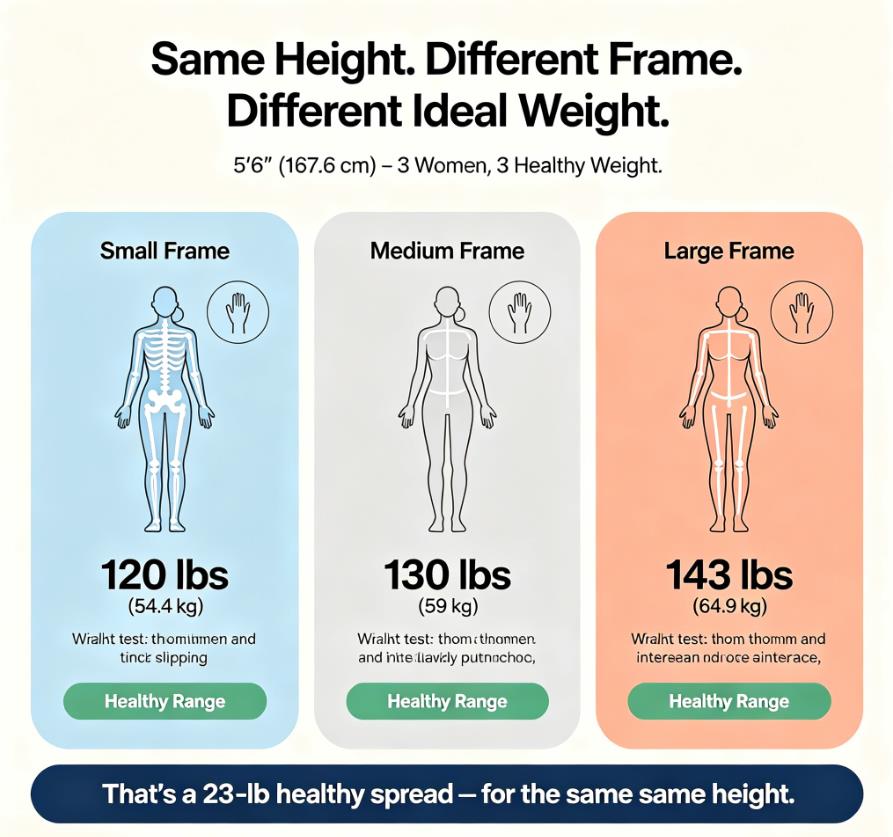
Healthy Weight Ranges by Height Before Any Adjustment
The CDC’s 18.5–24.9 band is a population screening line, not a personal finish line. It was never built to name a target for one specific woman.
| Height | BMI 18.5–24.9 Weight Band | Spread |
|---|---|---|
| 5′0″ (152 cm) | 95–128 lbs | 33 lbs |
| 5′2″ (157 cm) | 104–135 lbs | 31 lbs |
| 5′4″ (163 cm) | 108–145 lbs | 37 lbs |
| 5′5″ (165 cm) | 111–150 lbs | 39 lbs |
| 5′6″ (168 cm) | 115–154 lbs | 39 lbs |
| 5′8″ (173 cm) | 122–164 lbs | 42 lbs |
Source: CDC Adult BMI Categories, rounded to nearest pound.
At 5′4″ that is a 37-pound corridor. Devine lands near 120 for the same height. Devine was drafted decades ago for medication dosing, not health screening. The band says anywhere 108 to 145 reads normal. Only the wider band leaves room for bone structure and the lean mass a printed formula cannot price in.
Frame Size: The Inside-One-Height Spread
We see this pattern every week from women using our BMI screening tool: identical heights, weights 20-plus pounds apart, both landing normal. Skeletal frame explains nearly all of it.
Hamwi’s medium-frame output at 5′6″ sits near 130. Knock off roughly 10% for small and you get about 117; add 10% for large and you land near 143. That is a 26-pound spread for one height, before age or training history enter the math.
The wrist test? Crude, honestly. If your fingers overlap: small frame. Barely touching: medium. If there is space left between them: large. Not precision-grade, but it beats trusting one printed midpoint. One reader wrote in last spring frustrated that every chart flagged her “high”; a body composition estimate put her below the median for her age group. The scale had never been the issue.
Age Moves the Boundary, Not Just the Number
That standard band was modeled mostly on younger and midlife cohorts. Past menopause, composition drifts in directions paper charts do not capture.
Lean tissue drops about 3–8% per decade from the 30s onward while visceral fat can accumulate without the scale moving. Research on older adults suggests that a modest reserve may buffer bone and frailty risk later in life, though that is a population signal rather than a personal prescription. All screening guidance in this write-up stays consistent with the editorial review process led by Dr. Sarah K. Johnson, so nothing below contradicts that published baseline.
Here is what usually confuses our readers: a woman in her early 50s told us she dropped two waist inches across three months after adding two short lifting sessions, while the scale barely moved at all. That is not a glitch. It is the actual signal.
When the Printed Range Misses Visceral Fat
Many women with a BMI in the normal range still carry excess body fat, and their waist size tells a different story. Researchers label it normal-weight obesity, and it is less fringe than the name implies.
CDC screening guidance draws the line at more than 35 inches for women; above that mark, risk markers climb regardless of what the scale says. NHLBI applies the same 35-inch cutoff across its materials.
Waist-to-height ratio scales the check to stature. A 2023 UK Biobank study tracked over 161,000 White European adults and found waist-to-height ratio predicted type 2 diabetes risk better than BMI alone, with a hazard ratio near 2.27 per standard-deviation increase in women. Separately, NICE guideline NG246 sets the healthy upper bound for waist-to-height ratio at 0.49; above that mark, central adiposity is classed as increased risk. This large-cohort evidence is one reason waist measurements matter beyond a simple BMI screen. For those two 5′4″ women from the opening — same 140 lbs, same BMI 24 — the tape separates them where no chart can. A height-and-age weight reference adds the age layer, yet nothing stands in for a tape at navel level.
A Two-Week Recalibration
If one fixed number has been running the show for years, a short reset helps without demanding a full overhaul.
First morning: weight, barefoot height against a wall, waist at navel after a relaxed exhale. Jot it without narrating it. Our homepage calculator drops weight and height into the CDC band instantly; the waist is the field it cannot touch. Pro tip — use the exact same tape each time and measure right after waking; hydration shifts alone can move a waist reading by half an inch. Over the next few days, scratch an afternoon energy rating, 1 to 10. Stable weight plus dragging afternoons usually traces back to under-fueling protein, not to body weight itself. By midweek, run the division. Above 0.49, the useful move is almost always resistance work plus enough protein, not another deficit round.
By the second week, two short strength sessions and roughly 0.7 to 0.8 grams of protein per pound covers most women comfortably — about 100 to 115 grams daily at 140 lbs. Not every woman lands under 0.49 inside fourteen days; some of the long-term users we hear from see waist shrinkage lag a full two months before the tape shows much. That lag is ordinary. Remeasure anyway. A waist drifting down while weight holds still is the shift that improves markers, even if the scale does not move a single pound.
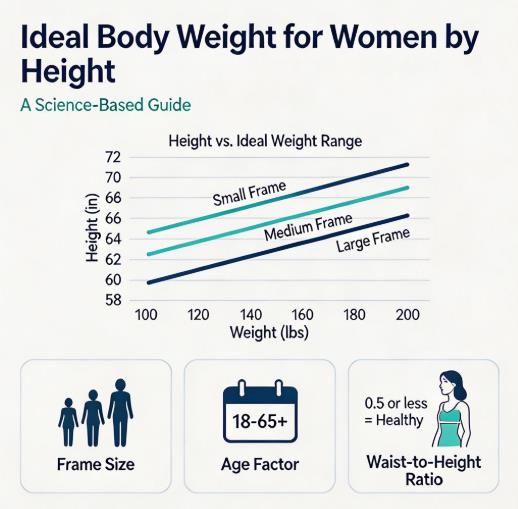
Frequently Asked Questions
What is a realistic healthy weight for a 5′4″ woman?
For a 5′4″ woman, the CDC-based band is 108–145 lbs. However, small frames typically settle near 112–120 lbs, while larger frames sit comfortably around 130–140 lbs. Waist circumference and daily energy levels are better indicators than the scale.
Do classic formulas account for frame or age?
Most do not. Hamwi hints at frame; Devine ignores both. Neither was drafted for personal tracking. When the numbers are read by life stage, things shift:
Through roughly age 50, 18.5–24.9 holds as a reasonable screening floor.
From about 50 into the mid-60s, a mild upward drift is normal; waist under 35 stays the guardrail.
After roughly 65, a mid-20s BMI associates with steadier bone and lower frailty markers when strength is maintained.
A formula drafted decades ago was never going to hold all of that.
Why does my BMI read overweight when I feel completely fine?
BMI math cannot parse lean mass. Women who lift regularly often print a point or two above 25 with perfectly ordinary visceral readings. Waist under 35, steady energy, routine labs — together those say more than the category label ever will.
Do I need to match the weight I carried at 25?
Almost never. Clawing back to a 25-year-old number after menopause tends to cost muscle before it fixes anything metabolic. Holding waist-to-height near 0.49 or below, with some strength work on the calendar, beats any old dorm-room memory.
How do I screen for normal-weight obesity before scheduling a professional assessment?
Look for the trio: normal BMI, elevated body-fat estimate, waist above 35. Flat energy and post-meal sluggishness can show up even when the scale reads innocent. A tape measure plus a home estimate is enough to know whether a deeper look with a qualified healthcare provider is worth scheduling.
Sources
This article is for informational and educational purposes only. It does not constitute medical advice or replace professional health assessment. Always consult a qualified healthcare provider regarding your individual health and weight-related goals. Individual results will vary. The BMI Calculator Blog Team maintains editorial independence and does not sell health products.
Related Articles
Ideal Body Weight Based on Height: Why the Chart Is Wrong and What to Track Instead
Your Ideal Body Weight Is a Range, Not a Number: What Formulas Miss and What to Track
What Is My Ideal Body Weight? A Complete Guide to Finding Your Healthy Range
Last updated: October 19, 2026.