Overweight and obesity are distinct categories on the BMI scale — but that one-point gap between 29.9 and 30 carries far more weight than most people realize. Overweight (BMI 25–29.9) signals excess weight for height; obese (BMI ≥30) means excess body fat linked to disease. Waist size adds critical context: above 35 inches in women or 40 inches in men raises danger regardless of BMI. And even a modest 5% weight loss can measurably improve blood sugar, cholesterol, and blood pressure.
The Question Everyone Asks: Am I Overweight or Obese?
If you've ever stared at a BMI calculator result and wondered, "What exactly separates overweight from obese?" you are not alone. A reader once shared that her wellness screening labeled her "obese" based on BMI alone—yet her waist was 32 inches, she trained for triathlons, and her bloodwork was pristine. That disconnect between a medical label and metabolic reality fuels this entire article.
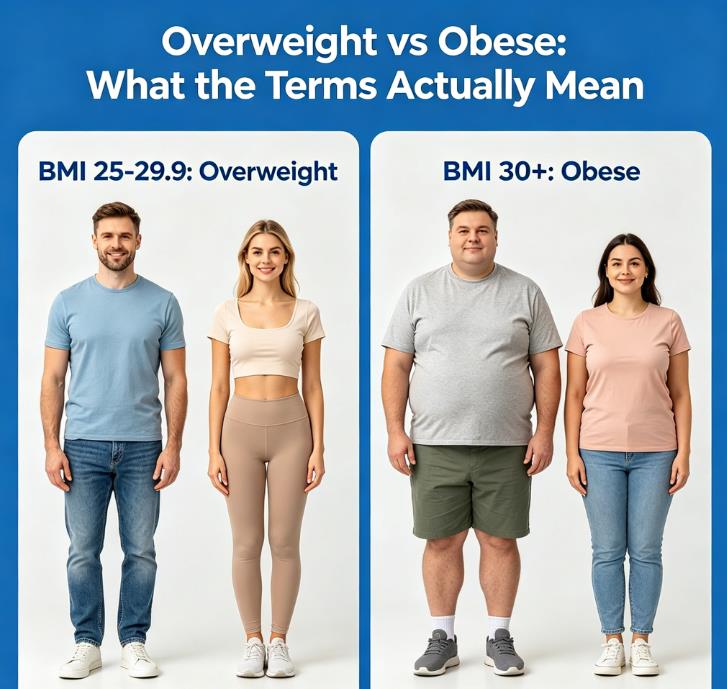
The short answer: overweight means carrying more body weight than is considered healthy for a given height. Obesity means carrying excess body fat to the degree that it significantly elevates disease risk. The numerical border is a BMI of 30. Below it—25 to 29.9—is overweight. At or above 30 is obese, further split into Class 1 (30–34.9), Class 2 (35–39.9), and Class 3 (40+), sometimes called severe obesity. These cutoffs come from decades of epidemiological data linking fat accumulation to mortality and are used by both the CDC and the World Health Organization.
You can locate yourself on this spectrum in seconds with our Adult BMI Calculator. But the number only begins the conversation. The real question is what that category means for your body, your habits, and your next steps.
The Clinical Definitions: Where the Lines Are Drawn
The National Institutes of Health and the CDC recognize the following BMI categories for adults aged 20 and older. They apply regardless of gender, though body composition nuances can shift interpretation.
Underweight: below 18.5.
Healthy weight: 18.5 to 24.9.
Overweight: 25.0 to 29.9.
Obese (Class 1): 30.0 to 34.9.
Obese (Class 2): 35.0 to 39.9.
Severe Obesity (Class 3): 40.0 and above.
The gap between overweight and obese is not trivial. The National Heart, Lung, and Blood Institute notes that obesity carries a markedly higher risk for hypertension, type 2 diabetes, coronary heart disease, and sleep apnea compared to the overweight range alone. Risk climbs with BMI, but it also depends heavily on where the fat is stored. A deeper look at BMI categories explained helps contextualize these numbers beyond the label.
Where BMI Trips Up: Muscle, Fat, and Waistlines
A 5'10" man weighing 210 pounds has a BMI of 30.1—obese. Unless he is a strength athlete with a lean, muscular build and a waist under 37 inches. A 5'4" woman at 150 pounds has a BMI of 25.7—overweight. But if her waist measures 37 inches and she is sedentary, her actual metabolic risk may match someone in the obese category.
This is why the NHLBI now recommends waist circumference alongside BMI as a risk indicator. A waist above 35 inches in women or above 40 inches in men signals high visceral adipose tissue—the deep belly fat linked to inflammation and insulin resistance—regardless of BMI category. The American College of Sports Medicine adds that body fat percentages above 32% for women or 25% for men correlate with elevated health risks, even when BMI falls in the overweight range. A body fat calculator can clarify whether excess weight comes from lean tissue or fat stores.
There is even a term for people whose BMI is normal but whose body fat is dangerously high: normal-weight obesity. It describes body fat above 30% in women or 23% in men while BMI stays under 25. The scale looks fine, but the metabolism may not be. That silent mismatch is exactly what a narrow overweight definition can miss.
The Metabolic Inflection Point: Why Obesity Carries Heavier Risk
Crossing from overweight into obesity is not simply a matter of adding a few pounds. It often triggers a cascade of inflammatory and hormonal changes. Visceral adipose tissue secretes pro-inflammatory cytokines—messenger proteins that promote insulin resistance and damage the lining of blood vessels. This is the biological pathway linking obesity to type 2 diabetes and atherosclerosis.
The American Heart Association reports that each 5-unit increase in BMI above 25 raises heart failure risk by roughly 29% in women, with comparable trends in men. That means the leap from a BMI of 27 to 32 is statistically more dangerous than the move from 23 to 27. The dose-response curve steepens, not flattens.
Even within the same BMI classification, risk varies by ethnicity. The WHO recommends lower BMI thresholds for Asian populations—overweight at 23 and obese at 27—because visceral fat tends to accumulate at lower absolute weights. A fuller look at what is considered overweight must account for these important nuances.
Category-Specific Action: What to Do Based on Where You Land
Where you fall on the BMI scale shapes how aggressively you need to act. The National Weight Control Registry, which has tracked over 10,000 people who have successfully maintained weight loss, points to a few common threads: high levels of physical activity, consistent eating patterns, and regular self-monitoring.
If your BMI is 25.0–29.9 (overweight): Your primary goal is preventing further gain. A modest loss of 3–5% of your body weight can lower triglycerides and blood pressure measurably. Track your intake with a calorie calculator for a week to establish your baseline. Add 150 minutes of brisk walking per week.
If your BMI is 30.0–34.9 (Class 1 obesity): Aim for a sustained 5–10% weight loss. The CDC notes that this level produces clinically meaningful drops in fasting glucose and inflammatory markers. Add two strength-training sessions per week to protect lean mass while losing fat, and prioritize protein at every meal.
For those at BMI 35.0 or above (Class 2 or 3 obesity), the path looks different. The Obesity Medicine Association recommends a structured, medically guided program that may include pharmacotherapy or surgical evaluation alongside diet and physical activity. A loss of 10% or more can significantly improve or resolve type 2 diabetes, sleep apnea, and joint pain. This is not about willpower alone—biology plays a strong role at this level, and support matters.
The trend matters more than any single reading. A 45-year-old man who moves from a BMI of 32 to 28—still technically overweight—has likely shed visceral fat and improved insulin sensitivity more than someone who merely trimmed from 24 to 22. The healthy weight range is a compass, not a jail cell.
The 5% Solution: How Much Weight Loss Actually Moves the Needle
Staring at a 50-pound gap between your current weight and an "ideal" chart can feel paralyzing. But the NIH-supported Look AHEAD trial demonstrated that losing and keeping off just 5% of starting body weight produces measurable improvements in blood sugar, HDL cholesterol, and blood pressure. For a 200-pound person, that is 10 pounds. Do not underestimate the 5% target.
Weeks 1–2 — Data, not discipline: Log everything you eat and drink in a typical week. No restrictions yet.
Weeks 3–4 — One swap, one drop: Replace one high-calorie, low-nutrient item with a healthier alternative.
After that initial month, the focus shifts to muscle. Weeks 5–8 mean adding short strength bursts—10-minute bodyweight circuits three times a week—because muscle activity improves insulin sensitivity before any weight comes off. Then weeks 9–12 are for reassessment: check your weight and waist, and if you have lost 5%, consider holding that weight for a month before pursuing more.
Myths That Keep People Confused
A common misconception is that overweight and obesity are interchangeable terms. They are medically distinct categories with different risk profiles. Another myth: that being "overweight" automatically means unhealthy. An active person with a healthy waist and normal labs may be in excellent cardiometabolic health. And while BMI has real limitations—especially for muscular individuals—it is far from worthless. Paired with waist circumference and body fat percentage, it remains a valid starting point for health conversations. The Obesity Society emphasizes that body weight regulation involves complex genetic, neuroendocrine, and environmental factors; biology is not an excuse, but it is part of the equation.
Frequently Asked Questions
What BMI qualifies as overweight vs obese?
Overweight is a BMI of 25.0 to 29.9. Obese is a BMI of 30.0 or higher. These cutoffs come from the CDC and WHO and apply to adults aged 20 and older.
Is it possible to be overweight but metabolically healthy?
Yes. If your blood pressure, cholesterol, blood sugar, and waist circumference are all within normal limits and you are physically active, being in the overweight BMI category does not automatically signal poor health.
How many pounds separate overweight from obese?
For a 5'5" woman, the threshold is roughly 180 pounds. For a 5'10" man, it is about 210 pounds. The exact number depends on your height, which is why BMI—a ratio of weight to height squared—is used instead of a single weight value.
Why does waist size matter if my BMI is only in the overweight range?
A waist above 35 inches in women or 40 inches in men signals high visceral fat, which raises cardiometabolic risk independently of BMI. Waist size fills in what BMI leaves out.
Are athletes ever misclassified as overweight or obese by BMI?
Frequently. Athletes with high muscle mass can register as overweight or even obese on BMI. In these cases, a body fat percentage test or waist measurement provides a far more accurate picture of metabolic health.
What is the first step if I fall into the obese category?
Aim for a 5% body weight loss over 3–6 months. This modest target is achievable through dietary swaps and increased walking, and it produces measurable health improvements. If your BMI is 35 or above, consider consulting a registered dietitian or an obesity medicine specialist.
Sources
This article is for informational and educational purposes only. It does not constitute medical advice. Consider discussing your results with a qualified professional. Individual results vary. The BMI Calculator Blog Team maintains editorial independence.