At a Glance: BMI categories are the simplest way to understand what your body mass index means for your health. This guide breaks down the standard CDC and WHO ranges—underweight below 18.5, healthy weight 18.5 to 24.9, overweight 25.0 to 29.9, obese 30.0 and above—along with the exceptions that matter for athletes, seniors, children, and Asian populations. You'll learn how to calculate your BMI accurately, why context changes everything, and how to use your category as a starting point for smarter health decisions.
Key Takeaways
Standard BMI ranges: Underweight (<18.5), Healthy (18.5–24.9), Overweight (25–29.9), Obese (≥30).
One size doesn't fit all: Athletes, seniors, children, and Asian adults need adjusted interpretations.
For seniors 65+, a BMI of 23–30 is linked to lower mortality risk than the standard "healthy" range.
For Asian adults, WHO recommends lower cutoffs: healthy ends at 22.9, overweight starts at 23.
Remember: BMI is just a screening tool, not a final diagnosis. For the full picture, always pair it with waist circumference and relevant blood work.
What Your BMI Category Actually Tells You
Most people have heard of BMI, but far fewer truly understand how BMI categories work and what they indicate about overall health. It's not just a random number—your BMI falls into a specific category that can guide your wellness choices, from diet to activity levels. And figuring out where you stand is simple. Interpreting the results doesn't require a medical degree, but it does takes some context.
The Centers for Disease Control and Prevention (CDC) and the World Health Organization have established universal BMI categories for adults. These ranges are the foundation, but they're just the starting point. A BMI of 25 might mean "overweight" for a sedentary office worker, but for a muscular athlete, it could be completely healthy. Context is everything. Let's break down the standard categories first, then cover who needs a different lens.
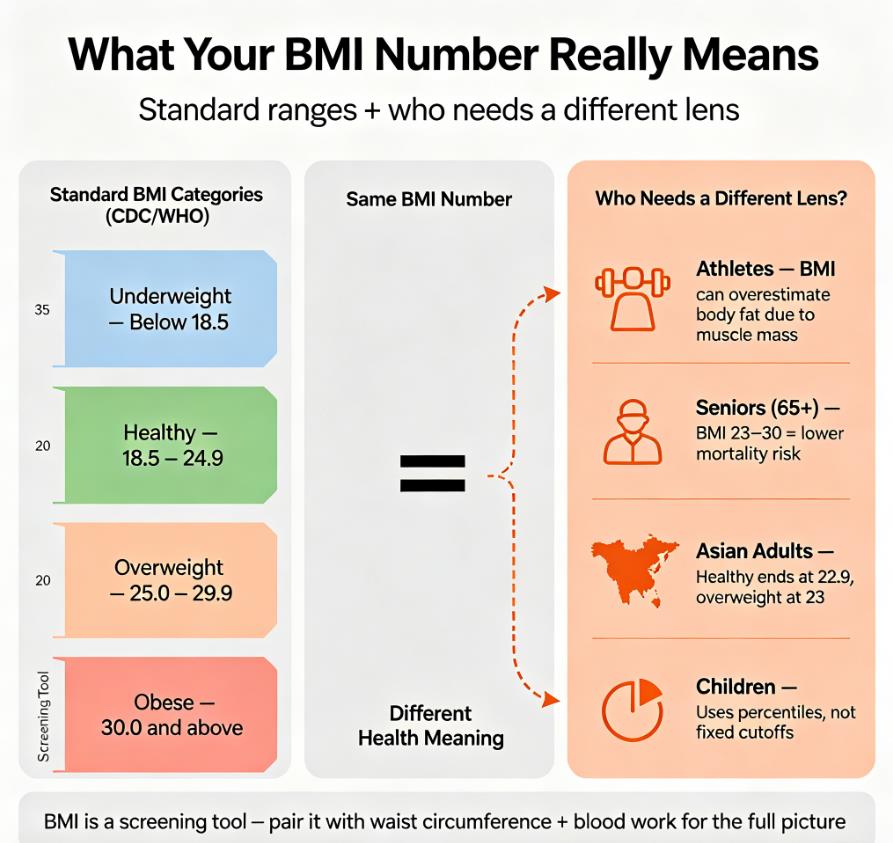
The Standard BMI Categories for Adults
For adults aged 18 to 65, the CDC and WHO define four core categories. Here's the complete reference table:
| Category | BMI Range | Health Risk Level |
|---|---|---|
| Underweight | Below 18.5 | Increased risk of nutritional deficiencies, osteoporosis, weakened immunity |
| Healthy Weight | 18.5 – 24.9 | Lowest risk of weight-related chronic disease for most adults |
| Overweight | 25.0 – 29.9 | Elevated risk; lifestyle adjustments recommended |
| Obese Class I | 30.0 – 34.9 | High risk of type 2 diabetes, hypertension, cardiovascular disease |
| Obese Class II | 35.0 – 39.9 | Very high risk; medical intervention often warranted |
| Obese Class III | 40.0 and above | Severe risk; comprehensive medical management recommended |
These categories are the most widely used weight classification system in the world, but they have limits. As the CDC emphasizes, BMI is a screening tool, not a diagnostic one. It doesn't measure body fat directly, it doesn't distinguish between muscle and fat, and it doesn't account for age or ethnicity. A free BMI calculator gives you your category in seconds—but interpreting it takes the context covered below.
As the American Academy of Family Physicians (AAFP) states in its position paper on weight assessment, BMI should be used as a screening tool to initiate health conversations—clinical judgment must incorporate additional factors including body fat distribution, cardiopulmonary fitness, and individual risk profiles to form a complete assessment. A number opens the conversation. It doesn't close it.
How to Calculate Your BMI Correctly
Before you can interpret your category, you need an accurate number. The formula is straightforward, and you can use either metric or imperial units:
Metric: BMI = weight (kg) / (height (m) × height (m))
Imperial: BMI = (weight (lb) / (height (in) × height (in))) × 703
Weigh yourself first thing in the morning, after using the bathroom and before eating or drinking. Measure your height without shoes, standing straight against a wall. Small errors in either measurement can shift your BMI by a full point or more—enough to flip your category. A reliable online BMI checker removes the math risk and handles the unit conversions automatically.
When the Standard Ranges Don't Apply
One of the biggest misconceptions about BMI categories is that they apply to everyone equally. The standard ranges work for most cases, but several important groups need adjusted interpretation. Here's who needs a different lens and why.
Athletes and Muscular Individuals
Muscle is denser than fat, which means athletes or people with high muscle mass often have higher BMIs—even when their body fat is low. Picture a male powerlifter with a BMI of 28, classified as "overweight" by standard ranges, but carrying just 10% body fat. For these individuals, BMI categories alone can be misleading. The WHO recommends athletes pair BMI with waist circumference and body fat percentage for a complete picture. For a precise reading, use an athlete BMI calculator designed to account for higher muscle density.
Seniors (65+)
For adults over 65, the standard BMI categories shift. Clinical guidelines suggest a healthier BMI range of roughly 23.0 to 29.9 for older adults—higher than the 18.5 to 24.9 range for younger adults. This is supported by a 2022 meta-analysis published in the Journal of the American Geriatrics Society, which analyzed over 37,000 older adults and found that those with a BMI between 23 and 30 had the lowest all-cause mortality over a 10-year follow-up period. BMI below 21 was associated with significantly higher mortality—the very range that standard charts label "normal." This J-shaped relationship between BMI and mortality in seniors explains why a slightly higher weight helps prevent malnutrition, muscle loss (sarcopenia), and falls. For this group, a senior BMI calculator with age-adjusted ranges provides targets that are safer and more relevant than the standard adult chart.
Children and Teens (2-19)
Kids and teens are still growing, so fixed BMI categories don't apply. Instead, their BMI is measured using percentiles, which compare their result to other children of the same age and gender. A BMI that's healthy for a 15-year-old might be underweight for a 7-year-old. The CDC provides separate growth charts for ages 2 to 19. Always use a pediatric BMI calculator rather than adult reference charts for anyone under 20.
Asian Populations
The WHO has established adjusted BMI categories for Asian populations, who develop metabolic diseases like diabetes at significantly lower BMI values than Western populations. A 2004 WHO expert consultation published in The Lancet reviewed data from multiple Asian cohorts and found that for every unit of BMI above 22.0, the risk of type 2 diabetes increased more steeply in South and East Asian populations than in white populations of comparable age. This led to the formal recommendation: for East, South, and Southeast Asian adults, the healthy range tightens to 18.5 to 22.9, with overweight at 23.0 and above and obese at 25.0 and above. An Asian BMI calculator using these adjusted thresholds catches risks that the standard chart would miss.
Pregnant and Postpartum Women
BMI categories don't apply to pregnant women, as weight gain is normal and necessary for a healthy pregnancy. Instead, health professionals use pre-pregnancy BMI to guide recommended weight gain ranges. If you're pregnant or planning to be, track your pre-pregnancy BMI with a standard calculator, then discuss the result with your obstetrician to set a personalized weight gain plan based on your starting point.
How to Use Your BMI Category to Improve Your Health
Your BMI category isn't a judgment—it's a tool to help you make informed choices. The Dietary Guidelines for Americans 2023-2025 recommend that weight management strategies be individualized, sustainable, and focused on overall dietary patterns rather than single nutrients or extreme approaches. Here's how to use your category as a starting point:
If you're underweight: Focus on nutrient-dense foods to gain weight healthily—whole grains, lean proteins, healthy fats, and fruits and vegetables. Avoid empty calories from sugary snacks and drinks. If you're struggling to gain weight, talk to a healthcare provider to rule out underlying issues.
If you're in the healthy weight range: Maintain a balanced diet, stay active with at least 150 minutes of moderate exercise per week as recommended by the CDC, and get 7 to 9 hours of sleep nightly. Regular check-ins with your BMI can help you stay on track through life changes.
If you're overweight or obese: Small, sustainable changes are key. Start by adding more movement to your day—even a 10-minute walk after meals makes a difference. Focus on whole foods and limit processed foods and sugary beverages. To support your goals, use a calorie calculator to determine your daily energy needs and create a sustainable plan.
Your 5-Minute BMI Check
Step 1: Calculate your BMI using accurate measurements—morning, after bathroom, before food.
Step 2: Note your category. If you fall into an exception group, use the adjusted ranges.
Step 3: Measure your waist circumference. Pair it with your BMI for a fuller health picture.
As the WHO emphasizes, BMI should be used as an initial screening tool in combination with other clinical indicators—not as a standalone diagnostic measure. Pairing your category with waist circumference, body fat percentage, and regular checkups turns a single number into a complete health assessment.
Common Myths About BMI Categories
Myth: BMI is the only measure of health. Fact: BMI is a screening tool, not a diagnostic one. It doesn't measure body fat distribution, muscle mass, or overall fitness. Pair it with waist circumference, blood pressure, and cholesterol levels for a complete picture.
Myth: Being in the "healthy" category means you're perfectly healthy. Fact: BMI doesn't account for diet, exercise, or genetics. Someone with a healthy BMI could still have high cholesterol, while someone overweight might be physically fit.
Myth: BMI categories are the same for everyone. Fact: Age, ethnicity, activity level, and muscle mass all affect how BMI categories should be interpreted. The WHO itself recommends different thresholds for Asian populations and different approaches for children, seniors, and athletes.
Myth: A "normal" BMI means I don't need to worry about weight. Fact: A 2023 CDC analysis found roughly 24% of normal-weight American adults have metabolic abnormalities. Waist circumference and body fat percentage often reveal risks that BMI alone misses.
Myth: Lower BMI is always better. Fact: Research shows a J-shaped relationship between BMI and mortality—risk increases at both extremes. For seniors especially, a BMI in the 23 to 30 range is associated with better outcomes than a BMI below 21. The healthiest range depends on age, muscle mass, and individual circumstances.
Your BMI Category Is a Starting Point
Understanding BMI categories is a simple way to take control of your health, but no single number defines you. Whether you're checking your own range or your child's, use the results as a guide—not a final answer. Talk to a healthcare provider if you have questions about your BMI, especially if you fall into an exception group or have concerns about your health.
Ready to check your category? Use a reliable BMI calculator to get your number and start your wellness journey today. Small steps lead to big changes—and understanding where you stand is the first one.
Sources
Frequently Asked Questions
Are BMI categories different for men and women?
The core BMI categories are gender-neutral—underweight below 18.5, healthy 18.5 to 24.9, overweight 25.0 to 29.9, and obese 30.0 and above—for both men and women. However, interpretation differs. Women naturally carry a higher body fat percentage than men at the same BMI, so pairing BMI with body fat percentage gives a more accurate individual picture. The standard categories are a screening starting point for both genders, not a final diagnosis.
What if my BMI is at the borderline between two categories?
A BMI at the exact line between categories—like 24.9 or 25.0—shouldn't be overinterpreted. Daily weight fluctuations from hydration alone can shift your BMI enough to cross a threshold. If you're at a borderline, watch the trend over several months rather than fixating on the exact number. Pair it with waist circumference and body fat percentage for a fuller view.
Can my BMI category change even if my weight stays the same?
Yes, if your height measurement was inaccurate. This is more common in older adults, who lose height over time due to spinal compression. A height change of just one inch can shift BMI by a full point. Re-measure your height annually if you're over 60, and always use a current height measurement—not the one from your driver's license from 20 years ago.
How often should I check my BMI category?
Once or twice a year is sufficient for most adults, or whenever your weight changes by 10 pounds or more. What's more valuable is tracking trends over time rather than obsessing over a single reading. If your BMI is moving in a healthier direction—even slowly—that's meaningful progress.
Related Articles
BMI Healthy Range: What It Really Is for Every Age, Body Type, and Background
BMI Normal Range: A Complete Guide for Every Age, Ethnicity, and Life Stage
BMI Calculator Blog. This content is provided for educational and informational purposes only. Medical Disclaimer: The content of this article is for informational purposes only and does not replace professional medical advice, diagnosis, or treatment. Always seek the advice of a qualified physician or other health experts with any questions regarding medical conditions or health goals.