Quick Summary: A BMI calculator guide is your shortcut to using this screening tool correctly — not just plugging in numbers, but measuring your body the right way and interpreting the result wisely. The CDC defines four adult weight categories: underweight below 18.5, healthy 18.5–24.9, overweight 25.0–29.9, and obesity 30.0+. This guide covers the five most common mistakes that skew results and how to fix them in under five minutes.
Most BMI errors come from measurement, not math. Weighing at night, slouching during height checks, or mixing units can shift your result by an entire category.
BMI is a screening tool, not a diagnosis. It can't tell muscle from fat, and it doesn't reflect where fat sits on your body.
Special populations need adjusted cutoffs. Athletes, adults over 65, Asian adults, pregnant women, and children all need different interpretation.
Track trends, not single readings. Monthly measurements under the same conditions tell the real story.
Waist circumference adds critical context. Above 40 inches for men or 35 inches for women signals elevated risk regardless of BMI.
What Is a BMI Calculator Guide — and Why Follow One?
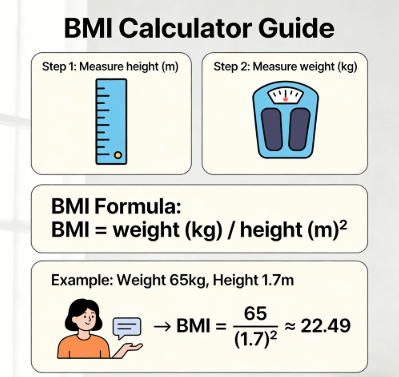
BMI stands for Body Mass Index. The formula is simple: weight in kilograms divided by height in meters squared. For imperial, it's (weight in pounds divided by height in inches squared) × 703. The CDC classifies the result into four categories for adults aged 20 and older: underweight (below 18.5), healthy weight (18.5–24.9), overweight (25.0–29.9), and obesity (30.0 and above).
The formula is simple enough. But its accuracy lives or dies by the quality of your inputs. The CDC notes that BMI accuracy depends heavily on precise height and weight measurement — and that's where the real value of a guide lies.
Most BMI errors trace back to measurement technique, not the formula itself. Accurate inputs are the foundation of a reliable result.
Mistake 1: Weighing Yourself at the Wrong Time
Your weight fluctuates by 2–5 pounds (0.9–2.3 kg) over the course of a day due to food, water, and sodium. Research on daily mass variation in active adults documented an average fluctuation of about 1.12 pounds (0.51 kg) under controlled conditions. An evening weigh-in can easily push a borderline BMI into the next category.
How to fix it: First thing in the morning, after using the bathroom, before eating or drinking. Lightweight clothing or none. Hard, flat floor — carpet can distort the reading by 1–2 pounds. Same scale, same spot, every time.
Mistake 2: Guessing Your Height (or Slouching)
Sneakers can add up to an inch of false height. A 1-inch error shifts BMI by 0.5 to 1 point — enough to move you from "healthy weight" into "overweight" on paper. Slouching has the opposite effect, making you appear shorter and inflating BMI.
How to fix it: Stand barefoot against a flat wall. Heels together. Back straight. Head level — don't tilt your chin up or down. Place a hardcover book flat on top of your head and mark the wall at the bottom edge. Measure from floor to mark with a metal tape. Don't use your driver's license height.
Once you have accurate numbers, use an Adult BMI Calculator to get your result instantly. The tool does the math — your job is to feed it clean inputs.
Mistake 3: Mixing Up Units
Entering 150 into a kg field when you meant pounds produces nonsense. So does typing 164 cm as 1.64 m — that gives a result 10,000 times too small. Many people rush through entering numbers without double-checking unit toggles, which is one of the simplest yet costliest mistakes.
How to fix it: Toggle the unit before you input anything. Match your measurement system to the calculator's expectation. Metric uses kg and meters. Imperial uses pounds and inches. If you're unsure, use a calculator that lets you switch units easily, or convert manually first.
Mistake 4: Ignoring Age, Ethnicity, and Body Composition
BMI has well-documented blind spots. The StatPearls entry on BMI physiology notes that the metric tends to overestimate body fat in individuals with high lean body mass and underestimate it in those with low lean body mass.
For example, a bodybuilder at 5'10" and 210 lb gets a BMI of 30.1 — "obese" — while carrying 12% body fat. A 70-year-old with a BMI of 26 may be healthier than a 30-year-old with a BMI of 23. Asian adults face higher metabolic risk at lower BMIs, so the WHO recommends overweight begins at 23 and obesity at 27.5 for this group.
How to fix it: If you're an athlete, over 65, of Asian descent, pregnant, or under 20, don't rely on standard BMI cutoffs. Use adjusted ranges or pair BMI with a body fat calculator and waist measurement. For a deeper look at what your number actually means for your specific situation, see our guide on what BMI calculator results mean.
Mistake 5: Treating BMI as the Final Verdict
A BMI of 24.9 versus 25.1 is not a health cliff. Risk rises gradually. Two people with the same BMI can have completely different health profiles depending on where they store fat, how much muscle they carry, and their metabolic markers.
How to fix it: Use BMI as a starting point, not the finish line. Pair it with waist circumference (under 40 inches for men, 35 for women), blood pressure, fasting glucose, and cholesterol. Look at trends over 6–12 months, not daily fluctuations.
Quick Reference: Correct Measurement Protocol
| Measurement | Correct Method | Common Mistake |
|---|---|---|
| Weight | Morning, after bathroom, light clothing, hard floor | Weighing after dinner or on carpet |
| Height | Barefoot, against wall, book on head, metal tape | Guessing height or wearing shoes |
| Units | Toggle before inputting, match measurement system | Entering pounds into a kg field |
| Tracking | Once a month, same conditions | Daily checks (measures water fluctuations) |
Frequently Asked Questions
How accurate is an online BMI calculator?
The formula itself is standardized and accurate. The CDC states that BMI correctly identifies about 80% of people with excess body fat when compared to direct body fat measurement. But here's the catch — the error usually doesn't come from the calculator. It comes from how you measure yourself.
Should I use metric or imperial units?
Either works. The formula adjusts. What matters is consistency — use the system you're most comfortable with, and double-check which unit the calculator expects before you type.
How often should I check my BMI?
Once a month is plenty. Daily checks are counterproductive — you'd be measuring water fluctuations, not real change. Morning, same conditions, same scale.
My BMI is borderline — should I be concerned?
Don't panic over that decimal point. A BMI of 24.9 and 25.1 are essentially the same from a biological standpoint. What matters more is your waistline and your blood work. If your waist is under the risk threshold, you're likely fine.
Why does my BMI result change if I check it twice in the same day?
Food, hydration, sodium, and activity can shift your weight by 2–5 pounds from morning to evening. That's enough to move BMI by 0.5–1 point. Always measure under the same conditions.
What's a healthy BMI range for adults?
For most adults, 18.5 to 24.9 is considered healthy. But this range doesn't fit everyone — athletes, seniors, and Asian adults need adjusted interpretation. See our related articles below for population-specific guidance.
References & Sources
CDC: Adult BMI Categories — Underweight, Healthy Weight, Overweight, and Obesity
StatPearls/NIH: Physiology, Body Mass Index — Limitations and Special Populations
This article is for informational and educational purposes only. It does not constitute medical advice, diagnosis, or treatment. Always consult a qualified healthcare provider regarding your individual health and weight goals. Individual results will vary. The BMI Calculator Blog Team maintains editorial independence and does not sell health products.