At a glance: Female 30% body fat means 30 pounds of fat for every 100 pounds of body weight. For most adult women, ACE places 25–31% in the "average" non-athlete range. It is not automatically "overfat." Waist size, muscle mass, and BMI change the health meaning. A 30% reading with a 31-inch waist is very different from 30% with a 37-inch waist.
At 30%, roughly 45 pounds of a 150-pound woman’s body is fat tissue. The rest is muscle, bone, water, and organs. Two women can weigh the same, have identical BMIs of 22, and both hit 30% body fat. One carries it in her hips and thighs with a 31-inch waist; the other carries it around her middle with a 36-inch waist. The scale and BMI see them as identical. Biology does not.
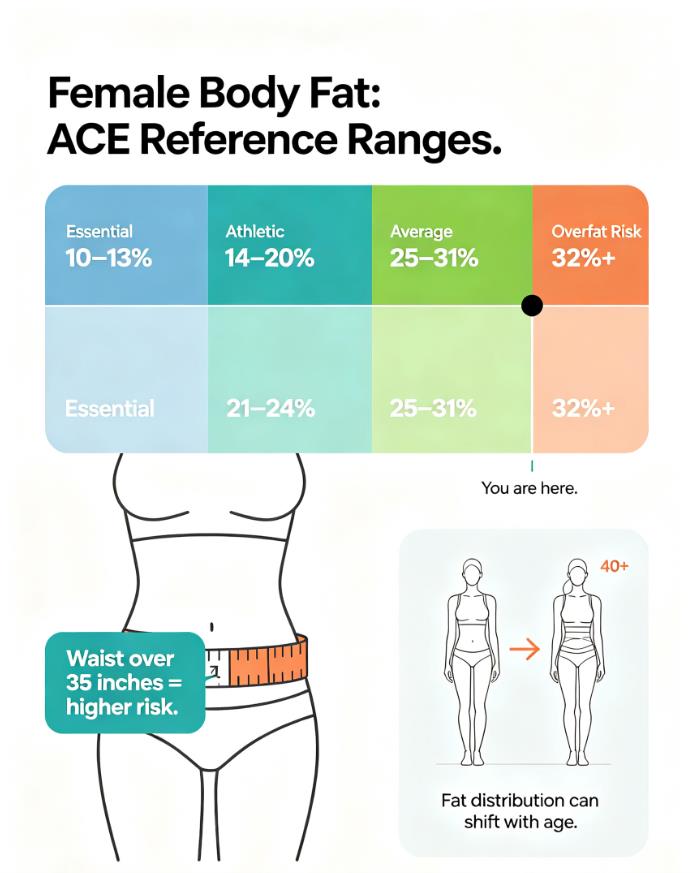
What 30% Body Fat Actually Means
Body fat percentage measures composition, not just weight. ACE classifies 25–31% as the average range for non-athlete adult women. You are not "obese" until you cross 32%. This range exists because female bodies require more essential fat than male bodies for hormonal function and bone health.
| Category | Body Fat % | What It Looks Like |
|---|---|---|
| Essential Fat | 10–13% | Biological minimum. Disrupts periods and bone health if sustained. |
| Athletic | 14–20% | Visible muscle definition. Requires structured training. |
| Fitness | 21–24% | Lean, sustainable for active women. |
| Average | 25–31% | 30% sits here. Normal for many non-athletes. |
| Overfat Risk | 32%+ | Review waist, activity, and metabolic markers. |
Source: ACE Fitness: Body Fat Percentage Reference Ranges.
Why Waist Size Changes the Verdict
The tape measure tells a story the scale can’t. Body fat percentage cannot tell you where the fat lives. Waist circumference can. We often see women fixate only on the percentage and overlook this simple check.
Visceral fat—the kind packed around your organs—is far more dangerous than the fat under your skin. CDC data identifies waist circumference as an independent risk marker, separate from BMI. Women with waists at or above 35 inches face a significantly higher risk of metabolic syndrome, type 2 diabetes, and heart disease, regardless of their BMI category.
Below 35 inches: Generally lower metabolic risk if BMI is normal.
Over 35 inches: Higher risk, even if BMI looks "healthy."
Waist-to-height ratio over 0.5: A strong signal for abdominal fat buildup.
In our user logs, a 38-year-old tracked her body fat every Sunday morning for six months. Her reading stayed between 29% and 31%, but her waist crept from 33 to 35.5 inches. The scale said her body fat was stable; the tape measure said otherwise. Her provider flagged the waist change—not the body fat percentage—as the signal worth acting on. She later told us she was surprised the tape measure caught what the scale missed. Over the next six months, she started with two 30-minute sessions—squats and rows with a set of dumbbells she already owned. Breakfast shifted from toast to Greek yogurt with nuts. Nothing drastic. Her waist dropped back to 34 inches. Her smart scale still read 30%. This small shift is easy to miss if you only check body fat percentage.
Age and Muscle Shift the Meaning
ACE ranges are sex-based, not age-adjusted. After 30, women lose roughly 3–8% of muscle mass per decade. This sarcopenia means you can stay at 30% body fat but lose strength and metabolic health if muscle drops.
A 30-year-old at 30% who lifts twice a week and eats enough protein is in a different place than a 50-year-old at 30% who sits most of the day. The number stays the same; the health picture changes.
Hormones play a role too. As estrogen drops in perimenopause, fat shifts from hips to the abdomen. A 30% reading at 50 often means more visceral fat than the same reading at 30. Even with steady weight on the scale, these gradual body-composition changes add up over time.
How to Track Without the Guesswork
Smart scales estimate; trends inform. If you want a clearer picture, start with our body fat calculator. It uses height, weight, age, and waist to give a more personalized estimate than BMI alone.
For a broader weight screen, an online BMI calculator is a quick starting point. Just remember: BMI cannot see muscle or fat location.
BIA scales (the most common smart scales) work by sending a tiny, harmless current through your body. Muscle, which is mostly water, conducts it easily. Fat, which holds less water, slows it down. The scale reads that resistance as a body fat estimate. Dehydration, a salty meal the night before, or even your menstrual cycle can shift readings by 2–4 points. Consistency matters far more than chasing perfect numbers—measure at the same time, under the same conditions, once a week. No single measurement paints your full health picture.
What to Do With a 30% Reading
Start simple by tracking your core metrics on the same day each week.
Add 2 resistance sessions weekly: Squats, rows, presses, hinges. Muscle protects your metabolism.
Target 1.2–1.6 g protein per kg body weight: Spread it across meals. A scoop of Greek yogurt at breakfast helps more than a steak at dinner.
Walk 7,000–8,000 steps most days: Add a 10-minute walk after meals to blunt blood sugar spikes.
Sleep 7–9 hours: Poor sleep raises hunger hormones and abdominal fat storage.
Your personal needs shift based on muscle mass, hormone patterns, medication use, and family health history. A qualified healthcare provider can review this full set of numbers and help you avoid extreme dieting plans.
Frequently Asked Questions
Is 30% body fat good for a woman?
Usually, yes. ACE lists 25–31% as the average range for non-athlete women. If your waist is under 35 inches and your BMI is 18.5–24.9, 30% often needs no action beyond maintenance. If your waist is over 35 inches, your provider may suggest lifestyle tweaks even if your BMI looks normal.
Will I have abs at 30% body fat?
Visible abdominal muscle is rare at this level. Women typically need 21–24% body fat for visible muscle definition and 14–20% for the athletic look. Abs also depend on muscle thickness and genetics, not just the number on the scale.
Can I be healthy at 30% body fat?
Yes, for many women. Health depends on waist size, blood pressure, blood sugar, lipids, fitness, and muscle—not just body fat. A woman with 30% body fat, a 31-inch waist, normal labs, and regular training may be healthier than a 24% woman with a 37-inch waist and poor cardio fitness.
How fast can I drop from 30% to 25% body fat?
A safe, sustainable pace is about 0.5–1% point per month. We’ve seen women drop 1 percentage point per month consistently by pairing a 400-calorie deficit with three strength sessions a week. The ones who go faster—3–4 points in a month—almost always see muscle loss on follow-up scans. Faster loss usually cuts muscle and water, slowing your metabolism and making weight creep back. Stick to the slower pace to keep the muscle you have.
Why does my smart scale say 30% but my BMI says overweight?
Different formulas. BMI uses only height and weight. BIA adds impedance and algorithms. Hydration, your cycle, and scale quality can move the body fat number 2–4 points. Trust the 3-month trend more than a single reading.
Do I need an expensive DEXA scan for 30% body fat?
Not usually. DEXA is the gold standard for research and specific medical cases, but it is overkill for routine tracking. It also tends to measure higher body fat percentages than home scales, which surprises many women. A consistent home method—tape measure, smart scale, or caliper—tracked over months gives you the trend that matters. Save the DEXA for when you need precise data for a specific health plan.
Sources
*This article is for informational and educational purposes only. It does not constitute medical advice, diagnosis, or treatment. Always consult a qualified healthcare provider regarding your individual health and body composition goals. Individual results will vary. The BMI Calculator Blog Team maintains editorial independence and does not sell health products.*