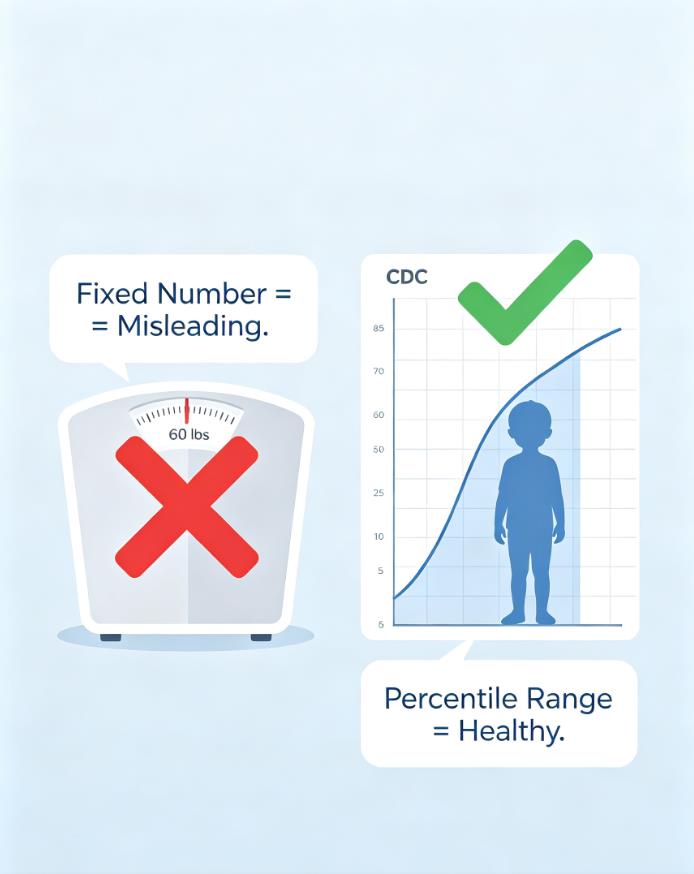
Short answer: Pediatric ideal body weight is a range, not a fixed number. For children 2–19, the healthy zone is the 5th to <85th percentile on CDC growth charts for their age and sex. That range is wide.
A 6-year-old boy at the 50th percentile weighs about 45 pounds. At the 85th percentile, about 53 pounds. Both healthy. The number alone? Almost meaningless. The percentile behind it? Everything.
Many parents fixate on one target weight at annual checkups. Pediatricians rarely pull out a formula. They watch the curve — where a child has tracked over 2–3 years. A steady 40th percentile is a healthier sign than a BMI that bounces from the 30th to the 70th in a year.
| Category | BMI Percentile | What to Do Next |
|---|---|---|
| Underweight | Below 5th | Check nutrition; ask about growth trend |
| Healthy weight | 5th to<85th<> | Keep current habits; track every 6 months |
| Overweight | 85th to<95th<> | Waist measurement; review activity and sleep |
| Obesity | 95th or higher | Pediatric guidance; assess metabolic markers |
Source: CDC 2000 BMI-for-age growth reference.
Many parents misunderstand these percentile ranges as pass/fail grades. They are not. A child at the 20th percentile is not failing — they are just smaller, and that is okay. Remember, growth charts are a reference, not a judgement on your child.
Why Percentiles Beat Fixed Numbers for Kids
A 5-year-old girl weighing 40 pounds is not the same as a 15-year-old girl at 40 pounds. The first is healthy. The second is dangerously underweight. Fixed weight tables cannot catch this. Percentiles can.
The CDC uses sex-specific BMI-for-age percentiles because boys and girls gain muscle and fat at different rates. A BMI of 17 is normal for a 6-year-old boy but underweight for a 16-year-old girl. The percentile tells you where that BMI falls relative to peers of the same age and sex — the standard approach outlined by the CDC.
Children grow in unpredictable spurts. A child tracking steadily at the 30th percentile is far healthier than one bouncing between extremes. Consistency beats the formula every time.
For children under 2, WHO growth standards apply. CDC recommends switching to CDC charts at age 2. BMI-for-age is not recommended under 2 because infant BMI relies on recumbent length, and what that number means in early childhood is poorly understood.
What Parents Can Actually Do
Plot height and weight every 6 months. One measurement tells you almost nothing. The trend across 2–3 years reveals whether growth is steady or drifting.
Track the percentile curve with a kids BMI percentile tool. Enter age, height, weight, and sex. The percentile output matters — not the raw BMI number.
Focus on habits, not the scale. CDC recommends 60 minutes of daily activity for children 6–17. Added sugars should stay under 10% of daily calories.
Bring a growth log to checkups. We have seen parents track their son every six months. At age 9 he sat at the 40th percentile — steady for three years. When he jumped to the 70th in eight months, they brought the log to his pediatrician. It turned out to be a growth spurt, not a weight problem.
Muscular children can have a high BMI percentile without excess fat. A 10-year-old who plays competitive soccer and lifts may land at the 90th percentile for BMI while carrying 15% body fat. BMI cannot tell the difference between muscle and fat. If your child is active and growing steadily, a single high reading is not a reason to panic. Do not rush to change your child's diet just because of one reading.
Use a child BMI calculator to see the percentile, then look at the trend. Individual results vary — always consult a qualified healthcare provider about your child's growth. For adult comparisons, our online BMI calculator offers a baseline, but remember that pediatric growth demands age-specific tools.
Frequently Asked Questions
Is there a "perfect" weight for a 10-year-old?
No. A healthy 10-year-old boy might weigh anywhere from 55 to 102 pounds and still be perfectly healthy, depending on his height and growth pattern. That range comes from CDC 2000 growth reference data for average-height boys. Focus less on the scale and more on the percentile trend over time.
Is BMI accurate for children?
BMI-for-age percentile is the standard screening tool for children 2–19. It is not a diagnosis. A high percentile alone does not mean a child carries excess fat — muscular kids often land at the 90th percentile with healthy body fat. Pair it with waist measurement and activity level for a fuller picture.
When should I worry about my child's weight?
If their BMI percentile crosses two major percentile lines in 6 months, or if they experience rapid weight loss, persistent fatigue, or delayed puberty alongside abnormal growth. We have seen parents bring in a log showing their child held steady at the 60th percentile for two years, then dropped to the 20th in four months. That kind of shift is exactly what pediatricians want to see — the trend, not the snapshot. Schedule a checkup with their pediatric provider.
Does pediatric ideal body weight apply to teens?
Yes, but the range widens during puberty. A 14-year-old boy at the 50th percentile BMI may carry more muscle than fat. The same percentile at age 10 may indicate different body composition. Age-specific charts handle this.
What is the difference between ideal body weight and healthy weight range?
Ideal body weight formulas give a single number, usually based on the 50th percentile. A healthy weight range spans the 5th to 85th percentile. The range is more practical because normal growth varies widely.
Should I use adult BMI for my teenager?
No. Adult BMI categories do not apply until age 20. A teen's BMI must be interpreted against CDC or WHO growth charts by age and sex. A BMI of 22 that is healthy for a 25-year-old may be overweight for a 13-year-old.
Sources
All content is reviewed against current CDC pediatric growth guidelines by our editorial team. This article is for informational and educational purposes only. It does not constitute medical advice, diagnosis, or treatment. Always consult a qualified healthcare provider regarding your child's growth and health. Individual results will vary. The BMI Calculator Blog Team maintains editorial independence and does not sell health products.
Related Articles
Ideal Body Weight for Toddlers: Why Percentiles Matter More Than a Single Number
BMI for Children 2-19 Years: CDC Growth Charts, Percentile Ranges & Tracking Guide
Height and Weight for Kids: How CDC Growth Charts & Percentiles Work (Ages 2-20)