A single BMI number means almost nothing for a teenager. Teen BMI uses CDC percentiles to compare a 13-to-19-year-old's weight and height against thousands of peers of the same age and sex. A healthy result falls between the 5th and 84th percentile. This guide explains how those percentiles work, why puberty changes the picture, how athletic teens get misclassified, and what to do next.
Quick Summary: Key Facts About Teen BMI
✅ Healthy range: 5th–84th percentile (CDC 2000 Growth Charts)
✅ Severe obesity: ≥120% of 95th percentile OR BMI ≥35 kg/m² (AAP 2023)
✅ Annual screening required for all children and teens aged 2+ (AAP CPG)
✅ 56.5% of high school athletes are misclassified by BMI (Coll Antropol, 2013)
✅ 60 minutes of daily physical activity recommended (WHO)
What Is BMI for Teens and Adolescents?
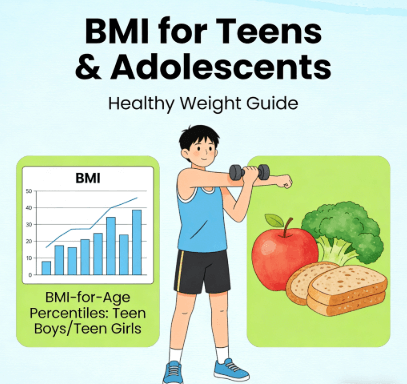
BMI for teens and adolescents is a screening measure — not a diagnosis. The CDC is explicit: BMI is a screening tool. It is not a diagnosis. It uses age- and sex-specific growth charts to compare a teenager's weight-to-height ratio against a reference population of peers. Unlike adults, who use a fixed healthy range of 18.5 to 24.9, teens are assessed using BMI percentiles.
Here is the official CDC classification for children and adolescents aged 2 to 20:
Underweight: Less than the 5th percentile
Healthy weight: 5th percentile to less than the 85th percentile
Overweight: 85th percentile to less than the 95th percentile
Obesity: 95th percentile or greater
Severe obesity: 120% of the 95th percentile or greater, or BMI 35 kg/m² or greater
This percentile system is the gold standard because it accounts for puberty, growth spurts, and the natural body composition differences between boys and girls. The CDC and the American Academy of Pediatrics recommend that U.S. health care providers use the 2000 CDC BMI-for-Age Growth Charts for standard measurements and the 2022 CDC Extended BMI-for-Age Growth Charts for children and adolescents with very high BMIs above the 97th percentile.
Many parents worry when they see shifting teen BMI numbers — and that reaction is understandable. A single reading rarely tells the full story. A teen BMI calculator automates the percentile process. Just enter height, weight, age, and sex to get results aligned with CDC standards. For adult reference, the BMI Calculator uses the standard 18.5–24.9 fixed range.
How Teen BMI Differs From Child and Adult Assessments
Teens occupy a unique space in BMI assessment. They are no longer children with purely percentile-based tracking, nor are they adults with fixed numeric ranges. The three groups compare this way:
| Feature | Children (2–12) | Teens (13–19) | Adults (20+) |
|---|---|---|---|
| Measurement method | Percentiles only | Percentiles, transitioning to adult ranges | Fixed BMI ranges |
| Healthy range | 5th–84th percentile | 5th–84th percentile | 18.5–24.9 |
| Key influencing factor | Steady growth | Puberty and growth spurts | Lifestyle and aging |
For teens approaching 18 or 19, numeric BMI values start to carry more weight. A 19-year-old with a BMI of 25 may fall into the 85th percentile (overweight) and also sit just above the adult healthy range. This overlap makes late adolescence an ideal window for building sustainable habits before adulthood.
Puberty is the biggest factor shaping teen BMI. Girls typically experience growth spurts and body fat changes earlier, around ages 12 to 14, while boys see their muscle mass and height surge later, around ages 15 to 17. This means a 14-year-old girl's healthy BMI percentile looks very different from a 14-year-old boy's. For younger children, the percentile approach continues but without the puberty-driven fluctuations — see our guide on BMI for children 2–19 years for a detailed breakdown.
Why Tracking Teen BMI Trends Matters More Than Single Measurements
A single BMI reading tells you almost nothing about a teenager's health. What matters is the trend over time.
Growth spurts can temporarily drop BMI percentile. When height surges ahead of weight gain, BMI can dip. This is normal and not a sign of being underweight.
Puberty can temporarily raise BMI percentile. Hormonal shifts increase body fat, especially in girls. This does not necessarily signal a health problem. Parents often panic when their 13-year-old daughter's BMI jumps during puberty. That is completely normal. Her body is preparing for adulthood, and a temporary increase in body fat is part of that process.
A sudden jump across multiple percentile lines is a red flag. If a teen moves from the 50th to the 85th percentile in six months, that warrants a doctor's visit.
The CDC emphasizes that BMI-for-age is a screening measure, not a diagnostic one. It provides an opportunity for health care providers to talk with patients and families about growth — not to label a teen as "unhealthy" based on one number.
The Long-Term Health Stakes
Teen BMI is not just a snapshot of current health — it is a strong predictor of adult outcomes. Globally, the percentage of adolescents aged 5 to 19 living with obesity increased four-fold from 2% to 8% between 1990 and 2022. Studies have found that without intervention, children and adolescents with obesity will likely continue to be obese into adulthood. In the United States, 21.1% of children and teens ages 2 to 19 had obesity during August 2021 through August 2023, including 7.0% with severe obesity, with another 15.1% who were overweight. Among adolescents aged 12 to 19 specifically, the obesity prevalence was 22.9%.
The flip side is equally important: teens who are underweight (below the 5th percentile) may face stunted growth, low energy, and weakened immune systems if their calorie and nutrient intake does not match their growth needs. Early intervention — small, sustainable changes to diet and activity — is far more effective during the teenage years than trying to reverse weight-related issues in adulthood. These statistics highlight why gentle, habit-based intervention in teenage years is far more effective than emergency weight correction in adulthood.
The Athlete Problem: When BMI Misclassifies Muscular Teens
BMI was designed for population screening, not for athletes. Muscle is denser than fat, so a teenage football player, wrestler, or track athlete can easily land in the 85th to 95th percentile (overweight or obese) while carrying a healthy body fat percentage.
Research backs this up. A 2013 study found that 56.5% of high school football players were called overweight or obese by BMI. But when researchers measured actual body fat, most were perfectly healthy. Another study of physically active adolescents in Zagreb concluded that "adolescents categorized as 'at risk of overweight' were predominantly characterized by larger lean body mass and not by increased fatness." The study authors confirmed that BMI "often misclassifies athletic populations, both children and adults" because it measures excess weight but not excess fat.
That is exactly what the Coll Antropol study captured: high school football linemen with BMIs over 30 who had healthy body fat percentages. For athletic teens, pair BMI with at least one other measurement: a body fat calculator, waist circumference, or skinfold measurement. When interpreting results, factor in the teen's sport, training intensity, and overall fitness level — not just the percentile.
Practical Tips for Supporting a Healthy Teen BMI
Supporting a healthy BMI for teens is not about strict dieting or extreme exercise. It is about building sustainable habits that fit into a busy teenage lifestyle. Here are the evidence-based fundamentals:
Aim for 60 minutes of daily physical activity. The WHO recommends that children and adolescents aged 5 to 17 should do at least 60 minutes of moderate-to-vigorous-intensity physical activity daily. This can include play, games, sports, transportation, chores, recreation, physical education, or planned exercise. Activities that strengthen muscle and bone should be included at least 3 times per week.
Prioritize 8–10 hours of sleep nightly. The American Academy of Sleep Medicine recommends that teenagers aged 13 to 18 years should sleep 8 to 10 hours per 24 hours on a regular basis to promote optimal health. Poor sleep disrupts ghrelin and leptin, the hormones that control hunger and satiety. In the U.S., about 7 out of 10 high school students (72.7%) do not get enough sleep on school nights. A consistent sleep schedule — even on weekends — directly supports weight health.
Limit recreational screen time. The American Academy of Pediatrics has recommended limiting total noneducational screen time to no more than 2 hours per day. Excess screen time leads to sedentary behavior and mindless snacking, both of which contribute to weight gain.
Focus on nutrient-dense foods, not restriction. Teens need extra calories for growth. Prioritize whole foods — fruits, vegetables, lean proteins, whole grains, and healthy fats — and limit sugary drinks and ultra-processed snacks.
Never use extreme dieting to change BMI. Crash diets deprive growing bodies of essential nutrients. For many teens with a high BMI percentile, the goal is not weight loss — it is weight maintenance while height catches up.
Address weight stigma. The AAP warns that stigma toward people with obesity contributes to binge eating, social isolation, avoidance of health care services, and decreased physical activity. Use person-first language and focus on health, not appearance.
Common Misconceptions About Teen BMI
| Myth | Reality |
|---|---|
| Adult BMI ranges work for teens | Adult ranges (18.5–24.9) do not account for puberty or growth spurts. A 15-year-old with a BMI of 25 may just be going through a muscle growth spurt. |
| A single BMI reading tells the whole story | Teen BMI is dynamic. A single reading is meaningless without tracking trends over 6 to 12 months. |
| A high BMI percentile means a teen is unhealthy | Muscular teens — football players, wrestlers, sprinters — often have a high BMI percentile but low body fat. BMI is a screening tool, not a diagnosis. |
| Teens need to lose weight to lower their BMI | For many teens, the goal is weight maintenance while height catches up. Rapid weight loss can stunt growth. |
When to Consult a Healthcare Provider
The AAP CPG recommends that pediatric health care providers screen all children aged 2 to 18 years for overweight, obesity, and severe obesity at least annually. Certain situations warrant a closer look:
Consistent percentile below the 5th or above the 85th. A single reading in these ranges is not an emergency, but consistent patterns should be discussed with a pediatrician.
Rapid crossing of multiple percentile lines. A jump from the 60th to the 85th percentile in under a year signals a meaningful change.
BMI at or above the 95th percentile. The AAP's 2023 Clinical Practice Guideline recommends immediate and intensive treatment for children and adolescents affected by obesity, including motivational interviewing, intensive health behavior and lifestyle treatment, and — when appropriate — anti-obesity medications for adolescents aged 12 years and older with obesity. For teens aged 13 years and older with severe obesity (BMI at or above 120% of the 95th percentile), evaluation for metabolic and bariatric surgery should also be considered under close medical supervision.
Beyond the numbers, the AAP's guidance emphasizes a family-centered, non-stigmatizing approach that acknowledges biological, social, and structural health factors.
Quick Wins: A 7-Day Starter Plan for Teens
Day 1: Calculate BMI using a teen BMI calculator that uses CDC percentiles. Write down the result and percentile category.
Day 3: Add one extra serving of vegetables or fruit to the day — at lunch, dinner, or as a snack.
Day 5: Replace one sugary drink (soda, sports drink, sweetened coffee) with water.
Day 7: Get 20 minutes of any physical activity beyond normal routines — a walk, a bike ride, shooting hoops, or dancing.
These are not about hitting a specific number. They are about building momentum toward habits that support growth, energy, and long-term health.
Frequently Asked Questions About Teen BMI
I'm 15 and my BMI says I'm overweight — should I worry?
Not necessarily. A single BMI reading at the 85th percentile or above does not automatically mean you are unhealthy. If you are active in sports, that extra weight may be muscle, not fat. What matters more is the trend over time and how you feel — your energy levels, sleep quality, and overall fitness. Talk to your doctor before making any changes.
Why do boys and girls have different BMI charts for teens?
The CDC uses sex-specific BMI-for-age growth charts because boys and girls develop differently during puberty. A 14-year-old girl at the 60th percentile and a 14-year-old boy at the 60th percentile are both at a healthy weight — but their body compositions may look very different due to hormonal differences. The sex-specific charts account for this.
Will my growth spurt mess up my BMI reading?
Yes — when height surges ahead of weight gain, common during early puberty, BMI percentile can temporarily drop. This is normal and not a sign of being underweight. The skeleton lengthens first, and muscle and fat mass take time to catch up. That is why tracking trends over 6 to 12 months matters far more than any single measurement.
My teen is a serious athlete — should I even bother with BMI?
BMI alone will likely misclassify a muscular teen. One study found that 56.5% of high school football players were misclassified as overweight or obese by BMI compared to body fat percentage (Coll Antropol, 2013). For athletic teens, pair BMI with a body fat estimate — skinfold measurements, bioelectrical impedance, or a DEXA scan if available. Do not rely on BMI as the sole indicator of health.
What is a healthy BMI for a 17-year-old?
There is no single number. A healthy BMI for a 17-year-old is any measurement that falls between the 5th and 84th percentile on the CDC sex-specific growth chart. Numerically, this can range widely depending on height and stage of development. What is considered healthy for a 5'2" (157 cm) 17-year-old girl will differ from a 6'1" (185 cm) 17-year-old boy. Always use a percentile-based calculator for an accurate assessment.
When should I take my teen to a doctor about their BMI?
Schedule a visit if: the BMI percentile is consistently below the 5th or above the 95th; there has been a rapid jump across multiple percentile lines in under a year; or there are accompanying symptoms like fatigue, shortness of breath, or significant changes in eating or activity patterns. Annual BMI screening is recommended for all teens, but these specific signals warrant a closer look.
Is BMI a diagnostic tool for teens?
No. BMI is a screening tool, not a diagnostic instrument. It identifies potential weight-related health risks but cannot diagnose any condition. Always consult a qualified healthcare provider before making medical decisions based on BMI or any other single measurement.
Sources
CDC: Plotting and Interpreting BMI-for-Age — Child and Adolescent BMI Categories
CDC: 2000 & 2022 Extended BMI-for-Age Growth Charts Overview
WHO: Physical Activity Recommendations for Adolescents 5–17 Years
BMI Calculator Blog. This content is provided for educational and informational purposes only. Medical Disclaimer: The content of this article is for informational purposes only and does not replace professional medical advice, diagnosis, or treatment. Always seek the advice of a qualified physician or other health experts with any questions regarding medical conditions or health goals.
Related Articles
How to Use the CDC BMI Calculator for Teens (And Read Percentiles)
BMI for Children 2-19 Years: CDC Growth Charts, Percentile Ranges & Tracking Guide
Girls BMI Calculator: How to Read CDC Percentiles and Spot Normal Puberty Changes
BMI Success Stories: How 3 Real People Dropped Their Numbers Without Extreme Diets