Quick answer: Waist-to-height ratio (WHtR) divides waist by height and flags belly fat with one universal cut at 0.5. Waist-to-hip ratio (WHR) divides waist by hips and shows fat distribution, but cutoffs differ by sex. Use WHtR for daily screening, WHR when hip comparison adds context.
Key points
WHtR = waist ÷ height (same unit). Under 0.5 is the common healthy screen; 0.5–0.59 suggests increased central risk.
WHR = waist ÷ hips. WHO uses 0.90 for men and 0.85 for women as increased abdominal-risk cutoffs.
Both are screening numbers only. Individual results vary by age, muscle, ethnicity, and metabolic markers.
Same waist, different height → different WHtR. A 34-inch waist yields 0.53 at 5'4" but 0.47 at 6'0".
NICE recommends BMI plus WHtR for central adiposity when BMI is below 35 kg/m².
Take the same 34-inch waist at two heights. At 5'4" the WHtR is 34÷64=0.53. At 6'0" it is 34÷72=0.47. WHtR reveals risk that weight alone does not capture.
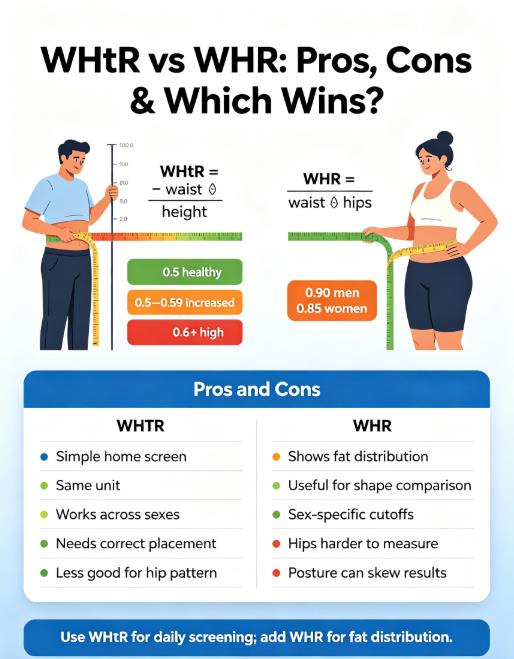
WHtR vs WHR: side-by-side
| Metric | Formula | Common risk cue | Best use |
|---|---|---|---|
| WHtR | waist ÷ height | 0.5+ increased; 0.6+ high | Fast home screen, all sexes |
| WHR | waist ÷ hips | 0.90+ men, 0.85+ women (WHO); 0.95/0.80 some US guides | Compare belly vs hip fat pattern |
Lee et al. found WHtR outperformed BMI, waist circumference, and WHR for hypertension, type 2 diabetes, and dyslipidemia discrimination in a meta-analysis. A 31-study prospective pool reported higher WHtR, WHR, and waist circumference all raised cardiovascular risk, with WHtR below 0.5 a widely applicable boundary.
These tradeoffs show why no single ratio works for everyone. Your body shape and measurement consistency will change what these numbers tell you.
WHtR pros and cons
One number, same unit: waist and height in inches or cm.
Works across sexes better than fixed waist-only rules.
NICE recommends BMI plus WHtR for central adiposity when BMI is below 35 kg/m².
Con: needs correct waist placement; a loose tape skews everything.
Con: pregnancy, major muscle gain, or spinal height loss need extra context.
WHR pros and cons
Shows whether fat sits centrally versus on hips and thighs.
Useful in population research and some ethnic risk models.
Con: hip measurement is harder to repeat; clothing and posture change it.
Con: sex-specific cutoffs vary by guideline, which confuses home users.
Con: hip size can rise after strength training without raising health risk.
For a combined body-composition check, run waist and age through the body fat calculator. Pair that with the BMI Calculator if you only have weight and height today.
How to measure without guessing
Find the midpoint between the bottom rib and top of the hip bone. That is usually just above the navel.
Stand relaxed, exhale normally, no sucking in.
Wrap a soft tape flat; snug but not compressing skin.
Measure hips at the widest point for WHR.
Repeat twice; average the numbers.
Recheck every 4–6 weeks under similar conditions.
A 5'4" adult with a 32-inch waist has WHtR 0.50. A 5'4" adult with a 30-inch waist and 40-inch hips has WHR 0.75, below the common female risk line. Same height, different action list.
Frequently Asked Questions
Which is better, WHtR or WHR?
WHtR is simpler for home screening because one cut near 0.5 fits most adults. WHR adds hip-contrast detail but uses sex-specific cutoffs that differ by guideline. Many people track both, then review trends with a clinician.
What is a normal WHtR for women?
The common healthy screen is below 0.5, ideally 0.4–0.49. A 5'4" woman needs waist under 32 inches for 0.50 and under 31.4 inches for 0.49. Ethnic and post-menopausal risk can shift the action plan.
What is a normal WHR for men?
WHO commonly flags 0.90 or above as increased abdominal risk; some US materials use 0.95. A man at 36-inch waist and 40-inch hips has WHR 0.90. That number alone does not diagnose disease.
Can WHtR replace BMI?
No. BMI gives weight-for-height quickly; WHtR adds belly-fat context. NICE suggests using them together for central adiposity when BMI is below 35 kg/m². Adding waist circumference improves screening further.
Do athletes need different cuts?
Muscle can change weight and shape but not always waist. WHtR and WHR still help, yet body-fat testing and performance goals matter more. Discuss individual targets with a qualified provider.
How often should I remeasure?
Every 4–6 weeks is practical for weight or waist programs. Measure at the same time of day, same placement, and same tape. Monthly trends beat daily fluctuations.
Sources
NICE, Overweight and Obesity Management (NG246): BMI, waist circumference, and waist-to-height ratio for central adiposity. nice.org.uk/guidance/ng246
WHO, Obesity and Overweight Fact Sheet: BMI, waist, and risk classification. who.int/news-room/fact-sheets/detail/obesity-and-overweight
Lee et al., J Clin Epidemiol 2008: WHtR vs BMI, waist, WHR for cardiovascular risk factors. PubMed ID: 18538976
Prospective meta-analysis of 31 cohorts on waist, WHR, and WHtR cardiovascular risk (Ashwell & Gibson, BMJ Open 2014;4:e003505).
*This article is for informational and educational purposes only. It does not constitute medical advice, diagnosis, or treatment. Always consult a qualified healthcare provider regarding your individual health and body-composition goals. Individual results will vary. The BMI Calculator Blog Team maintains editorial independence and does not sell health products.*