Quick Take: BMI calculator vs body fat scale — which is better for tracking health? They measure different things. A BMI calculator gives you a fast, free weight-to-height ratio using CDC categories. A body fat scale estimates fat-to-lean mass with bioelectrical impedance. BMI is better for quick screening and monthly trends. Body fat scales are better for tracking fat loss vs. muscle gain over time. For most people, using both together — plus waist circumference — delivers the clearest home picture.
BMI is fast, free, and standardized — but blind to body composition.
Body fat scales estimate fat vs. lean mass but vary 1–3% with hydration.
BMI suits broad screening and monthly trends; body fat scales suit recomposition tracking.
Use both plus waist circumference for the most complete home picture.
What Does Each Tool Actually Measure?
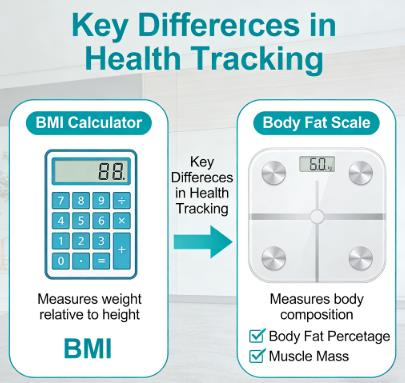
A BMI calculator measures weight relative to height. A body fat scale estimates how much of that weight is fat versus lean tissue. They answer different questions. BMI answers “is my weight in a healthy range for my height?” Body fat percentage answers “what is my body actually made of?”
The CDC classifies BMI into four categories for adults aged 20 and older. Use a Adult BMI Calculator to get your number in seconds — it’s the fastest starting point. A body fat calculator takes additional measurements to estimate your body composition. The two tools work best together, not in competition.
BMI Calculator: The Quick, Standardized Screening Tool
BMI has been used for over 150 years because it requires nothing more than a scale and a tape measure. The formula — weight in kilograms divided by height in meters squared (kg/m²) — is standardized globally. The WHO and CDC use identical thresholds: 18.5, 25, and 30. This standardization means your BMI means the same thing whether calculated in Chicago, London, or Singapore — though interpretation should vary by ethnicity. WHO recommends adjusted BMI thresholds for Asian populations (23 = overweight, 27.5 = obese), making body fat scales even more critical for accurate health tracking in these regions.
How to calculate BMI accurately at home:
Measure your height barefoot against a wall — use a metal tape measure, not fabric, and don’t rely on your driver’s license height
Weigh yourself first thing in the morning, after using the bathroom, before eating or drinking
Use the metric formula (kg ÷ m²) or imperial formula ((lbs × 703) ÷ in²)
Calculate monthly, not daily, to see genuine trend rather than water weight noise
Strengths: Free, fast, standardized worldwide, requires no special equipment, backed by decades of population health data.
Limitations: Cannot distinguish between muscle and fat. Does not measure fat distribution. Less accurate for athletes, older adults, children, and Asian populations (who need lower thresholds).
Body Fat Scale: The Deeper Look at Body Composition
Body fat scales use bioelectrical impedance analysis (BIA). A tiny, imperceptible electrical current travels through your body. Muscle tissue, which is about 70% water, conducts electricity well. Fat tissue, which contains much less water, creates resistance. The scale measures this resistance and uses an algorithm to estimate your body fat percentage. Most consumer scales also estimate muscle mass, bone mass, and water weight — though the accuracy of these secondary metrics varies widely.
How to use a body fat scale correctly:
Always measure at the same time — first thing in the morning is best, after voiding, before eating or drinking
Dry, bare feet are crucial because moisture or socks interfere with the electrical signal
Stand still with weight evenly distributed on both feet for 10–15 seconds
Track weekly or monthly trends, not daily readings — BIA can fluctuate 1–3% day-to-day from hydration changes alone
Don’t measure immediately after exercise — muscle pump and dehydration skew results
Research on home BIA measurements shows most inconsistent readings come from inconsistent morning measurement routines, rather than differences between scale brands. Many users make the mistake of treating daily fluctuations as real body composition changes.
Strengths: Distinguishes fat from lean mass, lets you track body recomposition (fat loss while gaining muscle), delivers personalized data beyond a single number.
Limitations: BIA is an estimation, not a direct measurement. Hydration status has a significant impact on accuracy — being dehydrated can overestimate body fat, and being well-hydrated can underestimate it. Per ACE (American Council on Exercise, 2024) data, consumer body fat scales carry a 3–5% margin of error versus gold-standard DEXA clinical scans. Results vary between brands and even between models from the same brand.
Head-to-Head Comparison: When Each Tool Wins
| Metric | BMI Calculator | Body Fat Scale (BIA) |
|---|---|---|
| Core Measurement | Height-to-weight ratio (population screening) | Fat vs lean muscle mass ratio (body composition) |
| Accuracy Stability | Fixed mathematical precision | ±3-5% error (affected by hydration/exercise) |
| Best Use Case | Quick baseline, monthly trend tracking | Fat/muscle recomposition tracking |
| Limitations | Blind to muscle/fat differences | Daily reading fluctuations |
No single tool works best for everyone — each shines in distinct daily use cases. Here’s when to trust which one:
For a quick baseline check: BMI wins. It takes 30 seconds and gives you a category that’s backed by decades of population health data.
For tracking fat loss vs. muscle loss: Body fat scale wins. If your weight stays the same but your body fat percentage drops, you’re losing fat and gaining muscle — exactly what you want. BMI would tell you nothing changed.
For athletes and strength trainers: Body fat scale wins. BMI routinely misclassifies muscular individuals as overweight or obese. A body fat estimate — even an imperfect one — offers far more useful context.
For older adults concerned about sarcopenia: Body fat scale wins. Age-related muscle loss can keep BMI “normal” while body fat rises to unhealthy levels. Body composition tracking catches this.
For population-level screening: BMI wins. It’s standardized, free, and requires no equipment beyond a scale. Public health agencies use BMI precisely because it’s universally applicable at scale.
For daily or weekly tracking: BMI wins for simplicity. Monthly BMI checks with consistent conditions show meaningful trend. Daily BIA readings are too noisy to be useful.
Which Should You Choose? A Practical Decision Framework
The best choice depends on your goals, your budget, and how much data you’re willing to track. Use this quick guide:
Use BMI alone if: You’re just starting to track your health, you want a free and fast baseline, and you’re not an athlete, older adult, or of Asian descent (in which case, use an ethnicity-adjusted calculator).
Add a body fat scale if: You’re actively losing weight and want to know if you’re losing fat or muscle. You’re strength training and want to track body recomposition. You’re at a stable weight but suspect your body composition may be changing with age.
Use both if: You want the most complete home-tracking picture. Track BMI monthly for broad weight trends. Track body fat percentage weekly under identical morning conditions for body composition trends. Use waist circumference — above 40 inches (102 cm) for men, above 35 inches (89 cm) for women — as a third data point that independently predicts cardiometabolic risk.
The NIH recommends pairing BMI with waist circumference and body composition assessment for the most complete picture. No single number captures your full health profile. The combination is what offers actionable insight.
Frequently Asked Questions
Is a body fat scale more accurate than a BMI calculator?
It’s not a simple “yes or no” answer because they measure entirely different metrics. BMI gives mathematically consistent results when your height and weight are entered correctly. Consumer body fat scales are only estimates; ACE 2024 research notes they can be off by 3–5 percentage points when compared against gold-standard DEXA scans. Where body fat scales shine is telling fat loss apart from muscle gain, something BMI cannot do. Instead of asking which tool is more accurate, ask which one answers your personal health question.
Why does my body fat scale give different readings on different days?
Hydration is the biggest factor. BIA works by measuring electrical resistance through body water. If you’re dehydrated, the current travels slower, and the scale estimates higher body fat. If you’re well-hydrated, resistance drops and body fat reads lower. This is why consistent measurement conditions — same time, same hydration state — matter more for BIA than for a standard scale.
Can I use both tools together?
Yes, and most health professionals recommend exactly this. BMI gives you a broad weight category. Body fat percentage tells you what that weight is made of. Together, they answer both “am I at a healthy weight?” and “is my body composition improving?”
Do body fat scales work for everyone?
No, they are not suitable for everyone. BIA technology is unreliable for pregnant people, anyone with a pacemaker — the tiny electrical pulse is contraindicated — those with heavy fluid retention or edema, and elite athletes whose muscle density falls outside the dataset these scales rely on. If you fall into any of these groups, ask your doctor about clinical body composition testing instead.
Sources
CDC: Adult BMI Categories — Underweight, Healthy Weight, Overweight, and Obesity
WHO: Obesity and Overweight Fact Sheet — BMI Classification Standards
NIH/NHLBI: BMI Calculator and Health Risk Assessment Guidelines (non-linked source)
ACE (American Council on Exercise): Body Composition Assessment Guidelines 2024 (non-linked source)
This content is for informational and educational purposes only. It does not constitute medical advice, diagnosis, or treatment. BMI and body fat scales are screening tools only, not diagnostic instruments. Always consult a qualified healthcare provider regarding your individual health and weight goals. Individual results will vary. The BMI Calculator Blog Team maintains editorial independence and does not sell health products.