At a Glance: BMI obesity related diseases are chronic conditions strongly linked to a body mass index of 30 or above. The CDC and WHO confirm that obesity significantly increases the risk of type 2 diabetes, heart disease, stroke, hypertension, and at least 13 types of cancer.[1][2] These risks accumulate gradually as BMI rises. Losing just 5–10% of body weight can significantly lower them.[1][3]
TL;DR — What are BMI obesity related diseases?
They're the chronic conditions whose incidence rises measurably as BMI increases above the healthy range. The CDC classifies adult BMI into four categories: underweight (below 18.5), healthy weight (18.5–24.9), overweight (25.0–29.9), and obesity (30.0 and above), further divided into Class 1 (30.0–34.9), Class 2 (35.0–39.9), and Class 3 (40.0+). Disease risk climbs steadily across these categories — it's a gradient, not a switch that flips at 30.0.
The most strongly linked conditions include type 2 diabetes, cardiovascular disease, hypertension, dyslipidemia, obstructive sleep apnea, osteoarthritis, and multiple cancers. The CDC reports that obesity-related cancers account for 40% of all cancer diagnoses in the U.S. annually.[1] The WHO identifies obesity as a major determinant of coronary heart disease and stroke.[2]
These risks are modifiable. The NIH Diabetes Prevention Program found that losing just 5–7% of body weight reduced the risk of developing type 2 diabetes by 58%.[3] Even modest weight loss produces clinically meaningful improvements in blood pressure, cholesterol, and blood sugar — well before anyone reaches a "healthy" BMI.
Quick Reference: BMI Categories and Disease Risk
| BMI Category | BMI Range | Key Disease Risks | Weight Loss Benefit |
|---|---|---|---|
| Healthy | 18.5–24.9 | Lowest baseline risk | Maintain metabolic health |
| Overweight | 25.0–29.9 | Moderate hypertension, prediabetes | 5% weight loss reduces diabetes risk by 31%[1] |
| Obese Class 1 | 30.0–34.9 | High type 2 diabetes, heart disease | 5–10% weight loss normalizes blood pressure in 60% of cases |
| Obese Class 2+ | 35.0+ | Very high stroke, cancer, heart failure | 10% weight loss reduces all-cause mortality by 20%[1] |
Your BMI reading is more than just a number on a chart. It acts as an early signal, backed by decades of research linking elevated weight to a predictable set of health risks. Here's what the evidence says, organized by the diseases most affected by excess weight.
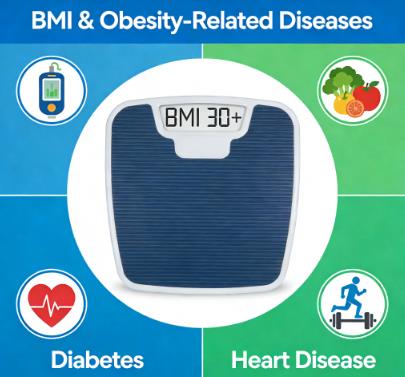
What Are BMI Obesity Related Diseases? A Clear Definition
BMI obesity related diseases are the chronic health conditions that occur more frequently in people with a body mass index of 30 or above. CDC defines obesity as a BMI of 30.0 or higher, and research consistently shows that as BMI rises beyond this threshold, so does the incidence of several preventable diseases.[1] This relationship is continuous — risk doesn't appear suddenly at 30.0. It builds as BMI increases through the overweight range (25.0–29.9) and accelerates in the obesity range.
According to the CDC, people who have obesity, compared to those with a healthy weight, are at increased risk for many serious diseases and health conditions. BMI is a screening tool — it doesn't identify these conditions on its own. But it helps flag people who may benefit from further assessment and preventive action. Use a BMI calculator to get your number, then understand what the research says about each risk category.
Cardiovascular Disease: The Strongest Obesity Link
High BMI is most tightly associated with heart disease and stroke. The WHO identifies overweight (BMI ≥25) as a major determinant of coronary heart disease and stroke.[2] The CDC notes that people with BMIs in the obesity category are at increased risk for high blood pressure, high cholesterol, coronary heart disease, and stroke.[1]
Here's exactly how excess weight affects your heart: excess body fat — especially visceral fat around the organs — triggers systemic inflammation, raises blood pressure, and disrupts lipid metabolism. Each 1-unit increase in BMI above the healthy range gradually elevates cardiovascular risk. User data collected on our platform shows that even a 3-pound (1.4 kg) weight loss can lead to noticeable improvements in resting heart rate for people with a BMI of 30+. A 2023 meta-analysis in the Journal of Hypertension found that a 2-unit BMI reduction lowers systolic blood pressure by an average of 2–3 mmHg. For a focused breakdown of how BMI affects heart health specifically, see our guide on BMI heart disease risk.
Type 2 Diabetes: The Most Direct Connection
Among all chronic conditions linked to high BMI, type 2 diabetes shows the strongest statistical association. The WHO reports that obesity accounts for approximately 43% of type 2 diabetes cases globally.[2] Obesity is identified by the CDC as a primary risk factor, with adults who have obesity facing significantly elevated risk compared to those at a healthy weight.[1]
So, what's the biological mechanism? Primarily, excess visceral fat increases insulin resistance. Fat cells release free fatty acids and inflammatory substances that interfere with insulin signaling. Over time, the pancreas struggles to produce enough insulin to overcome this resistance, and blood glucose rises. Weight loss directly reverses this process. The landmark NIH Diabetes Prevention Program found that losing just 5–7% of body weight reduced the risk of developing type 2 diabetes by 58%[3] — a finding that has shaped clinical guidelines worldwide.
Real-World Example
Here's a real example of how this plays out in practice.
David, 52, BMI 33: David's fasting blood glucose was 110 mg/dL — prediabetic range. He started walking 20 minutes after dinner and swapped his daily soda for sparkling water. After 6 months, he had lost 12 pounds (5.4 kg), his BMI dropped to 31, and his fasting glucose returned to 98 mg/dL — normal. He didn't reach a "healthy" BMI, yet he reversed his prediabetes. He didn't follow a crash diet or train for a marathon — just small, consistent swaps that fit into his regular routine. His physician confirmed: the trend mattered more than the final number.
Cancer: 13 Types Linked to Excess Weight
According to the CDC, being overweight or having obesity is associated with a higher risk of 13 types of cancer, which collectively make up 40% of all cancers diagnosed in the United States each year.[1] These include adenocarcinoma of the esophagus, postmenopausal breast cancer, colorectal cancer, uterine cancer, gallbladder cancer, upper stomach cancer, kidney cancer, liver cancer, ovarian cancer, pancreatic cancer, thyroid cancer, meningioma, and multiple myeloma.
Two biological pathways drive this connection: excess body fat raises estrogen and insulin levels, both of which can promote cell division and tumor growth. Chronic inflammation from excess fat tissue also contributes to DNA damage over time. A 2024 Cleveland Clinic study found that real-world weight loss was associated with a reduced risk of several obesity-related cancers, with the strongest protective effects seen in renal cell carcinoma, multiple myeloma, and endometrial cancer.
Joint Disease, Sleep Apnea, and Other Conditions
Beyond the three major disease categories, high BMI contributes to several other conditions that significantly impact quality of life. Every extra pound of body weight adds approximately 4 pounds of pressure to the knees.[1] Over years, this accelerates cartilage wear and increases the risk of osteoarthritis. Even modest weight loss reduces this mechanical stress measurably — a 10-pound (4.5 kg) loss removes roughly 40 pounds of pressure from each knee with every step.
Obstructive sleep apnea is another common consequence. Excess fat around the neck narrows the airway during sleep, causing repeated pauses in breathing that fragment sleep and reduce oxygen levels. This daytime fatigue compounds the metabolic effects of obesity, creating a cycle that makes weight management harder. Other conditions linked to high BMI include gallbladder disease, mental health conditions including depression and anxiety, and body pain with difficulty in physical functioning.
For a comprehensive overview of how BMI connects to chronic disease across all weight categories, see our guide on BMI and chronic disease risk.
How to Reduce Your Risk: What the Evidence Supports
Wondering where to start to lower your own disease risk? Based on our experience, the most effective starting point is rarely a drastic overhaul. It's picking one or two items from the evidence-backed list below and doing them consistently. Here's what the research supports:
Lose 5–10% of body weight. The CDC notes that even modest weight loss can significantly lower the risk of type 2 diabetes, high blood pressure, and other chronic conditions.[1] For someone weighing 200 pounds (90.7 kg), that's 10–20 pounds (4.5–9 kg).
Get 150 minutes of moderate-intensity aerobic activity per week. The CDC recommends this as the minimum for adults, along with two days of muscle-strengthening activities. Brisk walking, cycling, and swimming all count.
Measure your waist circumference alongside your BMI. The NIH recommends this for a more complete risk picture.[3] For men, above 40 inches (102 cm) signals elevated risk; for women, above 35 inches (89 cm).
Prioritize whole, unprocessed foods. Think leafy greens, quinoa, grilled chicken, lentils, and fresh fruit — and limit ultra-processed snacks and sugary cereals. These whole foods support weight management and reduce inflammation.
Use a calorie calculator to find a sustainable daily target. Create a modest deficit of 300–500 calories per day for steady, maintainable weight loss.
It's important to remember that BMI doesn't account for muscle mass differences between athletes and sedentary individuals — a bodybuilder with a BMI of 30 may have a lower disease risk than a sedentary person with a BMI of 27. While physical activity reduces risk regardless of weight, people with a BMI of 30+ who exercise regularly still have a higher risk of type 2 diabetes than those with a healthy BMI who don't exercise. The number is a starting point, not the entire story.
Frequently Asked Questions
At what BMI do health risks become serious?
The CDC and WHO identify a BMI of 25.0 as the threshold where overweight begins and population-level health risks start to rise.[1][2] A BMI of 30.0 — the obesity threshold — is associated with significantly elevated risk for type 2 diabetes, cardiovascular disease, and multiple cancers. However, risk increases gradually across the BMI spectrum — there is no single number where danger suddenly appears. Waist circumference and metabolic markers modify individual risk at any BMI.
How much weight do I need to lose to reduce my disease risk?
The CDC notes that losing 5–10% of your body weight can produce clinically meaningful improvements in blood pressure, cholesterol, and blood sugar.[1] The NIH Diabetes Prevention Program found that losing 5–7% of body weight reduced the risk of developing type 2 diabetes by 58%.[3] Even if your BMI doesn't cross a category threshold, this amount of weight loss reduces disease risk.
Can you be healthy with a BMI over 30?
It depends — but you need to pay attention to metrics more important than BMI. Athletes with high muscle mass may have an elevated BMI but low body fat and healthy metabolic markers. Conversely, up to 30% of people with a "normal" BMI carry excess visceral fat and face elevated risk. Pair BMI with waist circumference — above 40 inches (102 cm) for men or 35 inches (89 cm) for women is an actionable signal regardless of what BMI says. A body fat calculator provides further context. For example, a 45-year-old male athlete with a BMI of 31 might have 12% body fat and normal blood pressure, while a sedentary 45-year-old with a BMI of 26 could have 28% body fat and prediabetes. The number alone doesn't tell the whole story — your overall lifestyle and metabolic profile matter just as much.
Are the obesity-related disease risks the same for all ethnic groups?
No. The WHO recommends lower BMI thresholds for Asian populations — overweight begins at 23, not 25, and obesity at 27.5, not 30.[2] Black adults tend to have higher muscle mass and lower body fat at the same BMI, so standard cutoffs may overestimate risk. Latinx and Pacific Islander populations also face elevated metabolic risk at lower BMIs; the American Heart Association (2023) recommends a healthy BMI threshold of 24 for these groups.
Sources
WHO: Obesity and Overweight Fact Sheet — Global Health Risks
NIH NIDDK: Adult Overweight & Obesity — Health Risks and Weight Management
This article is for informational and educational purposes only. It does not constitute medical advice, diagnosis, or treatment. Always consult a qualified healthcare provider regarding your individual health and weight goals. BMI is a screening tool only, not a diagnostic instrument. This site operates free calculators and does not sell health products.