Quick Summary: BMI for pregnant women means your pre-pregnancy BMI — the number your provider uses to set a weight gain target. Current weight already includes the baby, placenta, and extra blood. CDC ranges run from 11–20 lb at BMI 30+ up to 28–40 lb below 18.5. Find yours: calculate pre-pregnancy BMI, match the CDC range, then confirm with your provider.
Pre-pregnancy BMI sets the target. Not today's weight, not your weight at 30 weeks — the BMI you had before conception.
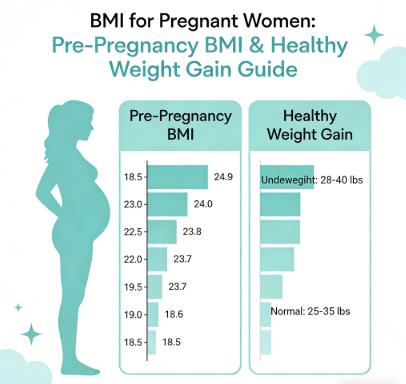
Four ranges, entirely determined by that one number. 28–40 lb under 18.5, 25–35 lb at 18.5–24.9, 15–25 lb at 25.0–29.9, and 11–20 lb at 30.0 and above.
Your current weight cannot measure body fat. The baby, placenta, amniotic fluid, extra blood volume, and maternal fat stores are all inside the number on the scale.
These are targets, not rules. Providers adjust for twins, health conditions, and how your own pregnancy is progressing.
Gaining weight is the point. No standard guidance recommends holding at zero or losing weight during pregnancy.
What Does BMI for Pregnant Women Mean?
What you weighed before conceiving is the number your provider will ask for at your first prenatal visit — and it sets every weight gain target that follows.
BMI for pregnant women is not a special pregnancy formula. It is your pre-pregnancy BMI — the same weight ÷ height² calculation used for any adult — treated as the baseline that determines how much weight you should gain.
The math never changes. What changes is which weight you plug in, and what you do with the answer.
Current weight cannot do that job. By the third trimester, the scale is carrying the baby, the placenta, amniotic fluid, a substantially larger blood volume, uterine tissue, and fat stores your body sets aside for breastfeeding. None of that is body fat you can assess. Weighing yourself at 36 weeks is a bit like stepping on the scale in a winter coat and heavy boots — the number is real, it just is not measuring you.
Both the CDC and the American College of Obstetricians and Gynecologists (ACOG) build their recommendations on pre-pregnancy BMI, and ACOG advises providers to determine BMI at the initial prenatal visit.
How Do I Calculate My Pre-Pregnancy BMI?
Two numbers: your weight just before pregnancy and your height.
Metric: BMI = weight (kg) ÷ height (m)²
Imperial: BMI = (weight (lb) ÷ height (in)²) × 703
At 65 kg and 1.70 m, the calculation runs 1.70 × 1.70 = 2.89, then 65 ÷ 2.89 = 22.5. That lands in the normal weight range, which carries a 25–35 pound target.
A pregnancy BMI calculator does this in one step and shows your range alongside it. If you want a fuller picture of where that number sits generally, see our guide to a healthy BMI for women.
Not sure what you weighed before conceiving? You are not alone, and it is workable. Your provider can estimate your starting point from your weight at the first prenatal visit, especially if that visit happened in the first trimester. It is an approximation rather than a measurement, and it may run slightly high, but it gives you a usable category.
How Much Weight Should I Gain?
Your pre-pregnancy BMI category answers this. These are the ranges the CDC publishes for a single baby, based on the 2009 Institute of Medicine guidelines, with the weekly pacing that ACOG recommends for the second and third trimesters:
| Pre-pregnancy BMI | Category | Total weight gain | Weekly gain, 2nd–3rd trimester |
|---|---|---|---|
| Below 18.5 | Underweight | 28–40 lb (12.5–18 kg) | 1.0–1.3 lb |
| 18.5–24.9 | Normal weight | 25–35 lb (11.5–16 kg) | 0.8–1.0 lb |
| 25.0–29.9 | Overweight | 15–25 lb (6.8–11.3 kg) | 0.5–0.7 lb |
| 30.0 and above | Obese | 11–20 lb (5–9.1 kg) | 0.4–0.6 lb |
Those weekly rates apply from the second trimester onward. The first trimester usually brings 1–4.5 pounds total, and plenty of women gain nothing at all through those first 13 weeks. Your body is building a placenta and a circulatory system at that stage, not stockpiling.
Two details worth noting about that last row. The CDC subdivides obesity into three classes — Class 1 at 30 to under 35, Class 2 at 35 to under 40, and Class 3 at 40 and above — but the Institute of Medicine does not set separate gain targets for each. Its 11–20 pound range applies across all of them.
ACOG also makes a point that often gets missed (Committee Opinion No. 548): for someone who is gaining less than the recommended range while the baby is growing appropriately, there is no evidence that pushing weight gain back up to the guideline improves outcomes. Your obstetrician makes the final call — the chart is only a starting point.
Carrying twins? The targets move up — underweight 50–62 pounds, normal weight 37–54 pounds, overweight 31–50 pounds, and obese 25–42 pounds. Note that most of these come from the Institute of Medicine, but the underweight twin figure does not; the CDC flags it as an exception drawn from a separate source. For triplets or higher-order multiples, the data are too thin for a general target, so your provider sets the goal.
When Do These Ranges Need Adjusting?
Pregnancy rarely runs to a script. Four situations commonly shift the plan:
Severe morning sickness. If ongoing vomiting causes weight loss, the priority moves from hitting a target to staying hydrated and keeping nutrients down. Gain usually catches up in the second trimester once symptoms ease.
Gestational diabetes or pregnancy-induced high blood pressure. The total range often stays the same, but what you eat and how steadily you gain get watched more closely. A registered dietitian can help balance blood sugar control against fetal growth.
PCOS or insulin resistance. An early conversation with a maternal-fetal medicine specialist or a dietitian experienced in prenatal nutrition sets more realistic goals.
A history of eating disorders. Frequent weigh-ins can be actively harmful. Agree on a monitoring approach with your provider and a mental health professional before you start tracking anything at all.
If vomiting is keeping fluids down or you notice signs of dehydration, call your provider. The same goes for ongoing first-trimester weight loss, or sudden swelling in your face and hands paired with a severe headache.
Myths About Pregnancy Weight Gain
| Common myth | What actually holds |
|---|---|
| "If I'm overweight, I shouldn't gain anything." | Not supported. Even at BMI 30 and above, the recommended gain is 11–20 pounds. The baby, placenta, and increased blood volume have to weigh something, and avoiding gain entirely risks depriving the baby. |
| "Eating for two means double the calories from day one." | Most women need no extra calories in the first trimester. Later the increase is modest — roughly 340 calories a day in the second trimester and 450 in the third, about a small sandwich and a yogurt. |
| "If I'm in the range, food quality doesn't matter." | It does. Nutrient-dense foods support fetal brain and bone development in ways that calorie-dense, nutrient-poor foods simply do not, even at the same total. |
| "The weight comes off quickly after delivery." | Around 10–13 pounds goes immediately — that is the baby, placenta, and amniotic fluid. The rest is gradual. Retaining some weight at a year postpartum is common and varies widely. |
Weight gain ranges from the Institute of Medicine (2009) as published by the CDC. Calorie estimates from ACOG Committee Opinion No. 548.
The Limits of BMI — Even Before Pregnancy
BMI is a screening measure, not a diagnostic one — the CDC states that plainly, and it is worth repeating here because a target range can feel like a verdict. The calculation uses height and weight and nothing else. It cannot separate muscle from fat, so a very active woman can land in a higher BMI category without carrying excess body fat. That is one more reason these ranges are a starting point your provider interprets, not a judgment on your pregnancy.
It also means two women in the same category can get genuinely different advice, and both can be right.
Talk to your provider before making any change to how you eat or exercise during pregnancy.
Frequently Asked Questions
Why is pre-pregnancy BMI used instead of current BMI?
Because current weight during pregnancy includes the baby, placenta, amniotic fluid, increased blood volume, and normal fat stores. Using it would overestimate body fat and produce a misleading picture. Pre-pregnancy BMI gives a stable baseline from which a gain target can be set.
What if I don't know my exact pre-pregnancy weight?
Your provider can estimate it from your medical records, or from your weight at the first prenatal visit if that visit was early in the first trimester. It is less precise than a true pre-pregnancy number and may run slightly high, but it establishes a usable category.
Can I use a regular BMI calculator during pregnancy?
A standard online BMI calculator is built for non-pregnant adults — ours is intended for adults aged 18 to 65 who are not pregnant. It would use your current weight, which by mid-pregnancy includes the baby. Use a pregnancy-specific tool that asks for your pre-pregnancy weight.
What if I'm carrying twins or multiples?
Targets are higher. For twins: 37–54 pounds for normal weight, 31–50 for overweight, and 25–42 for obese. The 50–62 pound range for underweight comes from external sources rather than formal IOM guidance, so treat it as a rough guide and let your provider set the actual goal. Triplets and higher-order multiples have no general target — your provider sets one.
Can I lose weight during pregnancy if my BMI was high?
Intentional weight loss during pregnancy is not recommended without direct medical supervision. Any calorie reduction needs a dietitian guiding it so the baby still gets what it needs.
How much weight comes off after delivery?
Around 10–13 pounds goes right away — the baby, placenta, and amniotic fluid. The remainder typically comes off gradually over the following months. A steady 1–2 pounds per week is the usual target once your provider clears you, and crash dieting is a bad idea, particularly while breastfeeding.
Sources
CDC: Weight Gain During Pregnancy — Recommendations by Pre-Pregnancy BMI
CDC: Adult BMI Categories — Underweight, Healthy Weight, Overweight, Obesity
WHO: Recommendations on Antenatal Care for a Positive Pregnancy Experience
Related Articles
BMI for Pregnant Women: First, Second & Third Trimester Weight Gain Guide
Understanding BMI Categories: What Your Number Really Means for Your Health
BMI Limitations: What Your BMI Won't Tell You About Your Real Health
BMI Calculator Blog. This content is provided for educational and informational purposes only. We encourage sharing with proper attribution to our site. Unauthorized commercial use is prohibited. Medical Disclaimer: The content of this article is for informational purposes only and does not replace professional medical advice, diagnosis, or treatment. Always seek the advice of a qualified physician, obstetrician, midwife, or other qualified health provider with any questions regarding your pregnancy or prenatal health. Individual results will vary. The BMI Calculator Blog Team maintains editorial independence and does not sell health products.