Quick Summary: The BMI formula is weight divided by height squared. In metric: kg ÷ m². In imperial: (lb ÷ in²) × 703. Drop that 703 and your answer lands about 700 times too low. Below: both formulas worked step by step, the four adult categories, and the groups the standard cutoffs misread.
Two formulas, one number. Metric divides kilograms by meters squared. Imperial divides pounds by inches squared, then multiplies by 703. Same body, same result — give or take a rounding gap.
703 is the whole trick. It converts pounds-per-inch-squared into kilograms-per-meter-squared in one step. Forget it and 22.8 turns into 0.03.
Centimeters are the metric trap. 165 cm has to become 1.65 m before you square it. Leave it at 165 and the answer is off by a factor of 10,000.
The formula never changes. The cutoffs do. Children read on CDC growth-chart percentiles. Asian adults start overweight at 23. Adults over 65 run healthiest a little higher.
BMI is a screening tool, not a verdict. It cannot tell muscle from fat, so pair it with waist size and body fat percentage before deciding what your number means.
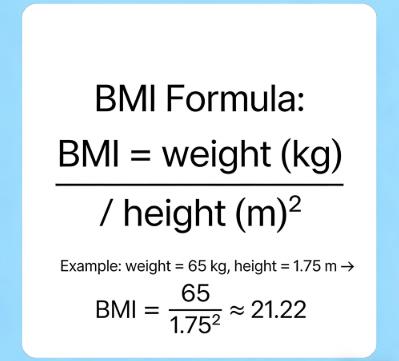
What Is the BMI Formula?
Body Mass Index is one ratio: your weight divided by your height squared. That is the entire formula.
A Belgian mathematician named Adolphe Quetelet worked it out in the 1830s while studying population averages. He was never trying to measure one person's health. He wanted a number that described a crowd.
The WHO and CDC still use it, and for a reason worth respecting: it is free, instant, and good enough to flag weight categories across millions of people. What it is not is a body fat measurement. Keep that distinction in view and the number stays useful.
Step 1: Run the Metric Formula
BMI = weight (kg) ÷ height (m)²
Take someone at 70 kg and 1.75 m:
Square the height: 1.75 × 1.75 = 3.0625
Divide the weight by that: 70 ÷ 3.0625 = 22.86
Round to one decimal: 22.9
One rule beats all the others here: convert to meters before you square, not after. That single habit prevents the most common wrong answer on the internet.
Step 2: Run the Imperial Formula
BMI = (weight (lb) ÷ height (in)²) × 703
Same person, converted to 154 lb and 68.9 in:
Square the height: 68.9 × 68.9 = 4,747.21
Divide: 154 ÷ 4,747.21 = 0.03244
Multiply by 703: 0.03244 × 703 = 22.8
So where does 703 come from? It is the unit conversion collapsed into a single number. One kilogram is 2.2046 pounds, and one meter is 39.370 inches. Square the inches-to-meters figure, divide by the pounds-to-kilograms figure, and you get 39.370² ÷ 2.2046 = 703.07. Round it off and there is your 703.
Notice the two answers above: 22.9 metric, 22.8 imperial. Same body. That 0.1 gap is rounding inside the unit conversion, not a mistake on your part. Both are correct.
Prefer not to type 703 yourself? A Metric/Imperial BMI Calculator runs the conversion in both directions and hands you the category at the same time.
Step 3: Match Your Number to a Category
Arithmetic gives you a number. The category gives it meaning.
| BMI range | Adult category |
|---|---|
| Below 18.5 | Underweight |
| 18.5–24.9 | Healthy weight |
| 25.0–29.9 | Overweight |
| 30.0 and above | Obesity |
Obesity splits further into three classes: class I at 30.0–34.9, class II at 35.0–39.9, and class III at 40.0 and above. The formula behind all of it never changes.
These are the adult cutoffs used by the WHO and CDC, and they apply to adults aged 20 and over. They describe populations. They were never designed to deliver a verdict on one person, which is exactly why the next step exists.
Step 4: Check Whether the Standard Cutoffs Fit You
The formula is identical for everyone. The interpretation is not.
| If you are | The cutoff shifts to | Why |
|---|---|---|
| A child or teen (2–19) | Age- and sex-specific percentiles | Body composition changes month to month during growth |
| An Asian adult | Overweight at 23, obesity at 25 | Metabolic risk rises at a lower BMI |
| Aged 65–79 | 23–28 | A little extra reserve protects against frailty |
| Muscular or an athlete | No shift — BMI simply over-reads | A kilogram of muscle weighs the same as a kilogram of fat |
Children and teens run the exact same arithmetic. A 14-year-old's result then gets plotted on a CDC growth chart as a percentile rather than dropped into an adult range — the 5th to 84th percentile generally counts as a healthy weight.
For Asian adults, the WHO cutoffs sit lower: healthy runs 18.5–22.9, overweight starts at 23, and obesity at 25. South Asian adults may warrant screening from 22. An Asian BMI calculator applies those thresholds instead of the standard ones.
Age pushes the other direction. Past 65, carrying a little more tends to protect rather than harm. Our senior BMI calculator stratifies by decade — 23–28 for ages 65–79, 24–29 for 80–89, and 25–30 past 90. Treat those as age-adjusted tool ranges rather than official cutoffs. The formula underneath them is the one you already know.
The Whole Calculation, Start to Finish
Let's take one person all the way through. Sam is 5'9", 180 lb, 42 years old, and lifts twice a week.
Metric: 1.75 m and 81.6 kg. Square 1.75 to get 3.0625. Divide 81.6 by 3.0625 → 26.6.
Imperial check: 69 in squared is 4,761. Then 180 ÷ 4,761 = 0.0378. Times 703 → 26.6.
Category: 26.6 falls in the 25.0–29.9 band, which reads as overweight.
Age check: at 42, the standard adult cutoffs apply as written. Run this same number at 70 and the 23–28 band would call it healthy.
Composition check: at 12% body fat, most of that 26.6 is lean mass, and the overweight label is doing no useful work.
One number. Three readings. Only one of them means anything without context, and it is not the first one.
Where Calculations Go Wrong
Four mistakes account for nearly every wrong BMI we see, and the first one dwarfs the rest.
Using centimeters as meters. Someone at 68 kg and 165 cm who types 165 gets 68 ÷ 27,225 = 0.0025. Done correctly — 1.65 m, squared to 2.7225 — the answer is 24.98. That is a factor of 10,000.
Dropping the 703. Imperial without it produces numbers around 700 times too small. If your BMI comes out below 1, this is why.
Rounding halfway through. Keep every digit until the final step, then round once. Round at each stage and the small errors stack.
Measuring at the wrong moment. Shoes on, or weighed after a meal and a litre of water, both nudge the result enough to cross a cutoff.
In our anonymized calculator usage data from 2025 — aggregated from site visitor records, not a peer-reviewed study — the results that came back obviously wrong clustered around two inputs: height typed in centimeters where meters were expected, and weight typed in kilograms where pounds were expected. Both are one-tap fixes. Measure barefoot in the morning, and check which unit the field wants before you type.
What the BMI Formula Cannot Tell You
The formula weighs everything the same, including the parts you would rather it did not.
Muscle versus fat. The CDC is direct about this: BMI does not distinguish between the two. A lifter and a sedentary adult can share a BMI of 27 and have nothing else in common.
Where your fat sits. Waist circumference catches what BMI misses. Risk rises above 40 inches for men and 35 inches for women, per NHLBI.
What age has taken away. Muscle mass declines with age while weight holds steady, so an unchanged BMI can quietly hide a worse body composition.
A body fat calculator adds the tissue-level detail that BMI cannot see. Put a tape measure around your waist and you have two numbers that catch what one formula misses.
Frequently Asked Questions About the BMI Formula
What is the BMI formula in kg and meters?
BMI = weight (kg) ÷ height (m)². At 70 kg and 1.75 m: square 1.75 to get 3.0625, then divide 70 by 3.0625 for a BMI of 22.9.
What is the BMI formula in pounds and inches?
BMI = (weight (lb) ÷ height (in)²) × 703. At 154 lb and 68.9 in: 68.9 squared is 4,747.21, then 154 ÷ 4,747.21 × 703 gives 22.8.
Why do you multiply by 703?
Because 703 converts pounds-per-inch-squared into kilograms-per-meter-squared. It comes from 39.370² ÷ 2.2046, using 39.370 inches per meter and 2.2046 pounds per kilogram. Without it, an imperial BMI comes out roughly 700 times too small.
Is the BMI formula different for children?
No, the arithmetic is identical. Only the interpretation changes: results for ages 2–19 are plotted on CDC growth charts as percentiles rather than matched to fixed adult ranges. The 5th to 84th percentile is generally considered a healthy weight.
Should I round the numbers partway through the calculation?
No. Keep every digit through the intermediate steps and round only the final BMI, to one decimal place. Rounding at each stage lets small errors compound, which is enough to push a borderline result across a category line.
What is a healthy BMI number?
For adults aged 20 and over, the WHO and CDC healthy weight range is 18.5 to 24.9. Below 18.5 is underweight, 25.0 to 29.9 is overweight, and 30.0 and above is obesity — which splits into class I (30.0–34.9), class II (35.0–39.9), and class III (40.0+). Those thresholds shift for children, Asian adults, and adults over 65.
Sources
CDC: Body Mass Index (BMI) — Screening Measure and Adult Categories
NIH/NHLBI: Aim for a Healthy Weight — BMI Range and Waist Circumference
CDC: Child and Teen BMI Categories — Percentile Interpretation
Related Articles
BMI Formula Explained: Step-by-Step Metric and Imperial Calculation Guide
How to Calculate BMI: The Exact Metric & Imperial Formulas (With Worked Examples)
BMI Calculation: The Metric & Imperial Formulas, 703 Factor, and Common Pitfalls
BMI Calculator Blog. This content is provided for educational and informational purposes only. Medical Disclaimer: The content of this article is for informational purposes only and does not replace professional medical advice, diagnosis, or treatment. Always seek the advice of a qualified physician or other qualified health provider with any questions regarding your health or medical conditions.