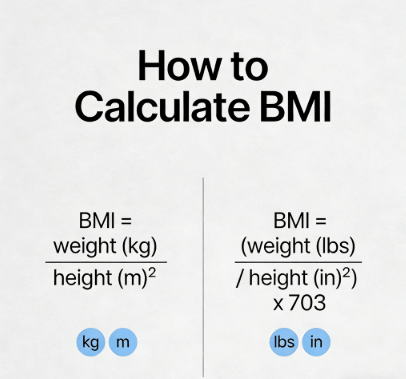
To calculate your BMI, take your weight in kilograms and divide it by your height in meters squared (kg/m²). For imperial units, divide your weight in pounds by your height in inches squared, then multiply the result by 703. That's the math. It works for everyone. What changes is everything around the math — how you measure, which mistakes throw the number off, and what to do once you have it. This guide is built as a hands-on tutorial: pick your unit system, follow the exact steps with real numbers, and avoid the errors that make people recalculate three times.
Key Takeaways
BMI formula is the same for everyone: weight (kg) ÷ height (m)² (or imperial: [weight (lb) ÷ height (in)²] × 703).
Measurement precision matters: Weigh yourself in the morning, after bathroom, no shoes; measure height barefoot against a flat wall.
Imperial users: Don't forget the ×703 factor — skipping it gives a decimal like 0.03 instead of 23.
Unit mixing is the top error: Kilograms with meters, pounds with inches — never mix systems.
Result category: Below 18.5 = underweight, 18.5–24.9 = healthy, 25–29.9 = overweight, 30+ = obesity.
Most articles tell you what BMI is. This one walks you through calculating it — with worked examples, a printable formula card, and a mistake-spotting checklist. If you already know the theory and just want to run the numbers, you're in the right place.
Quick Reference: BMI Formulas at a Glance
| Unit System | Formula | Key Step People Miss |
|---|---|---|
| Metric | weight (kg) ÷ height (m)² | Converting centimeters to meters before squaring |
| Imperial | [weight (lb) ÷ height (in)²] × 703 | Forgetting the ×703 entirely |
Before You Start: The Two Measurements That Determine Everything
Core takeaway: BMI uses exactly two numbers — your weight and your height. The quality of those two measurements determines whether your result is useful or misleading. Spend 60 seconds getting them right, and the math takes care of itself.
Here is a reliable routine for accurate measurements:
Weight: Digital scale. Hard floor, not carpet. Morning, after bathroom, before eating or drinking. No shoes, no heavy clothing. Your weight can swing 2–4 pounds over a single day from water, food, and sodium. Morning gives you the most consistent baseline.
Height: Barefoot. Flat wall. Heels, back, and head touching. Use a hardcover book placed flat on top of your head to mark the wall. Measure from the floor to the mark with a metal tape — cloth tapes can stretch over time.
Small measurement errors shift results noticeably. Measuring height while wearing thick-soled shoes, for instance, can add nearly an inch — enough to move a BMI from 25.4 to 27.0, crossing into a different category. Get the raw numbers right first, then calculate.
Metric Calculation: The 3-Step Walkthrough
If you use kilograms and meters, the math is direct. No conversion factor. Divide once, and you are done.
Step-by-Step
Write down your weight in kilograms. Example: 68 kg.
Write down your height in meters. If you measure in centimeters, move the decimal two places left. Example: 164 cm = 1.64 m.
Square your height, then divide. 1.64 × 1.64 = 2.6896. Then 68 ÷ 2.6896 = 25.29.
Result: BMI of 25.3 — just over the healthy weight threshold.
If decimals make your eyes glaze over, don't worry — we'll show you how to skip the manual work later. But walking through it once helps you spot errors when you do use a calculator.
Practice With These Three Examples
| Weight | Height | Calculation | BMI | Category |
|---|---|---|---|---|
| 55 kg | 1.58 m | 55 ÷ (1.58²) = 55 ÷ 2.4964 | 22.0 | Healthy weight |
| 85 kg | 1.75 m | 85 ÷ (1.75²) = 85 ÷ 3.0625 | 27.8 | Overweight |
| 105 kg | 1.80 m | 105 ÷ (1.80²) = 105 ÷ 3.24 | 32.4 | Obesity Class 1 |
Imperial Calculation: The 4-Step Walkthrough (With the 703 Factor)
Using pounds and inches? The extra ×703 step trips people up. A common result when someone forgets the multiplier is a decimal like 0.036 — far from the expected range of 15 to 45. Here is the correct sequence, locked in.
Step-by-Step
Write down your weight in pounds. Example: 185 lb.
Convert your height to inches. Feet × 12, plus remaining inches. Example: 5'10" = (5 × 12) + 10 = 70 inches.
Square your height, then divide your weight by it. 70 × 70 = 4,900. Then 185 ÷ 4,900 = 0.037755.
Multiply by 703. 0.037755 × 703 = 26.54.
Result: BMI of 26.5 — in the overweight range.
If you got a decimal instead of a number in the 20s, you forgot the 703. It happens to about half the people who try this for the first time. Just go back and add it — your result will snap into place.
Practice With These Three Examples
| Weight | Height | Calculation | BMI | Category |
|---|---|---|---|---|
| 130 lb | 5'3" (63 in) | [130 ÷ (63²)] × 703 = [130 ÷ 3,969] × 703 | 23.0 | Healthy weight |
| 200 lb | 5'8" (68 in) | [200 ÷ (68²)] × 703 = [200 ÷ 4,624] × 703 | 30.4 | Obesity Class 1 |
| 155 lb | 6'1" (73 in) | [155 ÷ (73²)] × 703 = [155 ÷ 5,329] × 703 | 20.5 | Healthy weight |
The Mistake-Spotting Checklist: Did You Get It Right?
Before you trust your result, run through these five checks. These are the errors that show up most often when people calculate BMI manually.
Is your BMI between 10 and 60? If your result is a decimal like 0.26, you forgot the ×703. If it is above 80, your height is probably in centimeters instead of meters. Most adult BMIs fall between 15 and 45.
Did you square your height? Dividing weight by height without squaring gives a completely different number. Square first. Always.
Did you mix units? Kilograms with inches? Pounds with meters? The numbers will look nonsensical. If you weigh 70 kg, your height must be in meters, not feet or inches.
Rounding too early is a silent killer. Keep all decimal places through the calculation. Rounding your height from 1.68 m to 1.7 m before squaring changes the denominator enough to shift your result by half a point.
Did you measure at the right time? Same-day weight swings from water and meals can shift BMI by 0.5–1.0 points. Morning, post-bathroom, no clothes — that is the standard for consistency.
Skip the Manual Work: Instant Calculation With a Tool
If you just want your number without the steps, a free BMI calculator does the math in under a second. Metric or imperial, no squaring, no conversion factors. It also stores your results locally in your browser so you can track trends. Use the manual method when you want to understand how BMI works. Use the tool when you just want the answer. Both give the same number.
After You Calculate: What Your Number Tells You
You ran the math. You have a number. Now what?
| BMI Range | Category | What to Consider Next |
|---|---|---|
| Below 18.5 | Underweight | Check with a healthcare provider. Look at nutrient intake and energy levels. |
| 18.5 – 24.9 | Healthy weight | Maintain habits. Measure waist circumference for a fuller picture. |
| 25.0 – 29.9 | Overweight | Context matters — muscle vs. fat. Pair with body fat or waist measurement. |
| 30.0 and above | Obesity | Schedule a provider visit. Gradual loss of 1–2 lbs/week is the CDC recommendation. |
A single BMI number is a snapshot. Trends matter more. Take your measurement again in 4–6 weeks under the same conditions — same scale, same time of day, same clothing level — and compare. That trend line tells you more than any single calculation. If you want to see how these ranges shift for athletes, seniors, or Asian populations, explore the complete BMI normal range guide.
Frequently Asked Questions About Calculating BMI
Why is there a 703 in the imperial formula?
✅ Quick answer: It converts pounds and inches to match the metric scale. The CDC specifies this factor. Without it, your result would be a tiny decimal — roughly 0.03 instead of 23. Write it on a sticky note if you calculate by hand often.
Do men and women use different formulas?
✅ Quick answer: No. The math is identical. A 5'6" woman weighing 140 pounds and a 5'6" man weighing 140 pounds get the same BMI — 22.6. What differs is interpretation: women naturally carry more body fat at that same BMI, so the number means something slightly different for body composition.
My BMI changed by 1 point since yesterday. Did I calculate it wrong?
✅ Quick answer: Probably not. Body weight shifts daily with water, salt intake, and digestion. A 2–3 pound swing changes BMI by about 0.5 points. A 5-pound swing changes it by nearly 1 point. Measure weekly, always in the morning, and look at the monthly trend instead of the daily number.
Can I use a measuring tape for height?
✅ Quick answer: Yes. Stand barefoot against a flat wall — no baseboards. Place a hardcover book on your head, flat side down. Mark where the bottom edge touches the wall. Measure from the floor up. Cloth measuring tapes can stretch over time; a metal tape is better.
How often should I recalculate my BMI?
✅ Quick answer: Every 4–6 weeks is a practical cadence. Enough time for real weight change to show up, not so frequent that you fixate on noise. Weigh yourself weekly if you are actively working toward a goal, and recalculate BMI once a month to track the trend.
Sources
CDC: Adult BMI Categories — Calculation and Classification Standards
NHLBI: Calculate Your Body Mass Index — Standard BMI Formula
WHO: Global Health Observatory — Obesity and BMI Data Standards
Related Articles
BMI Calculator Blog. This content is provided for educational and informational purposes only. Medical Disclaimer: The content of this article is for informational purposes only and does not replace professional medical advice, diagnosis, or treatment. Always seek the advice of a qualified physician or other health experts with any questions regarding medical conditions or health goals.