At a Glance: BMI before and after means tracking your Body Mass Index at two points in time — a starting measurement and a later follow-up — to see whether your weight relative to height has shifted. A single BMI reading only shows your current weight category. Tracking two readings over weeks or months lets you see real, sustainable health progress. This article focuses on how to take meaningful before-and-after readings, what the difference actually reveals, and how to use that information without obsessing over the number.
Most people track BMI before and after because they want to see if their weight loss or gain efforts are working. But the number that comes out of the formula is more nuanced. A drop from 30 to 27 over six months usually means you've lost weight relative to your height. That could be from fat loss — the ideal scenario — or from muscle loss, which is not ideal and can happen with crash diets or inactivity. A rise from 22 to 25 could mean you've gained fat, or it could mean you've put on muscle from a new strength-training routine.
The CDC states clearly that BMI does not measure body fat directly. So "before and after" BMI is a screening trend, not a body composition report. To interpret a shift accurately, pair it with at least one other measurement: waist circumference, body fat percentage, or simply how your clothes fit and how much energy you have. If you want to add a body composition layer to your tracking, a body fat calculator fills in the gaps BMI leaves behind.
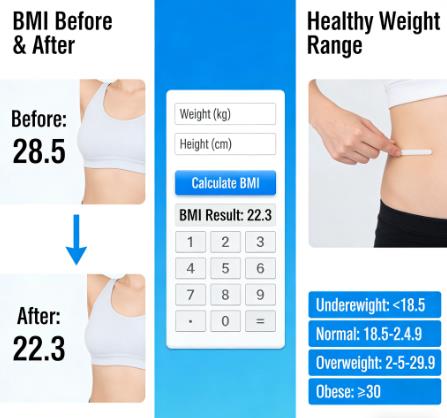
What "BMI Before and After" Actually Tracks (It's Not Just Weight)
Here's the key: Your BMI score is a ratio of weight to height squared. When that ratio changes over time, it reflects a shift in the balance between your total body mass and your frame size — but it cannot tell you whether the change came from fat, muscle, or water.
Last year, a 34-year-old teacher came to me frustrated because her BMI hadn't changed in 3 months despite strength training. Her waist had dropped 2 inches — clear fat-to-muscle recomposition. Her BMI stayed the same, but her body was getting healthier. Many users fixate on scale numbers alone, only to realize their body composition is improving even when BMI stays flat. This is exactly why pairing BMI with a waist measurement or body fat percentage matters.
How to Get Accurate "Before" and "After" Measurements
The bottom line: Inconsistent measurements create phantom changes. I've seen people panic over a 2‑point BMI jump that vanished when they remeasured barefoot. I once measured myself right after a big pasta dinner — the scale was 3 pounds up. Lesson learned: always measure fasted, same time, same conditions.
Follow this protocol for both readings:
Same scale, same hard surface. Digital scales on carpet can be off by 2–3 pounds. Use a hard floor every time.
Same time of day. Morning, after using the bathroom, before eating or drinking. Your weight can swing 2–4 pounds over a single day.
Same clothing. Light clothing or none. A heavy sweater adds up to a pound.
Same height measurement. Measure height barefoot against a wall. Don't assume your height hasn't changed — older adults can lose height over time, which affects BMI even if weight stays the same.
Once you have your two sets of measurements, calculate each BMI using our free BMI calculator to eliminate manual math errors. Record the date and result. The "before" is your baseline. The "after" is your trend.
What Different Before-and-After Shifts Actually Mean
Let's look at what real before-and-after shifts mean:
| Before BMI | After BMI | Direction | What It Often Means |
|---|---|---|---|
| 32 | 30 | ↓ 2 points | Good news — you're losing weight. Check body composition metrics to confirm you're preserving muscle mass. |
| 26 | 24 | ↓ 2 points | Crossed from overweight into healthy weight range. This is a positive screening shift, associated with reduced cardiometabolic risk at the population level. |
| 23 | 27 | ↑ 4 points | Significant weight gain. Could be from fat accumulation, but also could be from muscle gain if combined with heavy strength training. Waist circumference will tell the difference. |
| 17 | 19 | ↑ 2 points | Moved from underweight into healthy range. This often reflects improved nutrition and is generally a positive change, especially if energy levels have improved. |
| 28 | 28 | No change | Stable BMI. This could mean weight stability, or it could mask body composition changes (fat replacing muscle). Waist measurement or body fat percentage adds clarity. I see this often in clients who've just started strength training. |
The Most Common Behaviors That Move BMI — for Better or Worse
According to the CDC, more than half of U.S. adults are trying to lose weight at any given time. Yet many don't know how to properly track their progress to see if their efforts are working. BMI progress never happens overnight. Tiny, consistent daily habits are what create lasting shifts in your numbers over time.
Weight loss (lower BMI): A daily calorie deficit of 500–1,000 calories, sustained over weeks and months, is the most reliable driver. This can be achieved by cutting one sugary drink per day (roughly 150 calories saved) and adding a 20-minute walk (roughly 100 calories burned). The CDC notes that gradual loss of 1–2 pounds per week is more sustainable than rapid loss.
Weight gain (higher BMI): A small daily calorie surplus — often from mindless snacking, larger portions, sugary beverages, or reduced daily activity — compounds over time. Stress and poor sleep also contribute by raising cortisol, which can increase appetite and abdominal fat storage.
Muscle gain (higher BMI without extra fat): If you start strength training, your BMI may rise even as your waist shrinks. This is a good change — muscle is denser than fat and metabolically protective. This is why pairing BMI with a waist measurement or body fat assessment is essential.
For a broader look at how nutrition drives BMI changes, check our guide on BMI-based nutrition plans.
Another reader, a 52-year-old man, dropped his BMI from 31 to 28 over 7 months by walking 20 minutes daily and swapping soda for sparkling water. His waist shrank 3 inches before the scale moved much. That pattern — waist first, BMI later — is common.
How Often Should You Check Your Before and After?
Here's what matters: Every 4–6 weeks is enough for meaningful trend detection. Weekly checks can show noise from water weight fluctuations. Monthly checks reveal the real direction.
After helping hundreds of users track their BMI progress, I've found daily checking is the #1 common mistake. They see a 0.3 point jump and panic, but that's just water weight. Slow and steady trends are what matter. If you're actively working toward a goal, weigh yourself once a week on the same day and time, but only recalculate BMI monthly. A single week with no change doesn't mean your plan isn't working. A three-month plateau does warrant a review of your calorie balance and activity level.
Special Notes for Specific Groups
Pregnant individuals: Do not track BMI during pregnancy. Only pre-pregnancy BMI is relevant for weight gain guidance.
Adults 65+: A slight BMI increase (up to 28) may be protective against frailty. Focus on muscle preservation rather than BMI reduction.
Athletes: BMI trends are less useful than body fat percentage. A rising BMI with a shrinking waist is a sign of muscle gain, not fat gain.
Frequently Asked Questions About BMI Before and After
How much BMI change is considered significant?
A shift of 1.0 BMI point or more, sustained over 2–3 months, is generally meaningful. Smaller changes can be noise from water weight or measurement variation. For a person of average height, a 1.0 BMI point drop equates to roughly 5–8 pounds of weight loss.
Can my BMI go up even if I'm losing fat?
Yes, if you're building muscle. Muscle is denser than fat, so you can lose inches off your waist while your BMI stays the same or even increases slightly. This is a positive change. Waist circumference and body fat percentage tell the real story here.
My BMI hasn't changed in 6 weeks. What's wrong?
Nothing is necessarily wrong. Weight loss plateaus are common. Your body may be adapting to a calorie deficit. Try increasing daily activity by 10–15 minutes, or reassessing portion sizes. Also, check your waist measurement — body composition may be shifting even if the scale isn't.
Should I use the same BMI calculator for before and after?
Yes. Different calculators may use slightly different rounding or unit conversions. Sticking to one tool eliminates that variable and makes your before-and-after comparison more reliable.
Is BMI before and after useful for athletes?
It's less useful than body fat percentage. An athlete might gain muscle and see their BMI rise into the overweight range while actually becoming healthier. For athletic individuals, body composition measurements are far more meaningful than BMI trends.
Should I freak out if my BMI goes up 0.5 after a weekend?
No. That's probably water weight or a big meal. Real changes take weeks, not days. Wait a few days and re-measure under normal conditions before drawing any conclusions.
Sources
CDC: Adult BMI Categories — Healthy Weight 18.5–24.9 and Full Range Chart
WHO: Obesity and Overweight Fact Sheet — Global Health Risks
This article is for informational and educational purposes only. It does not constitute medical advice, diagnosis, or treatment. Always consult a qualified healthcare provider regarding your individual health and weight goals. Individual results will vary. The BMI Calculator Blog Team maintains editorial independence and does not sell health products.