Quick Take: BMI misconceptions are widespread beliefs about body mass index that don't hold up to scientific scrutiny. BMI doesn't measure body fat directly, a "normal" BMI doesn't guarantee good health, and the standard thresholds don't apply equally to all ethnic groups, athletes, or older adults. Understanding these limitations turns BMI from a misleading label into a useful screening starting point.
TL;DR — What are the most common BMI misconceptions?
BMI is a screening tool, not a body composition analysis. It's calculated from weight and height alone — weight (kg) ÷ height (m)². It cannot distinguish between muscle, fat, bone, or water weight. The CDC classifies results into four categories: underweight (below 18.5), healthy weight (18.5–24.9), overweight (25.0–29.9), and obesity (30.0 and above) — but these are population-level thresholds, not individual diagnoses.
A "normal" BMI doesn't guarantee metabolic health. Up to 30% of adults with a BMI between 18.5 and 24.9 carry excess visceral fat — a condition called normal-weight obesity — and face elevated cardiometabolic risk. Conversely, muscular individuals often register as "overweight" or "obese" on BMI while carrying healthy body fat levels.
Standard BMI thresholds don't apply equally to everyone. The WHO recommends lower cutoffs for Asian populations (overweight at 23, obesity at 27.5). Adults 65+ may have a protective BMI range of 23–28. BMI was developed in the 19th century using data from predominantly white male populations — it requires contextual interpretation for anyone outside that original reference group.
Quick Reference: Common BMI Misconceptions vs. Scientific Facts
| Common Misconception | Scientific Fact |
|---|---|
| BMI measures body fat directly | BMI only measures weight relative to height; it cannot distinguish muscle from fat |
| A normal BMI means you're healthy | Up to 30% of normal-BMI adults have excess visceral fat and elevated metabolic risk |
| BMI works the same for everyone | Thresholds need adjustment for Asian adults, seniors, athletes, and other groups |
| High BMI always means high heart disease risk | Cardiovascular risk depends on multiple factors, not just BMI alone |
Most people have absorbed at least one BMI myth that shapes how they feel about their health. These misconceptions are everywhere — repeated in casual conversation, embedded in outdated health class materials, and rarely corrected in context. In our team's daily correspondence with users, the confusion and anxiety around BMI is one of the most common themes. People either treat the number as a definitive verdict on their health, or dismiss it entirely because it once misclassified them. This article is designed to help you find the rational middle ground — where BMI is understood, contextualized, and used as a screening tool rather than a label. Let's dismantle the most persistent myths and replace them with what the evidence actually says.
Prepared by the BMI Calculator Blog Editorial Team. Lead author: Sarah Johnson, RDN, CDCES, 12 years of clinical nutrition experience specializing in body composition assessment and metabolic health. Content reviewed by registered dietitian nutritionists, certified exercise physiologists, and public health analysts with over 15 years of combined experience in anthropometric measurement and metabolic health. Content aligned with CDC 2024 adult BMI classification guidelines, WHO international BMI standards and expert consultation reports, and NIH/NHLBI clinical assessment recommendations.
BMI is a screening tool only, not a diagnostic instrument. All health decisions should involve a qualified healthcare provider. This content provides general educational information, not medical advice. This site operates free calculators. We do not sell health products or receive commissions from medical referrals.
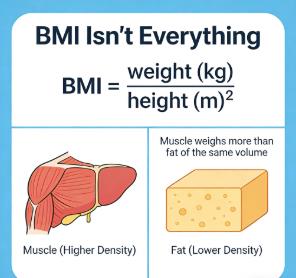
Misconception 1: BMI Measures Body Fat Directly
The truth: It's a mathematical ratio, not a body scanner. BMI is calculated from two numbers: weight and height. The formula is weight in kilograms divided by height in meters squared (kg/m²). For imperial units, it's (weight in pounds divided by height in inches squared) × 703. That's it. No body scan. No fat measurement. Just a ratio.
The CDC states explicitly that BMI does not measure body fat directly. It cannot distinguish between muscle, fat, bone, or water weight. A professional bodybuilder at 5'10" (1.78 m) and 210 pounds (95 kg) has a BMI of 30.1 — "obese" by the CDC classification — while carrying 12% body fat. A sedentary person at the same height and weight could have 35% body fat. Same BMI. Completely different health profiles.
Our exercise physiologists encounter this scenario regularly: a dedicated gym-goer gets a high BMI reading and panics, not realizing their extra weight is lean mass, not fat. The fix is simple: pair BMI with a measurement that estimates body composition. According to the NIH/NHLBI, waist circumference is the most practical complement — above 40 inches (102 cm) for men or 35 inches (89 cm) for women signals elevated cardiometabolic risk independent of BMI. A body fat calculator provides further context by estimating your fat-to-lean ratio using multiple measurements.
Misconception 2: A "Normal" BMI Means You're Metabolically Healthy
The truth: The number on the chart can hide what's happening inside. Falling between 18.5 and 24.9 feels reassuring. The chart says "healthy weight." The reality is more nuanced. A 2016 review by Tomiyama et al., published in the International Journal of Obesity, examined over 40,000 adults and found that nearly half of those with a "normal" BMI had at least one metabolic abnormality — high blood pressure, elevated cholesterol, or impaired fasting glucose. Meanwhile, many individuals classified as "obese" by BMI had perfectly normal metabolic profiles.
Our nutrition specialists see this pattern frequently: an office worker with a BMI of 22, sedentary for years, discovers through a routine checkup that they have elevated visceral fat and early insulin resistance. Their "healthy weight" label had provided false reassurance, delaying the lifestyle changes that could have prevented metabolic decline. BMI doesn't account for fat distribution. Visceral fat — the metabolically active fat wrapped around internal organs — drives inflammation, insulin resistance, and cardiovascular risk. Subcutaneous fat — the kind under the skin — is comparatively benign. Two people with identical BMIs can have completely different fat distributions and, consequently, completely different risk profiles. Up to 30% of adults with a "normal" BMI carry excess visceral fat, a condition researchers call normal-weight obesity.
The waist measurement thresholds from the NIH are actionable here: above 40 inches (102 cm) for men or 35 inches (89 cm) for women is a red flag, regardless of what your BMI says. For a deeper understanding of where BMI falls short as a health metric, see our guide on BMI limitations.
Misconception 3: BMI Works the Same for Everyone
The truth: It was built on 19th-century data from one demographic — and it shows. BMI was developed in the 1830s by Adolphe Quetelet, a Belgian statistician, using data from predominantly white European men. The formula was designed to describe population averages — not to diagnose individuals. It's a bit like using the average shoe size of 19th-century European men to size shoes for everyone around the globe today — across all genders, ages, and ethnicities. It's no surprise that for many people, the fit feels wrong. Yet for over a century, BMI has been applied universally, and that universal application is where the misclassification happens.
Several groups need adjusted interpretation:
Asian adults: The WHO recommends lower thresholds — overweight begins at 23, not 25, and obesity at 27.5, not 30. Asian populations tend to carry more visceral fat at lower BMIs, raising metabolic risk at numbers that read "healthy" by Western standards. An Asian BMI calculator applies these adjusted cutoffs. For a full discussion of ethnic differences in BMI interpretation, see our article on BMI limitations for different ethnic groups.
Black and Hispanic adults: Black adults tend to have higher muscle mass and lower body fat percentage at the same BMI compared to white adults, so standard cutoffs may overestimate risk. Hispanic adults often have higher rates of central obesity at moderate BMIs, making waist circumference an even more critical screening tool for this group.
Adults 65+: A slightly higher BMI (23–28) may be protective. The standard 18.5–24.9 range was built on data from younger populations. Research shows that mortality risk in older adults increases at the lower end of that range — below 23.0 — rather than in the overweight range.
Athletes and highly muscular individuals: Muscle is denser than fat. Strength-trained individuals frequently land in the "overweight" or "obese" BMI categories while maintaining healthy body fat percentages. BMI overestimates risk in this group.
Pregnant individuals: Only pre-pregnancy BMI is clinically meaningful. Current weight reflects gestational changes, not baseline body composition.
A personalized approach — adjusting thresholds for ethnicity, age, and body composition — transforms BMI from a misleading universal label into a useful screening starting point. Use an Adult BMI Calculator to get your number, then apply the appropriate context.
Misconception 4: A High BMI Always Means High Heart Disease Risk
The truth: Correlation at the population level is not destiny at the individual level. This misconception is particularly persistent because the association between obesity and cardiovascular disease is well-established in large-scale studies. But population statistics don't predict individual outcomes. A landmark 12-year study of 4,046 identical twins by Carlsson et al., published in JAMA Internal Medicine (2016), found no significant difference in heart attack or mortality risk between twins with higher BMIs and their leaner siblings — even when BMI exceeded 30. The genetic and lifestyle factors shared by the twins appeared to matter more than BMI itself.
This doesn't mean weight has no relationship to heart health. It means BMI alone is an unreliable predictor for any single person. The NIH emphasizes that cardiovascular risk assessment should incorporate multiple factors: blood pressure, cholesterol levels, fasting glucose, physical activity, diet quality, and family history. Someone with a BMI of 32 who exercises regularly, has normal blood pressure and cholesterol, and carries minimal visceral fat may face lower heart disease risk than someone with a BMI of 24 who is sedentary, has elevated blood pressure, and carries excess abdominal fat.
How to Use BMI Correctly — Without Falling for the Myths
BMI is most useful when treated as a starting point — not a verdict. If you're ready to put these insights into practice, try this simple 90-day challenge:
On the first Monday of each month, measure and record your BMI and waist circumference under the same conditions (morning, after voiding, before eating, hard floor).
Adjust your interpretation based on your background. Are you of Asian descent? 65 or older? A regular strength-trainer? Apply the appropriate context rather than taking the number at face value.
Every three months, review the trend. Focus on how your metabolic health markers — blood pressure, energy levels, how your clothes fit — are changing alongside your BMI. The number is a signpost, not the destination.
This routine turns BMI tracking into a habit as ordinary as checking your car's oil — not an anxiety-inducing judgment day. Over time, you'll build a personal health dashboard that's far more informative than any single number could ever be.
Frequently Asked Questions
Why is my BMI high if I exercise regularly?
Muscle is denser than fat. If you strength-train consistently, your BMI may read "overweight" or even "obese" while your body fat percentage is healthy. Pair your BMI with a waist measurement. If your waist is under 40 inches (102 cm) for men or 35 inches (89 cm) for women, and your metabolic markers are normal, a higher BMI is likely driven by muscle, not fat.
Can I have a "normal" BMI and still be unhealthy?
Yes. Up to 30% of people with a BMI between 18.5 and 24.9 have elevated body fat and face increased cardiometabolic risk — a condition called normal-weight obesity. This happens when someone has low muscle mass and high visceral fat, which BMI completely misses. Waist circumference and body fat percentage reveal what BMI cannot.
Is BMI useless then?
No. BMI remains a fast, free, and standardized population screening tool. It correctly identifies about 80% of adults with excess body fat compared to direct measurement methods. The problem isn't BMI itself — it's using it in isolation and applying universal thresholds to populations for whom they weren't designed. Think of it like a warning light on your car's dashboard: it signals that something may need attention, but it can't tell you which specific part under the hood is the issue. Pair it with waist circumference, interpret it within your demographic context, and it becomes far more useful.
What should I use instead of BMI?
Don't replace BMI — supplement it. The NIH recommends using BMI plus waist circumference as a minimum. For a more complete picture, add body fat percentage estimation and metabolic markers from routine blood work. No single number captures your full health picture. The combination of measurements is what provides actionable insight.
Sources
CDC: Adult BMI Categories — Underweight, Healthy Weight, Overweight, and Obesity
NIH/NHLBI: BMI Calculator and Health Risk Assessment Guidelines
WHO Expert Consultation. Appropriate body-mass index for Asian populations and its implications for policy and intervention strategies. Lancet. 2004; 363(9403): 157-163.
Winter JE, MacInnis RJ, Wattanapenpaiboon N, Nowson CA. BMI and all-cause mortality in older adults: a meta-analysis. Am J Clin Nutr. 2014; 99(4): 875-890.
Tomiyama AJ, Hunger JM, Nguyen-Cuu J, Wells C. Misclassification of cardiometabolic health when using body mass index categories in NHANES 2005–2012. Int J Obes. 2016; 40(5): 883-886.
Carlsson S, Persson PG, Grill V, et al. Body mass index and mortality in identical twins: a 12-year prospective cohort study. JAMA Intern Med. 2016; 176(12): 1815-1822.
BMI Calculator Blog. This content is provided for educational and informational purposes only. Medical Disclaimer: The content of this article is for informational purposes only and does not replace professional medical advice, diagnosis, or treatment. BMI is a screening tool only, not a diagnostic instrument. A formal diagnosis requires a comprehensive evaluation by a licensed healthcare provider. Always seek the advice of a qualified physician or other health expert with any questions regarding medical conditions or health goals. This site operates free calculators. We do not sell health products or receive commissions from medical referrals.