Quick answer: BMI (Body Mass Index) is a screening number calculated from height and weight. It sorts adults into underweight, healthy weight, overweight, or obesity. It is not a body fat test — it cannot tell muscle from fat.
Key Takeaways:
Formula (metric): weight (kg) ÷ height (m)²
Formula (imperial): [weight (lb) ÷ height (in)²] × 703
Healthy range: 18.5–24.9 for most adults
Not body fat: BMI cannot distinguish muscle from fat
Pair with waist: Waist circumference adds context BMI misses
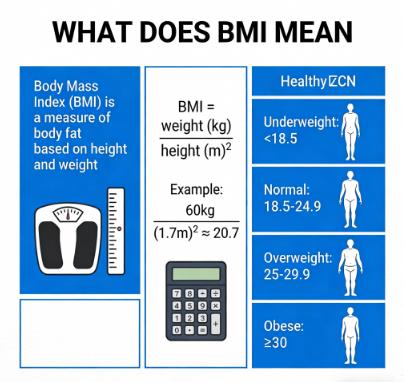
Where BMI Came From
BMI is nearly 200 years old. Belgian mathematician Adolphe Quetelet designed it in the 1830s to study populations, not individuals. He found weight scaled with height squared, not height. In 1972, Ancel Keys named it "Body Mass Index," and the NIH adopted it in 1998.
That 30.1 on your screen comes from nearly two centuries of population math. It was never meant to be a personal medical diagnosis. Quetelet wanted to describe crowds, not you. Use our Body Mass Index Calculator to get your number in seconds.
What Your BMI Number Tells You
The CDC and WHO use four categories for non-athletic, non-Asian adults aged 18–64:
| BMI Range | Category | Population-Level Link |
|---|---|---|
| Below 18.5 | Underweight | Linked to malnutrition and weak bones in large studies. |
| 18.5–24.9 | Healthy weight | Lowest all-cause mortality risk across populations. |
| 25.0–29.9 | Overweight | Elevated risk of hypertension, type 2 diabetes, and cardiovascular disease. |
| 30.0+ | Obesity | Strongly associated with metabolic disease. CDC recommends clinical assessment. |
Note for Asian adults: WHO sets overweight at BMI 23.0 and obesity at 27.5 for East, South, and Southeast Asian populations. These lower thresholds reflect higher diabetes and heart risk at lower BMIs.
Why BMI Gets It Wrong: Muscle vs. Fat
I've seen this firsthand in community screenings: a 5'10" construction worker weighing 210 lbs lands at a BMI of 30.1 — technically "obese." Yet his body fat tested at 13%, his waist was a lean 33 inches, and his metabolic labs were flawless. He strength-trained four days a week. BMI saw fat; reality saw muscle.
This misclassification is more common in men who lift weights, though exact rates vary. The CDC acknowledges BMI does not distinguish fat from muscle. If your BMI is elevated but you're active, pair it with a waist measurement or body fat calculator before drawing conclusions.
How to Use BMI Wisely
Start with BMI. Calculate it. Note your category. Use our online BMI calculator to get your reading quickly.
Add waist circumference. Above 35 inches (women) or 40 inches (men) signals elevated visceral fat risk.
Check metabolic labs. Blood pressure, fasting glucose, HbA1c, and lipids tell the inside story.
Track trends. A single reading is a snapshot. The trend over 4–6 weeks matters more.
Frequently Asked Questions
Does BMI measure body fat?
No. BMI calculates weight relative to height. It cannot distinguish fat from muscle. A muscular athlete can have an "obese" BMI with low body fat.
Is BMI the same for men and women?
The formula is identical. But women naturally carry more essential fat — roughly 6–11% more — so a BMI of 24 may reflect different body compositions.
Why square height instead of cubing it?
Because humans grow mostly upward, not proportionally in 3D. Weight scales with height squared in real populations.
Is BMI useful for older adults?
Less reliable after 65. Muscle loss can keep BMI stable while body fat rises. A slightly higher BMI (23–28) may be protective.
Does a healthy BMI guarantee health?
No. About 1 in 5 adults with a healthy BMI have high body fat — normal weight obesity. Waist circumference and labs are essential. This is why waist checks matter even when your BMI looks fine.
Sources
NHLBI: Calculate Your Body Mass Index — Standard BMI Formula (nhlbi.nih.gov)
Winter JE, et al. BMI and all-cause mortality in older adults: a meta-analysis (PMID: 25889322).
This article is for informational and educational purposes only. It does not constitute medical advice, diagnosis, or treatment. Always consult a qualified healthcare provider regarding your individual health and weight goals. Individual results will vary. The BMI Calculator Blog Team maintains editorial independence and does not sell health products.