Safe workout routines for obese beginners with a BMI of 30 or above are low-impact exercise plans designed to protect the joints, build foundational strength, and establish consistency without overwhelming the body. According to the CDC, over 42% of U.S. adults have a BMI of 30 or higher. Yet many people don't know where to start with exercise without risking injury. The goal is not maximum calorie burn or rapid transformation. It's finding movements you can do without pain — and doing them regularly enough that your body adapts and grows stronger.
No jumping. No running. No heavy weights. I know it sounds obvious, but you'd be surprised how many people think they need to start with burpees. Just controlled, joint-friendly exercises that meet you where you are today.
What Makes a Workout "Safe" at BMI 30+
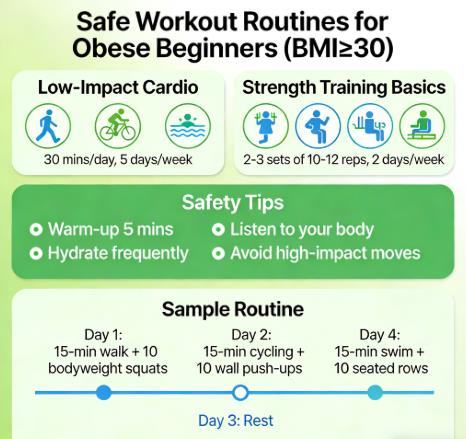
Here's what actually keeps you safe: low impact on your joints, controlled range of motion, and the ability to stop or modify any movement instantly. When your body carries extra weight, your knees and hips absorb roughly three to four times your body weight with every step. That force multiplies during jogging or jumping. This isn't a reason to avoid movement — it's a reason to choose the right kind of movement.
Low impact means at least one foot stays on the ground or the water supports your weight. Walking, cycling, swimming, and seated exercises all qualify. Running, jumping jacks, and box jumps do not. Controlled range of motion means you never force a joint past its comfortable limit — a shallow squat that doesn't hurt is infinitely better than a deep squat that does. And immediate modifiability means you can stop or adjust any movement mid-rep.
A 2022 ACSM Position Stand by Peterson and colleagues (DOI: 10.1249/MSS.0000000000002969) recommends that adults with obesity aim for at least 150 minutes per week of moderate-intensity activity. For more aggressive fat-loss goals, 150–250 minutes per week produces moderate weight loss, while exceeding 250 minutes per week is linked to clinically significant reductions. Here's the trick: three 10-minute walks a day, five days a week, is already 150 minutes. You don't have to do it all at once. For more structured guidance across different weight categories, see our overview of exercise routines for different BMI ranges.
Before You Start: The Pre-Workout Checklist
Check in with a healthcare provider. If you have high blood pressure, diabetes, joint pain, or any cardiovascular condition, get clearance before starting any new exercise routine. I've seen too many people skip this and regret it later.
Know your numbers. Use our body mass index calculator to confirm your starting point. Tracking changes every 4–6 weeks helps you see progress that the mirror might miss.
Wear supportive shoes. Cross-trainers with wide bases and cushioned soles reduce impact on hard surfaces. Avoid minimalist shoes or worn-out sneakers.
Choose a flat, stable surface. Grass, rubber tracks, and level indoor floors are ideal. Uneven ground increases the risk of ankle twists and falls.
Stop immediately and contact a healthcare provider if you experience: chest pain, pressure, or tightness; severe shortness of breath that doesn't improve with rest; dizziness, lightheadedness, or fainting; sharp, persistent joint pain; or an irregular heartbeat.
Cardio Options Compared: Walking vs. Water vs. Chair
Three low-impact cardio choices work well for beginners. Brisk walking on a flat surface is the simplest. Begin with 10–15 minutes, 3–4 days per week. You should be able to hold a conversation without gasping — that's your "talk test" for moderate intensity. Add 2–3 minutes per week; the goal is 30 continuous minutes.
Water walking in chest-deep water is the joint-friendliest option. Start with 20 minutes, 2–3 days per week. Water supports roughly 80% of your body weight, so your knees feel almost no impact. Progress by increasing pace, adding sideways steps, or using webbed gloves for gentle resistance.
Chair exercises work when standing feels tough. Seated leg lifts: sit tall, straighten one leg, hold 5 seconds, lower — 10 reps per side. Seated arm circles: extend arms to sides, make small circles forward then backward — 15 reps each direction. Seated torso twists: hold a water bottle, twist gently side to side — 10 reps per side. Seated marching: 1 minute of marching, 30 seconds of rest, repeat 10 times.
Strength Training Without Weights or Intimidation
Wall sits target legs and glutes. Start with 10–15 seconds, 3 repetitions, resting 30 seconds between reps. Back flat against the wall, feet shoulder-width apart and slightly forward so your knees never extend past your toes. Slide down until your knees bend to a 45-degree angle — no need to go lower. Hold, then push through your heels to stand back up. Add 5 seconds of hold time per week; your goal is 30 continuous seconds.
Wall push-ups work chest, shoulders, and arms. Start with 10–12 reps, 3 sets. Face a wall, hands at chest height and slightly wider than your shoulders. Bend your elbows and lower your chest toward the wall. Keep your body in a straight line — no sagging hips. Push back to the starting position. If it's too easy, step your feet farther from the wall. Too hard? Move closer.
Dead bugs build core stability. Start with 8 reps per side, 3 sets. Lie on your back. Lift your knees so your thighs are perpendicular to the floor. Extend your arms toward the ceiling. Slowly lower one leg toward the floor (keep the knee bent) while lowering the opposite arm overhead. Keep your lower back pressed firmly into the floor. Don't rush. Many beginners make the mistake of moving their legs too fast and arching their lower back — the whole point is control, not speed.
A Weekly Plan You Can Actually Follow
| Day | Activity | Duration |
|---|---|---|
| Monday | Brisk walk + wall sits | 15 min walk, 3 wall sits |
| Tuesday | Rest or gentle stretching | 5–10 min |
| Wednesday | Water walk or seated marching + wall push-ups | 15 min cardio, 3 sets push-ups |
| Thursday | Rest | — |
| Friday | Brisk walk + dead bugs | 15 min walk, 3 sets dead bugs |
| Saturday | Light activity (gardening, slow bike ride) | Whatever feels good |
| Sunday | Full rest | — |
Week 1 vs. Week 12: What Actually Changes
Last year, a 42-year-old woman who weighed 280 lbs (127 kg) came to our community health class. She could barely walk 5 minutes without getting winded. We started with just 3-minute walks around her block, twice a day. Three months later, she was walking 20 minutes straight and had enough energy to play soccer with her grandson in the backyard. She never did a single burpee.
Look, I'll just show you what her numbers did. Week 1 she could walk 12 minutes; by week 4 she hit 22 minutes without stopping. Wall sits that burned her legs for 10 seconds in week 1 felt manageable at 25 seconds by week 3. Daily activities improved first — carrying groceries, climbing stairs, playing with grandkids became less tiring. And her resting heart rate dropped from 82 to 74 over three months. That's the pattern: performance gains show up first, the scale follows later.
Frequently Asked Questions
I get out of breath walking for 5 minutes. Where do I start?
Start with 5 minutes. That's your baseline. Do 5 minutes, 3 times a day, 4 days a week. Next week, try 6 minutes. Here's how the progression can look over the first month:
Week 1: 5 minutes × 3 times a day, 4 days
Week 2: 6 minutes × 3 times a day, 4 days
Week 3: 8 minutes × 3 times a day, 4 days
Week 4: 10 minutes × 2 times a day, 5 days
The ACSM confirms that multiple short sessions provide the same health benefits as one long session. Your body does not care whether the 30 minutes happens all at once or in six 5-minute chunks.
What if I feel knee pain during a wall sit?
Stop immediately. Reduce the bend angle — stay higher. If any depth causes pain, skip wall sits and switch to seated leg lifts: sit in a chair, straighten one leg, hold for 5 seconds, lower, switch legs.
Is it safe to exercise every day?
No. Rest days are when your muscles repair and your joints recover. The ACSM recommends at least one full rest day per week for beginners. For someone just starting with a BMI above 30, a safe weekly split looks like this:
3–4 active days — walks, water exercise, or strength work
2–3 rest days — full recovery, no structured exercise
1 light movement day — gentle stretching or a short walk
Do I need to join a gym?
Not at all. Every exercise in this guide works at home with zero equipment. Here's what you need:
A sturdy wall — for wall sits and wall push-ups.
A stable chair — for seated exercises and step-ups.
A patch of floor — for dead bugs and stretching.
Gym anxiety is real, and it can derail consistency. Start at home. Join a gym later if you want to, not because you feel you have to.
How long until I see results?
Consistency shows up before the scale does. Within 2–3 weeks, most people notice they can walk longer or climb stairs with less effort. Scale changes may take 4–8 weeks, depending on nutrition and starting point. Focus on the performance gains — they come first.
What if I miss a day?
You don't start over. Just pick up the next day. Consistency beats perfection every time. The worst thing you can do is quit because you missed a session.
Sources
Peterson MD, et al. Physical activity and weight loss in adults with obesity: An ACSM Position Stand. Med Sci Sports Exerc. 2022. DOI
This article is for informational and educational purposes only. It does not replace professional medical advice. Consider consulting a qualified healthcare provider before beginning any exercise program, especially if you have joint pain, cardiovascular conditions, or other health concerns. The BMI Calculator Blog Team maintains editorial independence and does not sell health products.
Related Articles
BMI-based Fitness Plans: Safe Workout Routines for All 4 BMI Categories
Fitness Programs for Overweight, Obese, and Underweight BMI: Find Your Plan
Workout Plans by BMI Category: Safe Routines for Underweight to Obesity
Last updated: October 9, 2026.