At a Glance: Understanding BMI for pregnant women first second third trimester helps frame healthy weight gain as a supportive, not restrictive, part of pregnancy. Medical providers primarily use pre-pregnancy BMI as a baseline—rather than calculating BMI during pregnancy—because steady, individualized weight gain is essential for fetal growth. The CDC and American College of Obstetricians and Gynecologists (ACOG) provide total weight gain targets based on pre-pregnancy BMI categories, with distinct patterns emerging across the first, second, and third trimesters. This guide breaks down those patterns, explains why weight gain pace matters more than any single number, and clarifies that mild fluctuations from morning sickness, appetite shifts, or water retention are perfectly normal. If you're looking for a grounded, evidence-based framework rather than a rigid set of rules, what follows will help you navigate each trimester with greater confidence.
Editorial Review by the BMI Calculator Editorial Review Board. Our multidisciplinary board includes registered dietitians (RD/LD), certified prenatal wellness consultants, and Master of Public Health (MPH) analysts with a combined 40+ years of experience in evidence-based health content development. As our review team often reminds expectant parents: "Your pre-pregnancy BMI is a starting point, not a verdict. Weight gain during pregnancy is about nourishment, not numbers." All content is aligned with CDC 2025 maternal weight gain guidelines, ACOG 2024 prenatal care recommendations, and WHO maternal health standards.

How Pre-Pregnancy BMI Guides Healthy Weight Gain During Each Trimester
When you're pregnant, your body undergoes constant, gentle changes to support your growing baby. Medical care providers almost always use your pre-pregnancy BMI as the primary reference point—not a BMI calculated during pregnancy. If you tried to track your BMI every week during pregnancy, you'd end up stressing over perfectly normal changes that have nothing to do with fat gain. Fluid expansion, increased blood volume, placental tissue, amniotic fluid, and the baby itself all contribute to the number on the scale.
Think of it this way: trying to track BMI during pregnancy is like measuring the square footage of your house while it's being renovated. The added scaffolding, materials, and temporary changes are part of the process, not a reflection of the final outcome.
Instead, the CDC and ACOG provide total weight gain targets based on your pre-pregnancy BMI category. These targets are not about aesthetics or "staying thin"—they're about reducing the risk of complications such as gestational diabetes, pre-eclampsia, and preterm birth while supporting optimal fetal growth. The table below outlines the current CDC-ACOG recommendations for single-baby pregnancies:
Pre-pregnancy BMI below 18.5 (underweight): Total weight gain of 28–40 pounds.
Pre-pregnancy BMI 18.5–24.9 (healthy weight): Total weight gain of 25–35 pounds.
Pre-pregnancy BMI 25.0–29.9 (overweight): Total weight gain of 15–25 pounds.
Pre-pregnancy BMI 30.0 and above (obese): Total weight gain of 11–20 pounds.
If you need to check your pre-pregnancy baseline, a pregnancy BMI calculator can provide a personalized starting point. This is far more useful than attempting to track BMI week by week throughout gestation.
First Trimester: BMI Basics and Early Weight Shifts
"I've barely gained any weight—is my baby getting enough?" This is one of the most common worries we hear during the first trimester, and the answer is almost always: yes, your baby is likely doing just fine. In these initial 13 weeks, your baby's growth is measured in grams and millimeters, not pounds. Your body is prioritizing a delicate internal construction project—organ formation, neural tube closure, limb bud emergence—that doesn't yet require significant weight gain.
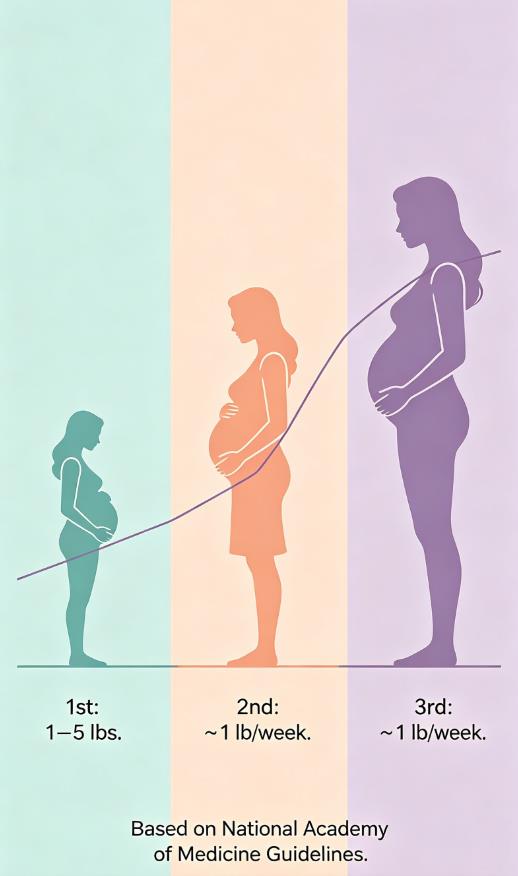
Most women gain just 1 to 4.5 pounds total during the first trimester. Some may stay the same weight, and others may even lose a few pounds due to morning sickness, food aversions, or shifting appetite. This is not a cause for concern unless severe vomiting leads to dehydration or sustained weight loss, which should be discussed with your provider.
One of our dietitians who specializes in prenatal nutrition often tells her patients: "The first trimester is about getting through the day, not eating perfectly." If you can only tolerate crackers and ginger ale for a week, that's okay. A practical tip from our team: keep a small box of plain soda crackers on your nightstand. Eating one or two before getting out of bed can help settle the empty-stomach nausea that often hits first thing in the morning. Your baby is very small at this stage and will get the nutrients they need from your body's stores.
Your pre-pregnancy BMI sets the total weight gain goal, but there is no strict trimester-by-trimester BMI target to hit. The first trimester is about survival and adaptation—nourishing yourself as best you can through potential nausea and fatigue, taking prenatal vitamins, and establishing care with an obstetrician or midwife.
Second Trimester: Steady Weight Gain Linked to Pre-Pregnancy BMI
The second trimester is when weight gain becomes more consistent for most pregnant women. For those carrying a single baby and starting from a healthy pre-pregnancy BMI, a gradual gain of 0.5 to 1 pound per week is typical. Women with a higher pre-pregnancy BMI may gain at a slower weekly rate, while those who were underweight may gain slightly faster—both patterns are physiologically appropriate when aligned with their respective total gain targets.
According to ACOG guidelines, the recommended weekly weight gain rates in the second and third trimesters are: underweight (1.0–1.3 lbs/week), normal weight (0.8–1.0 lbs/week), overweight (0.5–0.7 lbs/week), and obese (0.4–0.6 lbs/week). These ranges are not rigid—some weeks you'll gain a bit more, some a bit less. That's entirely normal. Your body is adapting to nourish your growing baby, and small week-to-week shifts are nothing to stress over. What matters is the overall trajectory, not any single weigh-in.
A common myth we hear all the time is that you need to "eat for two" during pregnancy. In reality, you only need an extra 340 calories per day in the second trimester and 450 calories per day in the third trimester—about the equivalent of a glass of milk and half a sandwich. Think of your plate as your baby's first home—fill it with colorful vegetables, quality proteins, and whole grains to give them the best possible start.
Third Trimester: Final Stages and Weight Gain Patterns
"My weight jumped by 3 pounds this week—is something wrong?" As you enter the home stretch, it's common to feel more aware of every pound. But late-pregnancy weight shifts are rarely about fat gain alone. Mild water retention—edema—is extremely common in these final weeks, particularly in the ankles and feet, and can temporarily shift the scale upward. This fluid accumulation is hormonal and circulatory in origin, not a sign that you're overeating.
The third trimester generally continues the steady gain pattern established in the second trimester, though you'll likely notice the increase more as your baby grows larger. Your pre-pregnancy BMI still guides the total weight gain goal, but every person's body responds differently to late pregnancy. Some women will track closely with the CDC-ACOG guidelines, while others will finish slightly above or below—and both outcomes can be perfectly healthy, provided your care provider confirms that you and your baby are doing well. Weight gain is not linear, and the third trimester is not the time for restrictive dieting. It's the time for final preparation, rest, and trusting the process your body has been building for nine months.
Special Considerations That May Adjust These Guidelines
The CDC-ACOG weight gain targets above apply to single-baby pregnancies. For twin pregnancies, the CDC recommends: underweight (28–40 lbs total), normal weight (37–54 lbs total), overweight (31–50 lbs total), and obese (25–42 lbs total). The weekly gain rate in the second and third trimesters is approximately 1.5 lbs for most twin pregnancies—significantly higher than for single-baby pregnancies. Women carrying multiples should follow the specific guidance of their maternal-fetal medicine specialist or obstetrician.
Women with pre-existing conditions such as type 1 or type 2 diabetes, chronic hypertension, or a history of bariatric surgery may receive individualized targets from their specialist care team. Gestational diabetes diagnosed during pregnancy also warrants tailored nutritional guidance from a registered dietitian.
If you are pregnant and have a history of eating disorders, frequent weigh-ins and fixation on BMI numbers can trigger harmful thoughts and behaviors. Work openly with your prenatal care provider and a mental health professional to find a monitoring approach that protects both your physical and emotional health.
Key Takeaways for BMI for Pregnant Women First Second Third Trimester
Pre-pregnancy BMI is the primary metric. It establishes your total weight gain goal. BMI calculated during pregnancy is rarely used because weight gain is an expected, healthy part of gestation.
Weight gain is personal. There is no universal number that fits every pregnant woman. Your target depends on your starting BMI, your health history, and whether you're carrying multiples.
Mild fluctuations are normal. Morning sickness, appetite changes, water retention, and the natural rhythm of fetal growth all contribute to week-to-week variation. A single weigh-in tells you very little; the trajectory over time matters more.
Follow your provider's guidance. Remember, these are general guidelines. Every pregnancy is different, and your provider will adjust these recommendations based on your unique health situation.
Understanding BMI for pregnant women first second third trimester is simply a way to stay informed, not a rigid set of rules to follow. Focus on eating nourishing foods, moving gently if your provider approves, staying hydrated, and listening to your body. These small, kind choices are what truly support a healthy pregnancy for you and your baby.
Postpartum Weight Recovery: What to Expect
After giving birth, most women lose about 10–13 pounds immediately—including the baby, placenta, and amniotic fluid. The remaining weight is typically lost gradually over the next 6–12 months. Breastfeeding can support gradual weight loss by burning an additional 300–500 calories per day, while also providing optimal nutrition for your baby. Aim for a slow, steady loss of 1–2 pounds per week, and avoid crash dieting, especially while breastfeeding. Always consult your healthcare provider before starting any weight loss program after birth.
A small tip from our team: One of our prenatal wellness coaches recommends setting a gentle "water alarm" on your phone—not just to remind you to drink, but to pair it with a 30-second stretch every time it goes off. It tackles hydration and the effects of prolonged sitting in one simple habit, and many new mothers find it carries over beautifully into the postpartum months when self-care can feel hard to come by.
Content Integrity Standard: All prenatal weight gain recommendations, trimester-specific guidance, and pre-pregnancy BMI classifications in this article are sourced from CDC 2025 maternal weight gain guidelines, ACOG 2024 prenatal care recommendations, and WHO maternal health standards. All health claims are based on peer-reviewed research and publicly available clinical guidelines. This article is for educational purposes only. It does not replace personalized prenatal care from a qualified obstetrician, midwife, or other licensed healthcare provider. Always follow the specific guidance of your own care team during pregnancy.
Prepared using CDC maternal weight gain guidelines, ACOG prenatal care recommendations, and WHO maternal health standards.
Sources
CDC: Healthy Weight During Pregnancy — Guidelines by Pre-Pregnancy BMI Category (2025)
WHO: Maternal Health — Standards for Antenatal Care and Healthy Gestational Weight Gain
Frequently Asked Questions
Should I calculate my BMI during pregnancy?
Medical providers generally do not calculate BMI during pregnancy because weight gain is a normal, expected part of fetal development. Your pre-pregnancy BMI is used as a baseline to determine your total weight gain target. Tracking weekly BMI throughout gestation is not recommended and can create unnecessary stress.
How much weight should I gain in the first trimester if my pre-pregnancy BMI is in the healthy range?
For women with a pre-pregnancy BMI of 18.5–24.9, first-trimester weight gain is usually mild—about 1 to 4.5 pounds total. Some women gain nothing or lose a small amount due to morning sickness, which is generally not a concern unless it leads to dehydration or sustained weight loss.
What if I'm gaining more or less than the recommended amount in the second trimester?
Week-to-week variation is normal. If your overall trajectory is significantly above or below the CDC-ACOG guidelines for your pre-pregnancy BMI category, your care provider may adjust your nutritional plan or investigate underlying factors such as fluid retention, gestational diabetes, or inadequate calorie intake. A single off-pattern week is not a reason to panic.
Do the same weight gain guidelines apply to twin pregnancies?
No. For twin pregnancies, the CDC recommends higher total weight gain targets: underweight (28–40 lbs), normal weight (37–54 lbs), overweight (31–50 lbs), and obese (25–42 lbs), with a weekly gain rate of approximately 1.5 lbs in the second and third trimesters.
Can I lose weight during pregnancy if my pre-pregnancy BMI was in the obese category?
Intentional weight loss during pregnancy is not recommended without direct medical supervision. Some women with obesity may gain little or no weight under careful provider monitoring, but any calorie restriction must be guided by a registered dietitian to ensure the baby receives adequate nutrition.
Standard Population Guidance
For women with pre-pregnancy underweight (BMI below 18.5): A higher total weight gain of 28–40 pounds is recommended to support adequate fetal growth and reduce the risk of low birth weight.
For women with pre-pregnancy obesity (BMI 30.0 and above): A more modest total gain of 11–20 pounds is recommended. Close monitoring for gestational diabetes and hypertensive disorders is standard.
For women carrying multiples: Weight gain targets increase significantly—for twins, normal weight women should aim for 37–54 pounds total. Follow the specific guidance of your maternal-fetal medicine specialist.
For women with a history of eating disorders: Frequent weigh-ins can trigger harmful behaviors. Discuss a monitoring plan with your prenatal care provider and a mental health professional before starting any self-tracking routine.
For women with gestational diabetes: Weight management should be guided by a registered dietitian in coordination with your obstetrician. Calorie needs differ from standard pregnancy guidelines.
BMI Calculator Blog. This content is provided for educational and informational purposes only. We encourage sharing with proper attribution to our site. Unauthorized commercial use is prohibited. Medical Disclaimer: The content of this article is for informational purposes only and does not replace professional medical advice, diagnosis, or treatment. Always seek the advice of a qualified obstetrician, midwife, or other licensed healthcare provider with any questions regarding your pregnancy or prenatal health.