Quick Take: High BMI health risks are the increased likelihood of developing chronic diseases when body mass index stays at 30 or above. The CDC and WHO link obesity to type 2 diabetes, heart disease, stroke, and at least 13 types of cancer. These risks are not automatic — they accumulate over time. Even a 5–10% weight loss can significantly reduce them.
TL;DR — What are high BMI health risks?
High BMI health risks are the elevated odds of developing serious chronic conditions when body weight exceeds what's healthy for your height. The CDC defines overweight as a BMI of 25.0–29.9 and obesity as a BMI of 30.0 or higher, further divided into Class 1 (30.0–34.9), Class 2 (35.0–39.9), and Class 3 (40.0+).
The risks are not hypothetical. People with obesity are at increased risk for type 2 diabetes, coronary heart disease, stroke, hypertension, dyslipidemia, sleep apnea, osteoarthritis, and at least 13 types of cancer — including breast, colon, kidney, liver, and pancreatic cancers. The CDC reports that obesity-related cancers account for 40% of all cancers diagnosed in the U.S. each year.
Risk varies by ethnicity, age, and fat distribution. Asian populations face elevated metabolic risk at lower BMIs (WHO action points: 23 and 27.5). Adults 65+ may have a protective BMI range of 23–28. Waist circumference — above 40 inches (102 cm) for men, above 35 inches (89 cm) for women — is an independent risk factor regardless of BMI.
Quick Reference: BMI Categories and Health Risks
| BMI Range | Category | Relative Health Risk |
|---|---|---|
| Below 18.5 | Underweight | Increased risk of nutrient deficiencies |
| 18.5–24.9 | Healthy Weight | Lowest risk of weight-related diseases |
| 25.0–29.9 | Overweight | Moderately elevated metabolic risk |
| 30.0–34.9 | Class 1 Obesity | Significantly elevated chronic disease risk |
| 35.0–39.9 | Class 2 Obesity | High risk of diabetes, heart disease, and cancer |
| 40.0+ | Class 3 Obesity | Very high risk of severe health complications |
Most people know a high BMI isn't ideal. Few understand exactly what it means for their body over time. Here's what the evidence says — organized by the conditions most strongly linked to excess weight.
What Counts as a High BMI?
The CDC classifies adult BMI into four categories: underweight (below 18.5), healthy weight (18.5–24.9), overweight (25.0–29.9), and obesity (30.0 and above). The obesity category is further divided into Class 1 (30.0–34.9), Class 2 (35.0–39.9), and Class 3 (40.0 and above). The World Health Organization uses the same core thresholds — 18.5, 25, and 30 — and adds further gradations for thinness and severe obesity.
According to the CDC, some BMI categories are associated with health problems, and a BMI in the obesity category often indicates excess weight for height — too much weight can increase risk for high blood pressure, high cholesterol, and other chronic conditions. Routine BMI tracking over time is useful for detecting trends. Use a BMI calculator to get your baseline.
Cardiovascular Disease: The Strongest Link
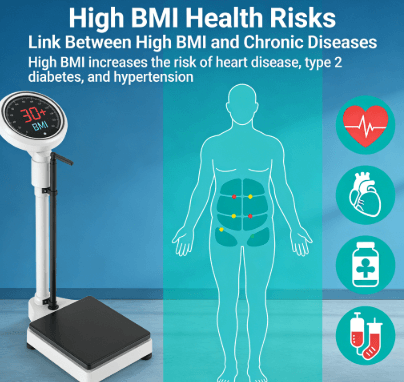
When people find out their BMI is too high, heart health is often their first worry — and for good reason. The cardiovascular system is one of the earliest and most frequent targets of excess weight. High BMI is most tightly linked to heart disease and stroke. The WHO identifies overweight (BMI ≥25) as a major determinant of coronary heart disease and stroke. The CDC notes that people with BMIs in the obesity category are at increased risk for high blood pressure, high cholesterol, coronary heart disease, and stroke.
Why this happens: excess body fat — particularly visceral fat around the organs — triggers inflammation, raises blood pressure, and disrupts lipid metabolism. According to the NIH, excess body fat can increase fat and cholesterol levels in the blood, raising the risk of heart disease and stroke. The relationship is continuous: risk doesn't start at a BMI of 30. Research shows that each 1-unit increase in BMI above the healthy range gradually elevates cardiovascular risk.
Action point: If your BMI is 25 or above, the CDC recommends having your blood pressure checked at least once a year and discussing lipid panel screening with your healthcare provider. These two simple tests reveal far more about your cardiovascular risk than BMI alone.
Type 2 Diabetes: The Most Direct Connection
Among all chronic conditions linked to high BMI, type 2 diabetes shows the strongest statistical association. The CDC identifies obesity as a primary risk factor for type 2 diabetes, with adults who have obesity facing significantly elevated risk compared to those at a healthy weight. The WHO reports that obesity is a major driver of type 2 diabetes globally, contributing to a significant proportion of cases.
The biological mechanism is well understood: excess body fat — especially visceral fat — increases insulin resistance. Fat cells release free fatty acids and inflammatory substances that interfere with insulin signaling. Over time, the pancreas struggles to produce enough insulin to overcome this resistance, and blood glucose rises. Weight loss directly reverses this process. The landmark NIH Diabetes Prevention Program study found that losing just 5–7% of body weight reduced the risk of developing type 2 diabetes by 58%.
Cancer: 13 Types Linked to Excess Weight
According to the CDC, being overweight or having obesity is associated with a higher risk of 13 types of cancer, which collectively make up 40% of all cancers diagnosed in the United States each year. These include adenocarcinoma of the esophagus, breast cancer (in postmenopausal women), colon and rectal cancer, uterine cancer, gallbladder cancer, upper stomach cancer, kidney cancer, liver cancer, ovarian cancer, pancreatic cancer, thyroid cancer, meningioma, and multiple myeloma. The CDC also reports that individuals who are overweight or have obesity are nearly twice as likely as healthy-weight individuals to develop adenocarcinoma of the esophagus and cancers of the gastric cardia, liver, and kidney.
The WHO warns that in some countries, obesity is predicted to overtake smoking as the main risk factor for preventable cancer. The biological pathways: excess body fat increases levels of estrogen and insulin, both of which can promote cell division and tumor growth. Chronic inflammation from excess fat tissue also contributes to DNA damage over time. A 2024 Cleveland Clinic study found that real-world weight loss was associated with a reduced risk of obesity-related cancers, with significant risk reductions observed for renal cell carcinoma, multiple myeloma, and endometrial cancer.
Other Conditions: The Full Picture
Beyond the three major disease categories, high BMI is linked to several other health conditions that significantly impact quality of life. The CDC lists these additional risks: sleep apnea and breathing problems, osteoarthritis due to joint stress, gallbladder disease, mental health conditions including depression and anxiety, body pain and difficulty with physical functioning, and all-cause mortality (early death). The WHO adds that obesity is also associated with musculoskeletal disorders and respiratory symptoms, and notes that the costs attributable to obesity are high — not only in terms of premature death and healthcare, but also in terms of disability and diminished quality of life.
Here's something our team has noticed: roughly 30% of the people who reach out to us about high BMI aren't initially concerned about diabetes or heart disease. They come to us because they can't sleep through the night, or their knees hurt when they climb stairs, or they feel winded playing with their kids. The conditions that erode quality of life often become the most powerful motivators for change — long before the long-term disease risks feel real.
Not All Fat Is Equal: Why Waist Circumference Matters
BMI doesn't tell you where fat is stored on your body — and location matters enormously for disease risk. Visceral fat, the kind wrapped around internal organs, is metabolically active. It releases inflammatory substances and fatty acids directly into the bloodstream. This leads to insulin resistance, high blood pressure, and unhealthy lipid levels. Subcutaneous fat, the fat sitting just under your skin, tends to carry much less metabolic risk.
This is why the NIH now recommends pairing BMI with waist circumference for a more complete risk picture. The thresholds: for men, a waist measurement above 40 inches (102 cm) signals elevated cardiometabolic risk; for women, above 35 inches (89 cm). Two people with identical BMIs can have dramatically different risk profiles depending on where their fat is stored. The Lancet Commission now recommends using at least two anthropometric measurements — BMI plus waist circumference, waist-to-hip ratio, or waist-to-height ratio — to accurately characterize obesity.
Who Faces Greater Risk: Ethnicity and Age Matter
The standard BMI thresholds don't apply equally to everyone. Two groups need adjusted interpretation.
Asian populations: The WHO recommends lower BMI cutoffs for Asian populations: overweight begins at 23, not 25, and obesity at 27.5, not 30. This is because Asian populations tend to carry a higher proportion of visceral fat and face elevated metabolic risk at lower BMIs. Research published in 2024 in the Annals of Internal Medicine confirmed that Asian Americans face a substantial risk for type 2 diabetes and cardiovascular disease at BMI levels considered "healthy" by Western standards. An Asian BMI calculator applies these adjusted cutoffs.
Older adults (65+): A 2024 study published in Aging Clinical and Experimental Research found that regardless of classic BMI or knee-height-based BMI estimation, overweight men and women aged 80 and older had lower mortality risk compared to normal-weight and underweight individuals of the same age group. For older adults, a BMI of 23–28 may be protective against frailty and falls. The standard 18.5–24.9 range — built on data from younger populations — may not apply.
Reducing High BMI Health Risks: What Works
One of our site visitors, a 48-year-old man, had a BMI of 33 and a waist circumference of 42 inches (107 cm). He had no obvious symptoms, but his blood work showed prediabetes. By losing just 12 pounds (5.4 kg) over 6 months through daily walking and swapping his evening snack for a piece of fruit, his blood sugar returned to normal and his diabetes risk dropped substantially — without a gym membership or a single crash diet. He told us the hardest part wasn't the walking — it was remembering to buy sparkling water at the grocery store instead of his usual 12-pack of soda.
BMI is modifiable. The CDC and WHO emphasize that even modest weight changes produce meaningful health benefits. Here's what the evidence supports:
Lose 5–10% of body weight. The CDC notes that even modest weight loss can significantly lower the risk of type 2 diabetes, high blood pressure, and other chronic conditions. For someone weighing 200 pounds (90.7 kg), that's 10–20 pounds (4.5–9 kg).
Get 150 minutes of moderate-intensity aerobic activity per week. The CDC recommends this as the minimum for adults, along with two days of muscle-strengthening activities. Brisk walking, cycling, and swimming all count.
Make your kitchen work for you. Try planning 2–3 meals per week that put vegetables and quality protein — fish, beans, chicken breast — at the center of the plate. Even this small shift can meaningfully improve markers of inflammation.
Measure your waist circumference alongside your BMI. A shrinking waist is a more immediate sign of improving metabolic health than a dropping BMI. Track it monthly.
Use a calorie calculator to find a sustainable daily target. Create a modest deficit of 300–500 calories per day for steady, maintainable weight loss.
Frequently Asked Questions
At what BMI do health risks become serious?
The CDC and WHO identify a BMI of 25.0 as the threshold where overweight begins and population-level health risks start to rise. A BMI of 30.0 — the obesity threshold — is associated with significantly elevated risk for type 2 diabetes, cardiovascular disease, and multiple cancers. However, risk increases gradually across the BMI spectrum — there is no single number where danger suddenly appears. Waist circumference and metabolic markers modify individual risk at any BMI.
How much weight do I need to lose to reduce my health risks?
The CDC notes that losing 5–10% of your body weight can produce clinically meaningful improvements in blood pressure, cholesterol, and blood sugar. The NIH Diabetes Prevention Program found that losing 5–7% of body weight reduced the risk of developing type 2 diabetes by 58%. Even if your BMI doesn't cross a category threshold, this amount of weight loss reduces disease risk.
Can you be healthy with a high BMI?
It depends on body composition and fat distribution. We know a recreational powerlifter with a BMI of 29 and 15% body fat — his metabolic markers are perfect. What protects him isn't the number on the scale. It's his high muscle mass and very low visceral fat. Pair your BMI with waist circumference: above 40 inches (102 cm) for men or 35 inches (89 cm) for women is an actionable signal regardless of what BMI says.
Are the risks different for Asian populations?
Yes. The WHO recommends lower BMI thresholds for Asian populations: overweight begins at 23, not 25, and obesity at 27.5, not 30. This is because Asian populations tend to carry more visceral fat at lower BMIs, raising the risk of type 2 diabetes and cardiovascular disease at numbers that read "healthy" by Western standards.
Does a high BMI affect older adults differently?
Yes. Research including a 2024 study in Aging Clinical and Experimental Research found that overweight adults aged 80 and older had lower mortality risk compared to normal-weight individuals of the same age. A BMI of 23–28 may be protective for adults over 65, providing metabolic reserve against frailty and illness. Weight loss in this age group should focus on preserving muscle mass rather than hitting a specific number.
All health claims in this article have been reviewed by our health editorial team, following the clinical review standards noted on this page.
Sources
WHO: Obesity and Overweight Fact Sheet — Global Health Risks
NIH NIDDK: Adult Overweight & Obesity — Health Risks and Weight Management
WHO: Obesity Causes Cancer — European Regional Obesity Report 2022
WHO Expert Consultation. Appropriate body-mass index for Asian populations and its implications for policy and intervention strategies. Lancet. 2004; 363(9403): 157-163.
CDC: Obesity and Cancer — 13 Cancers Linked to Excess Weight
This article is for informational and educational purposes only. It does not constitute medical advice, diagnosis, or treatment. Always consult a qualified healthcare provider regarding your individual health and weight goals. BMI is a screening tool only, not a diagnostic instrument. This site operates free calculators and does not sell health products.