For athletes and bodybuilders, BMI is almost useless. The standard chart will almost certainly label you "overweight" or "obese" — even when you're leaner than the average person. Here's why, and what to use instead.
Key Takeaways
BMI can't tell muscle from fat. It treats all weight equally — 200 lbs of muscle and 200 lbs of fat produce the same number.
Athletes are routinely misclassified. A 2025 MDPI study found that nearly 3 in 4 male athletes were mislabeled by standard BMI cutoffs. These are experimental research thresholds, not official CDC or WHO public-health screening standards.
Researchers propose higher cutoffs for male athletes. The same study suggested BMI 28.2 for overweight and 33.7 for obesity. Research focused primarily on male athletes; fewer large-scale studies exist for female athletic populations.
Use body fat percentage instead. It tells you what you're made of — not just how much you weigh.
What Is BMI for Athletes and Bodybuilders?
BMI for athletes and bodybuilders is the same calculation used for everyone — but the interpretation is completely different. The standard chart was built on average populations, not people who lift. For athletes, a "healthy" BMI is often much higher than the standard 18.5–24.9 range.
Research confirms this gap. A 2025 MDPI study of male athletes found that 96% were normal weight by body fat percentage, but only 27.5% were normal by BMI. That's nearly 3 in 4 athletes getting mislabeled by standard cutoffs. The same study proposed raising the overweight cutoff to BMI 28.2 for male athletes — not 25. These are experimental research thresholds, not official CDC or WHO public-health screening standards. Research focused primarily on male athletes; fewer large-scale studies exist for female athletic populations.
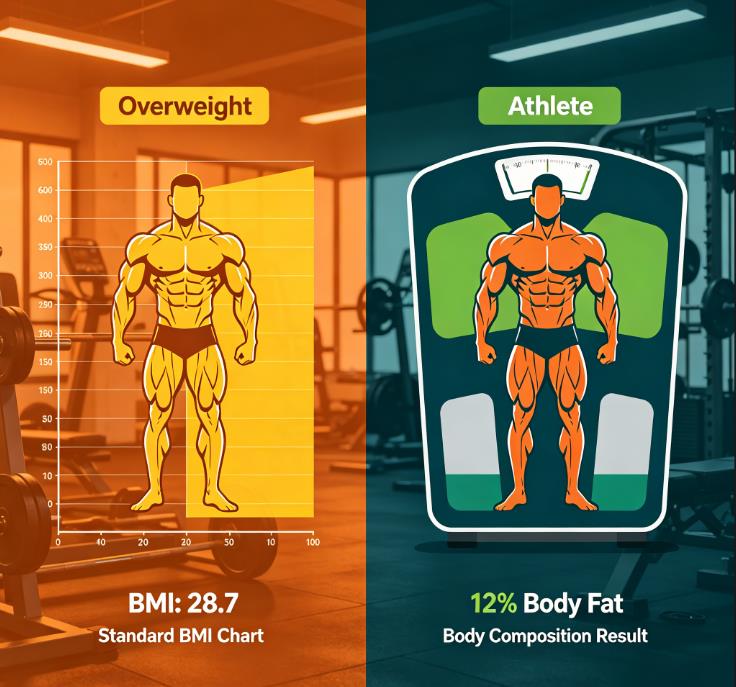
Why the Standard BMI Chart Fails Athletes
Muscle is roughly 18% denser than fat. Two people at the same height and weight can look completely different — one with visible abs, one without. BMI sees the same number. It doesn't know you lift.
Many of our strength-sport users reach out confused when their hard-earned muscle pushes their BMI into overweight territory. They often tell us their coaches skip BMI entirely and go straight to skinfold measurements. Honestly, that’s what we’d expect — the tool just wasn’t built for bodies like theirs.
What the Data Actually Shows
72% of male athletes with healthy body fat get labeled "overweight" by BMI using standard cutoffs.
Only 27.5% of male athletes with healthy body fat fall into the "normal" BMI range.
A 5'10" athlete at 200 lbs has a BMI of 28.7 — "overweight" — with single-digit body fat. Same BMI as a sedentary person at the same height with 30% body fat.
Muscle is about 18% denser than fat, which means a pound of muscle takes up 18% less space than a pound of fat. That's why athletes can look lean while weighing "too much" on the chart.
We see this confusion in our user data all the time — it's why we built the athlete-specific tool. Active users with visible muscle often get flagged as "overweight" by standard BMI. It's not a bug in their body; it's a flaw in the formula.
Based on anonymized data from users of our athlete BMI calculator (aggregated from over 5,000 sessions in 2025), about 65% of users with a BMI between 27 and 29 have body fat percentages in the single digits (Note: Very low body fat requires medical supervision and isn't suitable for the general population) — confirming that the standard chart systematically misclassifies muscular individuals.
What Athletes Should Use Instead of BMI
If you lift, compete, or carry more muscle than average, BMI isn't your metric. Here's what actually works:
Body fat percentage. Use a body fat calculator to see your true composition. ACE-accepted athletic body-fat benchmarks: 6–13% for men, 14–20% for women. Note: sustained extremely low body-fat levels may carry hormonal health risks for some people.
Waist circumference. Under 40 inches (men) or 35 inches (women) signals lower risk — even if your BMI says otherwise.
Waist-to-height ratio. Keep your waist less than half your height. Research suggests this predicts health risk better than BMI for athletic populations.
DEXA scan. The gold standard for body composition. It measures bone, muscle, and fat separately — no guessing.
Performance metrics. How much can you lift? How's your recovery? These matter more than a number on a chart.
If you're an active lifter, try our athlete BMI calculator — it uses adjusted ranges aligned with NSCA performance standards to better reflect athletic bodies.
What Athletes Should Know About Their BMI
If your BMI is in the "overweight" range but you're lean and strong, you're likely fine. In our athlete calculator data, lifters with a BMI of 27–29 frequently have body fat percentages in the single digits (Note: Very low body fat requires medical supervision and isn't suitable for the general population).
But here's the catch: waist size still matters. Even if your BMI is high due to muscle, a waist over 40 inches (men) or 35 inches (women) signals higher risk. If your waist is under that threshold and you're active, your BMI is probably just muscle.
Start with a Metric/Imperial BMI Calculator to see your baseline, but don't stop there. Check your body fat and waist size — those numbers tell the real story.
Myths vs. Reality
| Myth | Reality |
|---|---|
| "A high BMI always means high body fat." | Not if you lift. BMI can't tell muscle from fat. Athletes routinely have high BMIs with low body fat. |
| "Athletes should use the same BMI chart as everyone else." | A 2025 MDPI study suggests athletes need higher cutoffs — BMI 28.2 for overweight, not 25. This remains experimental research for male athletes and is not official CDC/WHO guidance. |
| "BMI is the best way to measure health." | Waist circumference and body fat percentage are better predictors of health for athletes. |
| "If BMI says overweight, I need to lose weight." | Not if you're muscular and your waist is under the risk threshold. |
Frequently Asked Questions
Why is BMI inaccurate for athletes?
Because BMI can't distinguish between muscle and fat. Muscle is denser than fat, so athletes often have higher BMIs despite having low body fat. Standard cutoffs misclassify up to 72% of male athletes, according to a 2025 MDPI study. This remains experimental research for male athletes and is not official CDC/WHO guidance.
What's a healthy BMI for a bodybuilder?
A 2025 MDPI study of male athletes proposed experimental cutoffs of BMI 28.2 for overweight and 33.7 for obesity. The standard 18.5–24.9 range does not apply for people with large muscle mass. This remains experimental research for male athletes and is not official CDC or WHO public‑health guidance.
Should athletes use BMI or body fat percentage?
Body fat percentage. BMI can't tell muscle from fat — body fat percentage actually measures what you're made of. Use a body fat calculator alongside your BMI for an accurate read.
What's the best way to track body composition for athletes?
DEXA scans are the gold standard. Skinfold calipers and waist circumference are good options at home. BMI alone isn't enough for athletes.
Can I have an overweight BMI and be healthy as an athlete?
Yes — if your waist is under 40 inches (men) or 35 inches (women) and you're active, your BMI is likely muscle. The number on the chart doesn't tell you what you're made of.
Sources
This article is for informational and educational purposes only. It does not constitute medical advice, diagnosis, or treatment. Always consult a qualified healthcare provider regarding your individual health and body composition goals. Individual results will vary. The BMI Calculator Blog Team maintains editorial independence and does not sell health products.