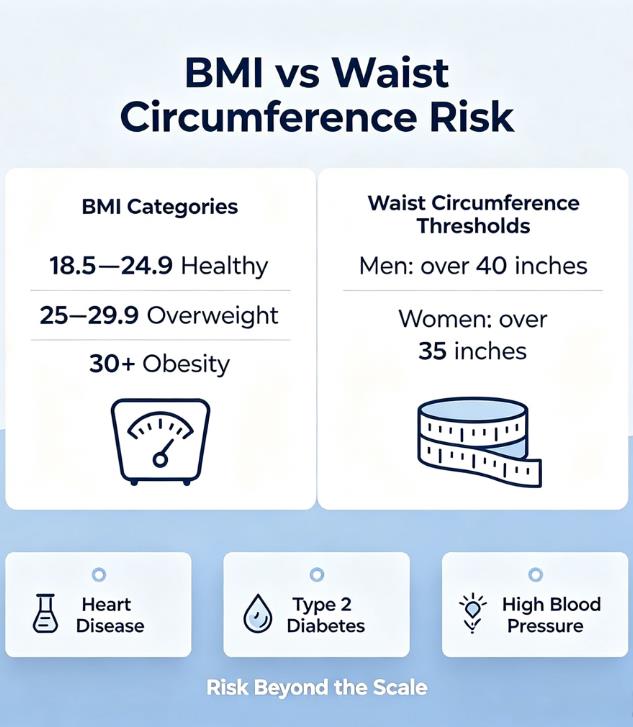
Quick Take: Your BMI number isn't just a label — it's a signal. A BMI above 25.0 raises your odds of type 2 diabetes, heart disease, and 13 cancers. Below 18.5 carries its own risks: weakened immunity and bone loss. The CDC and WHO classify disease risk across four BMI categories, and even a 5–10% weight shift changes your risk profile measurably. But here's what most people miss: up to 30% of adults with a "normal" BMI still carry dangerous visceral fat. Your waist measurement often tells a truer story than your BMI alone.
TL;DR — What is the link between BMI and chronic disease risk?
BMI is a screening number that signals where your weight falls relative to population risk data. The CDC defines four adult categories: underweight (below 18.5), healthy weight (18.5–24.9), overweight (25.0–29.9), and obesity (30.0 and above). Each step up — or down — changes your statistical odds of developing chronic conditions.
The risk isn't just about obesity. A BMI below 18.5 is linked to higher mortality from respiratory disease and weakened immune function. A BMI of 25.0–29.9 already raises diabetes risk. Above 30.0, the risk curves steepen for cardiovascular disease, several cancers, and metabolic syndrome.
BMI alone misses about 20% of people at risk. Up to 30% of adults with a "normal" BMI carry excess body fat — a condition called normal-weight obesity. That's why the NIH recommends pairing BMI with waist circumference for a clearer picture.
Quick Reference: BMI Categories and Chronic Disease Risk
| BMI Category | BMI Range | Key Chronic Disease Risks |
|---|---|---|
| Underweight | <18.5 | Osteoporosis, weakened immunity, cardiovascular disease |
| Healthy Weight | 18.5–24.9 | Lowest risk of weight-related chronic conditions |
| Overweight | 25.0–29.9 | Elevated type 2 diabetes, hypertension risk |
| Obesity | ≥30.0 | High risk of heart disease, stroke, 13 types of cancer |
We've spent years building BMI tools and watching how people react to their results. The number on the screen isn't your destiny — but it's a signal you shouldn't ignore. Here's what the research actually says about each category and what you can do about it.
Prepared by the BMI Calculator Blog Editorial Team. Medically reviewed by Sarah Mitchell, MPH, Community Nutrition Specialist with 12 years of experience in adult weight management and chronic disease prevention. Content aligned with CDC adult BMI classification guidelines (2024), WHO international BMI and NCD risk standards, and NIH/NHLBI clinical assessment recommendations.
This guide uses BMI standards for adult populations in the United States, Canada, and Europe.

BMI and Chronic Disease Risk: What the Research Actually Shows
BMI — Body Mass Index — is a single number calculated from your weight and height: weight in kilograms divided by height in meters squared (kg/m²). The CDC classifies the result into four categories for adults aged 20 and older. These categories aren't arbitrary. They're based on decades of population data linking BMI ranges to the likelihood of developing chronic, noncommunicable diseases.
The CDC states that too much weight can increase the risk for high blood pressure, high cholesterol, and other chronic conditions. BMI is one measure that an individual can use — alongside their healthcare provider — to help determine chronic disease risk. It's a screening tool, not a diagnostic one. But the correlation between rising BMI and rising disease burden is one of the most replicated findings in public health.
Before you do anything else, know your starting point. Use a Free BMI Calculator to get your number and category. Then come back here to understand what that category means for your long-term health.
The Four BMI Categories and Their Disease Risk Profiles
Each BMI category carries a different statistical risk profile. These are probabilities drawn from large population studies — not guarantees for any single person. But they're the best screening data we have.
Underweight: BMI Below 18.5
Most conversations about BMI focus on excess weight. But a BMI below 18.5 carries its own set of risks. The WHO classifies underweight as a BMI below 18.5, with a BMI below 17.0 indicating moderate to severe thinness. About 3–5% of a healthy adult population falls into this range naturally. When low BMI results from inadequate nutrition rather than natural body type, the health consequences are measurable.
Research shows that underweight adults face a 19.7% greater risk of cardiovascular disease compared to normal-weight individuals. A census-linked cohort study of over 31,000 individuals followed for up to 32 years found that underweight was associated with increased all-cause mortality. The risks extend beyond the heart: underweight individuals have higher rates of osteoporosis, weakened immune function, and nutrient deficiencies that can lead to anemia and hormonal imbalances. Each 1-unit increase in BMI is associated with a 9% reduction in osteoporosis risk — underscoring how even modest weight gain in the underweight range can protect bone health.
For this group, the goal isn't just gaining weight. It's building healthy muscle mass and ensuring adequate nutrient intake. Greek yogurt, nut butters, lean proteins, and healthy fats added to existing meals can shift BMI upward without relying on processed foods.
Healthy Weight: BMI 18.5 to 24.9
This is the range most strongly associated with the lowest risk of weight-related chronic conditions. The CDC and WHO both designate 18.5–24.9 as the healthy weight category. But here's what most people miss: "healthy" in this context is a statistical average. It doesn't mean you're in the clear.
In my 12 years working with adults on weight management, I've seen too many people with a "perfect" BMI of 22 who have high blood pressure and elevated cholesterol because they carry all their fat around their middle. That's why I always emphasize: your waist measurement tells a better story than your BMI number alone.
Up to 30% of people with a BMI in this range actually carry elevated body fat when measured by more precise methods — a condition called normal-weight obesity. Research published in 2025 found that individuals with normal-weight obesity had over threefold increased odds of systemic inflammation compared to those with normal BMI and normal body fat. Another 2025 study of 11,499 U.S. adults found that metabolically unhealthy status correlated with high cardiovascular disease risk among overweight and obese individuals — but not in normal-weight individuals. The takeaway? BMI alone can misclassify risk. Even if your number sits in the green zone, your body composition and metabolic health markers matter just as much.
Overweight: BMI 25.0 to 29.9
The overweight category is where population-level disease risk starts to climb measurably. This risk increase is not theoretical — large datasets have confirmed it repeatedly. The WHO states that a BMI ≥25 signifies overweight and is a major determinant of many noncommunicable diseases, including type 2 diabetes, coronary heart disease, and stroke. The CDC notes that people who have overweight or obesity, compared to those with healthy weight, are at increased risk for many serious diseases and health conditions.
Each 1-unit increase in BMI above 18.5 significantly elevates the risk of type 2 diabetes. For cardiovascular disease, a 2025 NHANES analysis found that metabolically unhealthy status was associated with substantially higher odds of prevalent CVD in overweight individuals compared to metabolically healthy individuals in the same BMI range. The risk is modifiable — the CDC notes that even modest weight loss of 5–10% of body weight can significantly lower these risks.
Obesity: BMI 30.0 and Above
A BMI of 30 or greater defines obesity in both the CDC and WHO classification systems. The WHO notes that a BMI ≥30 signifies obesity, which is a disease that is largely preventable through lifestyle changes. The CDC states that obesity is a complex chronic disease — too much body fat can cause inflammation and other long-lasting metabolic changes in the body.
Now, let's talk about the diseases associated with this range. The list is long: high blood pressure, high cholesterol, high triglycerides, type 2 diabetes, heart disease, stroke. Add to that many types of cancer — the CDC reports that being overweight or obese nearly doubles the likelihood of developing adenocarcinoma of the esophagus and cancers of the gastric cardia, liver, and kidney. The International Agency for Research on Cancer recognizes obesity as a cause of at least 13 different cancer types. You'll also see higher rates of chronic kidney disease, sleep apnea, and osteoarthritis.
Obesity is further divided into three classes: Class 1 (30.0–34.9), Class 2 (35.0–39.9), and Class 3 (40.0 and above). Risk gradients increase across these classes, but individual factors — fat distribution, physical activity level, metabolic health — modulate the actual risk for any given person.
Why Waist Circumference Matters as Much as BMI
Core Principle: Your waist measurement often tells a truer story than your BMI number alone.
BMI tells you how much you weigh relative to your height. It doesn't tell you where the fat sits on your body — and that location matters enormously for disease risk. Think of visceral fat as an unruly chemical plant: it continuously dumps inflammatory substances and fatty acids directly into your bloodstream, slowly polluting your cardiovascular system over time.
The NIH clinical guidelines recommend measuring waist circumference within BMI categories as a screening tool for increased health risk. High waist circumference is an independent risk factor for cardiovascular disease and all-cause mortality regardless of BMI. The Mayo Clinic notes that weight-related health conditions are more common in men with a waist circumference over 40 inches (102 cm) and in women with a waist over 35 inches (89 cm).
A 2025 study of 158,699 adults found that waist circumference was the adiposity marker most strongly associated with all-cause and cardiovascular disease mortality — even after excluding the first 10 years of follow-up. The WHO established high-risk waist circumference thresholds at over 102 cm for men and over 88 cm for women. If your BMI is in the healthy range but your waist measurement exceeds these cutoffs, your disease risk profile may resemble someone in a higher BMI category.
To measure your waist: place a flexible tape measure around your bare abdomen at the level of your navel, at the end of a normal exhale. Don't pull the tape tight enough to compress the skin. Record the number and track it every 1–2 months.
Special Populations: When Standard BMI Cutoffs Don't Apply
The standard BMI categories work for most adults aged 20–64, but several groups need adjusted interpretation. Applying the wrong thresholds can either falsely reassure or unnecessarily alarm.
Asian adults. The WHO recommends lower BMI cutoffs for Asian populations: overweight begins at 23 instead of 25, and obesity at 27.5 instead of 30. Asian populations tend to carry a higher proportion of visceral fat and face elevated metabolic risk at lower BMIs. Research published in 2025 on Asian Indians found that the incremental risk of type 2 diabetes started at a BMI as low as 18.5 kg/m², with each 1-unit increase in BMI elevating risk by 28%. If you're of Asian descent and your BMI reads 24, don't assume you're in the clear — by population-specific standards, that's already in the overweight zone. An Asian BMI calculator applies these adjusted thresholds.
Adults 65 and older. The standard BMI ranges were developed primarily using data from younger and middle-aged adults. Research on older populations tells a different story. A meta-analysis published in the American Journal of Clinical Nutrition found that for older populations, being overweight was not associated with increased mortality risk. Instead, mortality risk increased at the lower end of the recommended BMI range — specifically below 23.0. A 2025 study of older Chinese adults found that weight loss at older ages was associated with higher mortality. For adults over 65, a BMI of 23–28 may be more protective than a BMI of 18.5–21.
Athletes and highly muscular individuals. BMI cannot distinguish between muscle and fat. Bodybuilders, strength athletes, and physically active individuals with high lean body mass frequently land in the overweight or obese BMI categories while maintaining healthy — sometimes exceptionally low — body fat percentages. In these cases, BMI overestimates risk. Pair BMI with waist circumference and body fat measurement for a more accurate assessment.
Pregnant individuals. Only pre-pregnancy BMI should be used to determine healthy weight gain targets. Current BMI during pregnancy does not reflect pre-pregnancy body composition and is not clinically meaningful for disease risk assessment.
For a deeper breakdown of how different BMI categories map to heart-specific risks, see our guide on BMI heart disease risk.
Reducing Your Risk: What the Evidence Says Works
BMI is modifiable. The CDC and WHO emphasize that even modest weight changes produce meaningful health benefits. Here's what the evidence supports, along with a real example that illustrates the point.
Losing 5–10% of body weight produces clinically significant improvements in blood pressure, cholesterol, and insulin sensitivity. The CDC states that losing this amount of weight can lower the risk of developing type 2 diabetes and other chronic conditions. For instance, one of our users found that simply swapping his nightly chips for a handful of almonds and adding a 15-minute walk after lunch trimmed 2 inches off his waist in three months — and his fasting blood sugar normalized.
150 minutes of moderate-intensity aerobic activity per week — brisk walking, cycling, swimming — reduces cardiovascular disease risk and helps maintain weight loss. The CDC recommends this as the minimum for adults in the Physical Activity Guidelines for Americans, along with two days of muscle-strengthening activities.
Waist circumference reduction matters independently of weight loss. Even if your BMI doesn't shift dramatically, losing abdominal fat — reflected in a shrinking waist measurement — reduces cardiometabolic risk.
Diet quality counts more than calorie counting alone. The CDC identifies poor nutrition and physical inactivity as significant risk factors for obesity and other chronic diseases, including type 2 diabetes, heart disease, stroke, and certain cancers.
For underweight individuals, the goal is building muscle mass and ensuring adequate nutrient intake — not just eating more calories. Combining protein-rich foods with resistance training supports healthy weight gain and bone density.
Frequently Asked Questions
My BMI is high — does that really mean I'm more likely to get sick?
Statistically, yes. The CDC states that a higher BMI is associated with increased risk for high blood pressure, high cholesterol, type 2 diabetes, heart disease, stroke, and certain cancers. According to the CDC, a BMI reduction of 1–2 points over 3–6 months is considered safe and sustainable. The relationship is continuous — meaning risk starts to rise even within the upper end of the healthy weight range. But BMI is a screening flag, not a diagnosis. Your waist circumference, blood work, and lifestyle habits all modify your actual risk.
Which chronic diseases are most strongly linked to high BMI?
Type 2 diabetes shows the strongest link — the WHO reports that obesity accounts for approximately 43% of type 2 diabetes cases. Cardiovascular disease (heart disease and stroke) is also strongly associated, as are at least 13 types of cancer, including endometrial, breast, colorectal, kidney, liver, and pancreatic cancers. High BMI also raises the risk of hypertension, dyslipidemia, sleep apnea, osteoarthritis, and chronic kidney disease.
This is a question I hear all the time: "Is BMI reliable for everyone?"
The honest answer: not entirely. BMI does not account for body composition, fat distribution, age, or ethnicity. Athletes with high muscle mass may have a high BMI but low disease risk. Asian populations face elevated risk at lower BMIs — the WHO recommends overweight begin at 23 for these groups. Older adults may benefit from a slightly higher BMI. The NIH recommends pairing BMI with waist circumference and individual risk factor assessment for a complete picture.
If my BMI is "normal," am I off the hook?
Not necessarily. We've been tracking the latest research, and a 2025 study confirmed what many nutrition specialists had observed for years: up to 30% of people with a healthy BMI carry excess body fat — a condition called normal-weight obesity — and face increased cardiometabolic risk. These individuals had over threefold increased odds of systemic inflammation. Waist circumference and body fat percentage provide additional risk information that BMI alone misses.
How much weight do I need to lose to actually reduce my disease risk?
The CDC notes that losing 5–10% of your body weight can produce clinically meaningful improvements in blood pressure, cholesterol, and blood sugar. For someone weighing 200 pounds (90.7 kg), that's 10–20 pounds (4.5–9 kg). Even if your BMI doesn't cross a category threshold, this amount of weight loss reduces disease risk. The benefits come from losing fat — particularly visceral fat — not from hitting a specific number on the scale.
My BMI is below 18.5 — should I be concerned?
It depends on the reason. If your low BMI is your natural body type and you have good energy, normal immune function, and healthy bone density, it may not be a problem. But if it results from inadequate nutrition, the risks are real: osteoporosis, weakened immunity, and nutrient deficiencies. The WHO notes that a BMI below 17.0 — moderate to severe thinness — has been linked to increased illness across multiple continents. Focus on nutrient-dense foods and resistance training to build muscle mass and bone density, not just eating more calories.
Sources
CDC: Adult BMI Categories — Underweight, Healthy Weight, Overweight, and Obesity
WHO: Obesity and Overweight Fact Sheet — BMI Classification and Chronic Disease Risk
CDC: Physical Activity Guidelines for Americans — Adult Recommendations
StatPearls/NIH: Physiology, Body Mass Index — Limitations and Special Populations
BMI Calculator Blog. This content is provided for educational and informational purposes only. Medical Disclaimer: The content of this article is for informational purposes only and does not replace professional medical advice, diagnosis, or treatment. Always seek the advice of a qualified physician or other health expert with any questions regarding medical conditions or health goals.