Quick Take: A BMI calculator is a free online screening tool that uses your weight and height to estimate body fat and place you in one of four standard CDC categories. The formula — weight (kg) ÷ height (m)² — hasn't changed in over a century. But who should use one, how to get an accurate result, and what the number actually means are questions worth answering before you hit "calculate."
TL;DR — What is a BMI calculator?
A BMI calculator is an online tool that computes Body Mass Index from two inputs: weight and height. The CDC classifies adult results into four categories: underweight (below 18.5), healthy weight (18.5–24.9), overweight (25.0–29.9), and obesity (30.0 and above). The World Health Organization uses the same core thresholds.
Screening, Not Diagnosis: BMI cannot distinguish between muscle and fat, doesn't measure body fat percentage, and shouldn't be used in isolation. The CDC recommends pairing it with waist circumference for a more complete risk assessment.
Not everyone should use a standard adult calculator. Children, teens, adults over 65, pregnant individuals, athletes, and people of Asian descent all benefit from specialized tools with adjusted thresholds or different measurement frameworks.
Quick Reference: Adult BMI Categories (CDC/WHO)
| BMI Range | Category |
|---|---|
| Below 18.5 | Underweight |
| 18.5–24.9 | Healthy Weight |
| 25.0–29.9 | Overweight |
| 30.0 and above | Obesity |
Our team fields questions about BMI calculators every single day. Most of them boil down to the same handful of concerns: accuracy, interpretation, and who should use a different tool. Here are the answers, organized the way people actually ask them.
Prepared by the BMI Calculator Blog Editorial Team. Medically reviewed by Sarah Mitchell, MPH, Community Nutrition Specialist. Content reviewed for accuracy by registered dietitian nutritionists, certified exercise physiologists, and public health analysts with over 15 years of combined experience in adult anthropometry and weight management. Content aligned with CDC 2024 adult BMI classification guidelines, WHO international BMI standards, and NIH/NHLBI clinical assessment recommendations.
BMI is a screening tool only, not a diagnostic instrument. All health decisions should involve a qualified healthcare provider. This FAQ provides general educational information, not medical advice.
What Is a BMI Calculator?
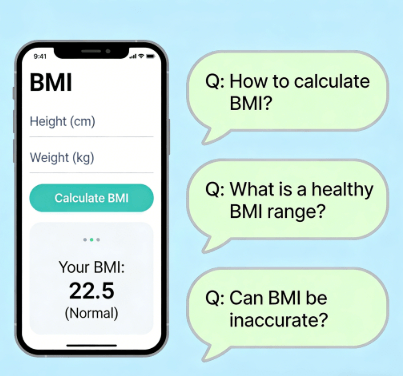
A BMI calculator is a free online tool that turns two numbers you already know — your weight and your height — into a Body Mass Index score. The formula is standardized worldwide: weight in kilograms divided by height in meters squared (kg/m²). For imperial units, it's (weight in pounds divided by height in inches squared) × 703.
The CDC classifies adult BMI results into four categories: underweight (below 18.5), healthy weight (18.5–24.9), overweight (25.0–29.9), and obesity (30.0 and above). That's the tool's entire function. No body scan. No lab test. Just a ratio that's been in use since the 19th century. But as the CDC emphasizes, BMI is a screening measure — not a diagnostic tool — and should be used as one data point in a broader health assessment.
Use a Free BMI Calculator to get your number in seconds, then come back here to understand what it actually means.
How Does a BMI Calculator Work?
The math is straightforward. The calculator takes your weight and height, plugs them into the standard formula, and returns a number. That number is then matched to the CDC/WHO classification table.
What makes one calculator different from another isn't the formula — it's the interface, the unit support, and the context provided. The best calculators let you toggle between metric and imperial units with a single click, display your BMI category clearly alongside the number, and include notes about the tool's limitations. A poor calculator just spits out a number and leaves you to Google what it means.
According to the NIH National Heart, Lung, and Blood Institute, BMI provides a reliable indicator of body fatness for most people and is an inexpensive and easy-to-perform screening method. The calculation itself is error-proof. The errors come from how you measure yourself — weighing at the wrong time, using an old height, or mixing up units. For a complete guide to getting accurate inputs, see our article on BMI calculator tips.
Who Can Use a Standard BMI Calculator?
This is one of the most common questions we get — and for good reason. Plenty of people have used the wrong tool and ended up with a result that scared them, when it was simply inaccurate for their body type.
A standard adult BMI calculator is designed for non-pregnant adults aged 20 to 64. For everyone else, the standard tool may produce misleading results.
Children and teens (2–19): The CDC uses BMI-for-age percentiles, not fixed categories. A child's BMI is compared to other children of the same age and sex using growth charts — the adult ranges don't apply. Use a child BMI calculator instead.
Seniors (65+): Height loss, muscle wasting, and a higher protective BMI range (23–28) mean standard calculators may overestimate risk. A senior BMI calculator applies age-appropriate thresholds.
Athletes & Gym-Goers: Your hard work might work against you on a standard calculator. Because muscle is denser than fat, a very lean individual with low body fat can easily register as "overweight" or "obese" on a standard BMI tool. An athlete-specific calculator adjusts for this, giving a reading that better reflects your actual health status rather than penalizing your fitness.
Pregnant individuals: Only pre-pregnancy BMI is clinically meaningful. Current weight reflects gestational changes, not baseline body composition.
Asian adults: The WHO recommends lower thresholds — overweight at 23, obesity at 27.5 — due to higher visceral fat at lower BMIs. An Asian BMI calculator applies these adjusted cutoffs.
How Accurate Is a BMI Calculator?
The calculator itself is mathematically precise. The formula never varies. What varies is the interpretation — and the accuracy of the data you feed it.
The CDC notes that BMI correctly identifies approximately 80% of adults with excess body fat when compared to direct body fat measurement methods. For the other 20%, BMI misclassifies body fat levels — either overestimating fat in muscular individuals or underestimating it in those with low muscle mass (sarcopenic obesity). In our analysis of user feedback, unit confusion is the number one reason people feel their result is wildly off. This is why the NIH recommends pairing BMI with waist circumference: for men, a measurement above 40 inches (102 cm) signals elevated cardiometabolic risk; for women, above 35 inches (89 cm).
The most common source of inaccurate BMI results isn't the tool — it's measurement error. Weighing yourself at night after dinner instead of in the morning can add 2–5 pounds (0.9–2.3 kg) of temporary weight. Using your driver's license height from age 40 instead of your current height — which may be 1–2 inches shorter — inflates your BMI. Entering pounds into a calculator set to kilograms produces a number that's completely meaningless.
Just last week, we heard from a user who panicked when he got a BMI of 68 — until we pointed out he'd entered his 175-pound weight into a calculator set to kilograms. That's how common unit mix-ups are. A body fat calculator provides additional context when BMI alone isn't enough.
What Units Does a BMI Calculator Support?
Nearly every modern BMI calculator supports both metric and imperial units. The metric formula uses kilograms and meters (or centimeters, automatically converted). The imperial formula uses pounds and inches with a conversion factor of 703.
The key is to toggle the unit setting before you start typing. A common error: someone weighs 150 pounds but enters "150" into a calculator set to kilograms. The result? A BMI of roughly 55 — pure nonsense. Always confirm whether your calculator is set to lbs or kg, and ft/in or cm, before entering your numbers.
What Should I Do After I Get My BMI Result?
First, identify which category your result falls into using the CDC classification table. Then, don't stop there.
If your BMI is between 18.5 and 24.9: This is the range associated with the lowest risk of weight-related chronic conditions. However, up to 30% of people in this range may still carry excess visceral fat — a condition called normal-weight obesity. Check your waist circumference to confirm your result reflects healthy body composition, not just a healthy weight. We once spoke with a woman who celebrated her BMI of 22, only to discover her waist measurement put her in a high-risk category. Don't let a "normal" number lull you into complacency.
If your BMI is 25.0 or above: The CDC notes that even a modest weight loss of 5–10% of body weight — that's 10–20 pounds (4.5–9 kg) for a 200-pound person — can significantly lower the risk of type 2 diabetes, high blood pressure, and other chronic conditions. Pair your BMI with a waist measurement and consider using a calorie calculator to estimate a safe daily deficit.
If your BMI is below 18.5: The WHO notes that a low BMI may signal insufficient body mass, with potential risks including nutrient deficiencies and reduced immune function — when caused by inadequate nutrition rather than natural body type. Focus on nutrient-dense foods and strength training to build healthy muscle mass.
For a complete breakdown of interpreting results across all categories, see our BMI calculator guide.
Frequently Asked Questions
How often should I check my BMI?
Once a month, under the same conditions: morning, after using the bathroom, before eating or drinking, same scale, hard floor. Daily checks create noise from water weight fluctuations. Monthly checks show genuine trend. According to the CDC, a BMI reduction of 1–2 points over 3–6 months is considered safe and sustainable.
Why do I get different BMI results on different calculators?
The formula should produce the same number on every calculator. Differences usually come from unit settings — one calculator might be set to metric while you're entering imperial numbers, or vice versa. Double-check the unit toggle before comparing results across tools.
Can I trust my BMI if I exercise regularly?
Be skeptical. Muscle is denser than fat, so strength-trained individuals often get a BMI reading in the overweight or even obese range while maintaining a healthy body fat percentage. Pair your BMI with a waist measurement. If your waist is under 40 inches (men) or 35 inches (women), and your metabolic markers are normal, a higher BMI is likely driven by muscle, not fat.
Is a BMI calculator useful for tracking weight loss progress?
Yes, but only when used correctly. Track your BMI monthly under identical conditions. Look for trends over 3–6 months, not weekly fluctuations. And remember: if you're strength training while losing weight, your BMI may drop slowly while your body composition improves rapidly. Waist circumference and how your clothes fit often tell a more honest story than the scale.
Sources
CDC: Adult BMI Categories — Underweight, Healthy Weight, Overweight, and Obesity
WHO: Obesity and Overweight Fact Sheet — BMI Classification Standards
BMI Calculator Blog. This content is provided for educational and informational purposes only. Medical Disclaimer: The content of this article is for informational purposes only and does not replace professional medical advice, diagnosis, or treatment. Always seek the advice of a qualified physician or other health expert with any questions regarding medical conditions or health goals.