Here's what body fat percentage actually tells you — and what it doesn't. It's the proportion of your total weight that comes from fat, not muscle or bone. Unlike BMI, which just compares height and weight, body fat percentage gives you a direct look at your body composition. ACE healthy ranges are 25–31% for women and 18–24% for men (average non-athletes). DEXA is widely treated as the gold standard for accuracy, but skinfold calipers and BIA scales are more practical for home tracking. While BMI works for population screening, body fat percentage usually gives a clearer picture of your actual composition — especially for active individuals and older adults.
What Is Body Fat Percentage?
Body fat percentage is exactly what it sounds like: the proportion of your total body weight that's made up of fat tissue. If you weigh 150 pounds and carry 45 pounds of fat, your body fat percentage is 30%. The rest — muscle, bone, organs, water — is your lean mass.
Your body needs some fat to function. Essential fat stores energy, cushions organs, regulates hormones, and supports brain function. The question isn't whether you have fat — it's whether you have too much relative to your lean mass.
Need a baseline? Start with our BMI calculator — but remember, BMI and body fat percentage are not the same thing.
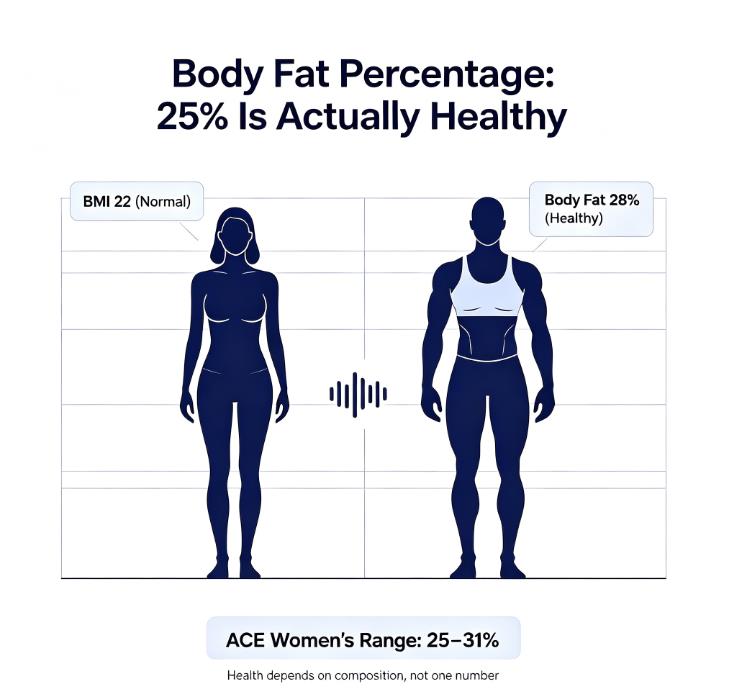
What's a Healthy Body Fat Percentage?
There's no single "ideal" number. It depends on your sex, age, and activity level. The American Council on Exercise (ACE) uses these widely accepted ranges:
| Category | Women | Men |
|---|---|---|
| Essential Fat | 10–13% | 2–5% |
| Athletes | 14–20% | 6–13% |
| Fitness | 21–24% | 14–17% |
| Acceptable (Average) | 25–31% | 18–24% |
| Obese | 32%+ | 25%+ |
A body fat below 14% for women or 6% for men is generally considered low enough that normal hormonal function can be affected. For context, the average American woman has about 39.9% body fat, and the average American man has about 28.1%, according to NHANES data.
Age shifts the numbers too. Women in their 20s typically have lower body fat than women in their 50s — and that's completely normal. ACE ranges don't adjust for age, which is one reason they're a starting point, not a final measure.
How to Measure Body Fat Percentage
Let's be straight: no home method is perfectly accurate. But some are better than others.
DEXA Scan (Most Accurate)
Dual-energy X-ray absorptiometry, or DEXA, is widely treated as the gold standard for body composition testing. It uses a three-compartment model — bone mineral, lean soft tissue, and fat mass — to scan your entire body. It's fast, low-radiation, and widely used in clinical and research settings. The catch? It costs money and you need to find a facility with a DEXA machine.
Skinfold Calipers (Practical)
A trained technician pinches skinfolds at specific sites (typically 3 to 7 spots) using calipers. It's portable and affordable, but accuracy depends heavily on technique. For very lean or very obese individuals, the precision drops off. Studies show calipers can be off by 5% or more compared to DEXA — sometimes more than 10% if the technique is off.
Bioelectrical Impedance Analysis (BIA) — Smart Scales
This is what most home scales use. You step on barefoot, and a safe electrical signal passes through your body. Fat resists the signal more than muscle, so the scale estimates your body fat percentage. It's fast and easy, but hydration, food intake, and even the time of day can throw off the reading. BIA tends to underestimate body fat compared to DEXA.
Walk into any gym and you'll see people stepping on smart scales, staring at the readout like it's the final word. It's not. These tools work great for tracking trends over time, but they cannot deliver a final verdict on your health.
For a more precise look at your numbers, try our body fat calculator — it estimates your percentage based on standard equations.
Body Fat Percentage vs. BMI: Which One Matters More?
BMI is a screening tool based solely on height and weight. It doesn't know if you're muscular or sedentary. Body fat percentage actually tells you what you're made of.
We see this in our own calculator data all the time: people with a "normal" BMI who carry too much fat around the middle. That's called normal-weight obesity, and it's more common than you'd think. Research shows that people with a "normal" BMI but high body fat face health risks similar to those who are visibly overweight.
From anonymized usage data across our calculator tools, roughly 1 in 4 people with a "normal" BMI show body-fat readings in the overweight range — this aligns with known normal-weight-obesity patterns. Meanwhile, about 1 in 3 users flagged as overweight by BMI fall into athletic or fitness-level body-fat ranges.
That doesn't mean BMI is useless. It's still a good population-level screening tool. But for individuals — especially athletes, older adults, and anyone with a muscular build — body fat percentage usually gives a clearer picture of your actual composition than BMI alone.
How to Use Your Body Fat Percentage
Put it to work like this: start with a baseline measurement using skinfold calipers, a BIA scale, or a DEXA scan if you can. Check your number against the ACE ranges above, then measure your waist at your navel — for women, over 35 inches (88 cm) is a risk signal; for men, over 40 inches (102 cm). Track trends, not single readings. Measure at the same time of day, under similar conditions, every 2–4 weeks. Consistency always beats perfect one-time precision.
Common Myths, Cleared Up
A common misconception is that BMI and body fat percentage are interchangeable. They aren't — BMI is height-to-weight, while body fat percentage measures fat-to-lean mass. Another myth: smart scales are perfectly accurate. In reality, BIA scales can drift 3–5% depending on hydration and time of day. Athletes don't always have low body fat either — linemen and throwers often carry more fat intentionally for performance. And you don't need to be in the "athlete" range to be healthy; the "fitness" and "acceptable" categories are perfectly fine for most people. Finally, thin doesn't always mean low body fat — normal-weight obesity is real, and scale weight alone won't catch it.
Frequently Asked Questions
I'm 45 and female. What should my body fat percentage be?
ACE ranges provide a general guide: 25–31% for average non-athlete women. But age matters — women over 50 naturally carry more fat due to hormonal changes. ACE ranges don't adjust for age, so older adults often do better with slightly higher numbers.
My BMI says I'm healthy, but I feel like I have more belly fat than I should. Which number should I trust?
Trust your waist measurement. The NIH says women over 35 inches and men over 40 inches face higher health risks — regardless of BMI. That's a stronger signal than either BMI or body fat percentage alone.
I want to lose fat but keep my muscle. What actually works?
Combine strength training (to preserve muscle) with a moderate calorie deficit and adequate protein — about 1.2–1.6g per kg of body weight. Cardio helps, but resistance training is what protects your lean mass while you lose fat. That's also why our calculator uses your waist size, not just weight — it catches fat loss even when the scale won't budge.
What's the most accurate way to measure body fat at home?
Skinfold calipers, if used correctly by someone trained, are the most practical accurate option. Smart scales (BIA) are convenient but less precise. For the gold standard, schedule a DEXA scan.
Sources
This article is for informational and educational purposes only. It does not constitute medical advice. Consider discussing your results with a qualified healthcare provider. Individual results will vary. The BMI Calculator Blog Team maintains editorial independence and does not sell health products.