The short version: Stepping on a scale won't tell you how much of your weight is muscle versus fat. This guide covers the most accurate ways to calculate body fat percentage – from simple tape measures to clinical DEXA scans. Learn which method fits your budget and lifestyle, how to interpret your results, and why body fat matters more than BMI for athletes, seniors, and anyone serious about health.
Editorial content by the BMI Calculator Blog team, drawing on expertise from registered dietitians and exercise physiologists. Sources: American Council on Exercise (ACE), National Institutes of Health (NIH), American College of Sports Medicine (ACSM).
Why body fat matters more than the number on your scale
Take a 45-year-old guy in Denver. He weighs 185 pounds – same as when he was 25. But his belt is two notches tighter. The scale didn't change, but his body composition did. Muscle dropped, fat crept up, and his health risk climbed without a single pound gained.
Body fat percentage tells you what the scale hides. Two people can weigh the same and wear the same size but have completely different disease risks. The one with higher body fat – especially visceral fat packed around organs – faces greater odds of diabetes, heart disease, and metabolic syndrome. The one with more muscle burns more calories at rest and moves through life with more energy.
Knowing how to calculate your body fat percentage gives you a real metric for progress, not just wishful thinking. This guide walks through seven methods, from free (tape measure) to clinical (DEXA), so you can pick what works for your life.
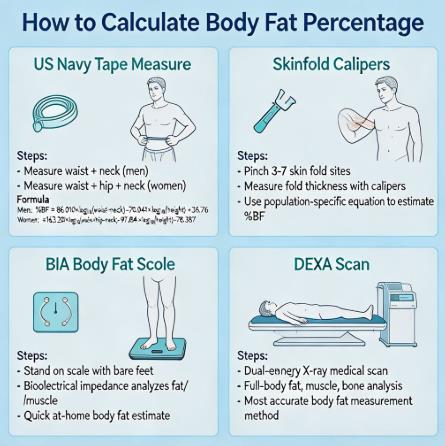
Method 1: US Navy tape measure method (best free option)
The US Navy developed this formula for recruits – it uses circumference measurements to estimate body fat with surprising accuracy (within 3-4% of DEXA). (Data sourced from official U.S. Navy body composition assessment standards.) All you need is a soft measuring tape.
For men: Measure neck (below Adam's apple) and waist (at navel). Formula: % body fat = 86.010 × log10(waist - neck) - 70.041 × log10(height) + 36.76.
For women: Measure neck, waist, and hips (widest point). Formula: % body fat = 163.205 × log10(waist + hip - neck) - 97.684 × log10(height) - 78.387.
Don't do the math manually – use a body fat calculator that applies the Navy formula instantly. Measure in the morning, after bathroom, with no clothing. Pull the tape snug, not tight, and keep it parallel to the floor.
Common errors that wreck your reading: Drinking water before measuring can lower the result by 1-2%. Heavy exercise the night before (dehydration) can artificially raise it. For women, the menstrual cycle can shift readings by 1-3% due to water retention. Best bet: same time, same conditions, once a week, and look at the 4-week trend.
Accuracy: ±3-4% compared to DEXA. Not perfect, but free and repeatable.
Method 2: Skinfold calipers (best for tracking change)
Calipers pinch fat at specific body sites – chest, abdomen, thigh for men; triceps, suprailiac, thigh for women (3‑site Jackson‑Pollock protocol). Sum the measurements and convert to body fat percentage using a published formula. ACSM recommends this method for fitness professionals. (Data sourced from ACSM body composition assessment guidelines.)
Pros: Inexpensive ($10-30), portable, accurate (±3-4%) with practice. Cons: Requires skill – inconsistent pinching yields inconsistent results. Best used by trained technicians, but consistent self-measurement can track trends.
Tip: Always measure on the same side of the body, at the same time of day, and use the same calipers. Take three measurements at each site and average them.
Method 3: Bioelectrical impedance (BIA) scales (most convenient)
Home bathroom scales with body fat sensors send a tiny, imperceptible electrical current through your body. Fat resists the current more than muscle, so the scale estimates your fat percentage based on how quickly the current travels.
Accuracy: ±5-8% compared to DEXA, heavily influenced by hydration. A glass of water can shift readings by 2%. For best results: measure at the same time (morning, after bathroom), on the same scale, on a hard floor (not carpet). Track trends over weeks, not daily changes.
Popular brands (Withings, Fitbit, Tanita) all use similar technology – don't expect clinical precision, but the convenience works for consistent monitoring.
Method 4: DEXA scan (clinical gold standard)
Dual-energy X-ray absorptiometry (DEXA) is the most accurate non‑invasive method, with error less than 2%. It also shows visceral fat, lean mass, and bone density. A full scan costs $75-150 at imaging centers and some gyms. Covered by insurance only with a doctor's order (usually for bone density, not body fat).
Use DEXA as an annual calibration check – confirm your home methods are tracking correctly. Not practical for weekly use, but invaluable for baseline and progress validation.
Method 5: Hydrostatic weighing (underwater weighing)
Considered the historical gold standard, this method measures body density by weighing you on land and submerged. Fat floats, muscle sinks – the difference calculates body fat. Accuracy within 2-3%, but requires specialized equipment and submersion. Uncomfortable for many and not widely available.
Method 6: Air displacement plethysmography (Bod Pod)
Similar to hydrostatic weighing but uses air pressure instead of water. You sit in an egg-shaped chamber for 5 minutes. Accuracy ±2-3%. Available at some universities and fitness centers ($50-100).
Method 7: 3D body scanning
Newer technology uses infrared or white light to create a 3D avatar, then estimates body fat from body shape. Accuracy similar to tape measure (±4-5%). Some gyms offer this as part of a membership.
How to choose the right method for you
On a budget and want decent accuracy: Navy tape method + online body fat calculator. Free, repeatable, and good enough for progress tracking.
Want to monitor weekly trends at home: BIA scale – but ignore individual readings and track 4‑week averages.
Need clinical accuracy for medical reasons or serious athletic goals: DEXA scan once or twice a year.
Between those extremes: Skinfold calipers with consistent technique or a Bod Pod annually.
What your body fat percentage means (by age, sex, and population)
The American Council on Exercise (ACE) publishes general norms. But healthy ranges shift with age and activity level. Below is a detailed breakdown by decade and special population – the kind of depth most articles skip.
Body fat percentage by age for men
| Age | Athlete | Fitness | Acceptable |
|---|---|---|---|
| 20-29 | 6-13% | 14-17% | 18-21% |
| 30-39 | 8-15% | 16-19% | 20-24% |
| 40-49 | 9-16% | 17-20% | 21-25% |
| 50-59 | 10-17% | 18-22% | 23-27% |
| 60+ | 11-18% | 19-23% | 24-28% |
Body fat percentage by age for women
| Age | Athlete | Fitness | Acceptable |
|---|---|---|---|
| 20-29 | 14-20% | 21-24% | 25-31% |
| 30-39 | 15-21% | 22-25% | 26-32% |
| 40-49 | 16-22% | 23-26% | 27-33% |
| 50-59 | 17-23% | 24-27% | 28-34% |
| 60+ | 18-24% | 25-28% | 29-35% |
Special population guidelines
Athletes (competitive): Men 6-13%, women 14-20%. These ranges support peak performance but require dedicated training and nutrition. Not sustainable year-round for most.
Older adults (65+): Slightly higher body fat is protective. A man at 24-28% or a woman at 29-35% may still be healthy if muscle mass and mobility are good. Focus on function, not chasing lower numbers.
General fitness goals (average adult): Men 14-24%, women 21-31%. Most people should aim for the fitness or acceptable categories, not athlete levels.
How to lower your body fat percentage safely
Crash diets and endless cardio often backfire – they burn muscle along with fat, lowering your metabolism. Sustainable body fat reduction requires:
Resistance training: 2-3 sessions per week preserves muscle while you lose fat.
Protein adequacy: About 0.6-0.8 grams per pound of body weight daily – supports muscle retention.
Moderate calorie deficit: 300-500 calories below maintenance per day – slow and steady.
Sleep and stress management: Poor sleep increases cortisol, which promotes fat storage, especially in the belly.
Don't chase extreme leanness – women below 14% body fat or men below 6% risk hormonal disruptions, bone loss, and immune suppression unless under medical supervision (e.g., bodybuilders pre‑competition).
Common body fat measurement myths
Myth: BMI tells you your body fat percentage. Fact: BMI is weight-to-height ratio, not fat measurement. Two people with same BMI can have vastly different body fat.
Myth: Home BIA scales are highly accurate. Fact: They're useful for trends, but day-to-day fluctuations (hydration, food, exercise) make single readings unreliable.
Myth: You need to be below 10% body fat to be healthy. Fact: For most men, 15-20% is healthy; for women, 22-28% is healthy. Single-digit body fat is not sustainable long‑term for most.
Myth: All body fat is bad. Fact: Essential fat protects organs, stores energy, and supports hormone production. Dropping too low can harm your health.
Frequently Asked Questions (FAQ)
What is the most accurate way to calculate body fat at home?
The US Navy tape measure method using a body fat calculator is the most accurate free home option (±3-4%). For a small investment, skinfold calipers with consistent technique offer similar accuracy.
How often should I measure my body fat percentage?
Monthly is sufficient. Body composition changes slowly. Weekly measurements add noise (hydration, menstrual cycle, food). Track the 3‑month trend, not the daily number.
Is DEXA worth the cost for regular people?
Once or twice a year, yes – to calibrate your home methods. For most people, consistent tape measure or caliper readings provide enough data to track progress without clinical scans.
Can I calculate body fat without any tools?
Estimate visually using comparison photos, but this is subjective and unreliable. Waist circumference alone (under 40 inches for men, 35 for women) is a decent proxy for unhealthy fat levels.
What's a healthy body fat percentage for a 50-year-old man?
For men 50-59, 14-17% is fitness range, 18-24% acceptable. Below 14% is athlete range but not necessary for general health. Waist circumference below 37 inches is a good real‑world goal.
Sources
American Council on Exercise (ACE): Body fat percentage norms
NIH: Assessing Your Weight and Health Risk – waist circumference guidelines
American College of Sports Medicine (ACSM): Body composition assessment guidelines (ACSM standards for skinfold measurement)
US Navy: Body fat estimation formulas (circumference method). Data sourced from official U.S. Navy body composition assessment standards.
Content Integrity Review: This article has been reviewed by the BMI Calculator Blog editorial team for alignment with ACE, NIH, and ACSM guidelines on body composition assessment. Individual health decisions should always be made with a qualified healthcare provider.
About the BMI Calculator Blog Editorial Team
We are health educators, registered dietitians (AND credentials), and exercise physiologists (ACSM certifications) with over 20 years of combined experience in clinical and community health. Every article is fact‑checked against current guidelines.
Ready to see where you stand for your age? Try our Free BMI Calculator to get your baseline.
BMI Calculator Blog. This content is provided for educational and informational purposes only. Medical Disclaimer: The content of this article is for informational purposes only and does not replace professional medical advice, diagnosis, or treatment. Always seek the advice of a qualified physician or other health experts with any questions regarding medical conditions or health goals.