Quick Summary: Wondering what a healthy weight for a 5'4" female is? The short answer: most women at 5'4" fall between 108 and 145 lbs — but frame size shifts that number by about 25 lbs. A small-framed woman might be healthiest near 112 lbs, while a large-framed woman can be healthy at 140 lbs or more. BMI gives a starting range, but waist size and body fat tell the real story. Here are the exact numbers.
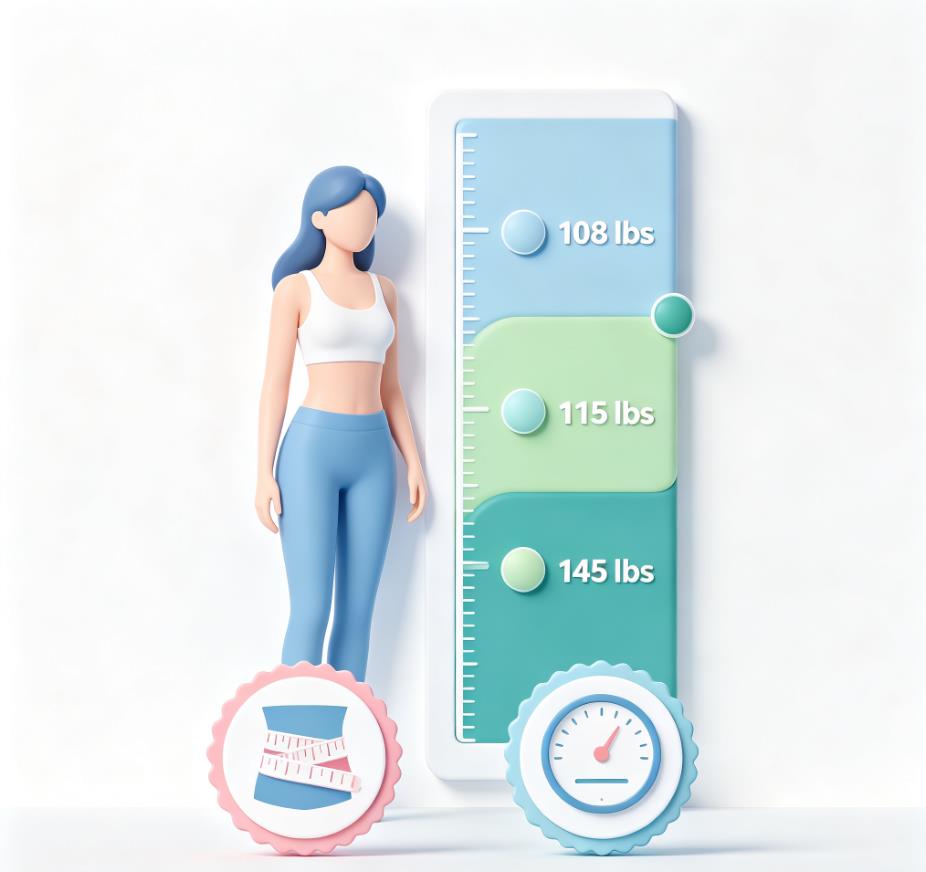
At 5'4", the healthy weight range is 108–145 lbs (BMI 18.5–24.9) for most women.
Frame size matters: small frame ~108–120 lbs, medium ~122–135 lbs, large ~137–145 lbs.
145 lbs at 5'4" = BMI 24.9 (top of healthy range); 130 lbs = BMI 22.3; 115 lbs = BMI 19.7.
Waist circumference under 35 inches and waist-to-height ratio under 0.49 signal lower metabolic risk.
BMI is a screening tool — pair it with body fat percentage and waist measurement for accuracy.
What Is a Healthy Weight for a 5'4" Woman?
For a woman who is 5'4" (about 162.6 cm), the healthy weight range based on BMI is roughly 108 to 145 lbs (49–66 kg). This range corresponds to a BMI of 18.5 to 24.9, the standard healthy category defined by the CDC BMI guidelines and categories for adults. Where you fall inside this range depends heavily on your frame size, muscle mass, and age.
| Frame Size | Healthy Weight Range (5'4") | BMI Range | What It Means |
|---|---|---|---|
| Small | 108–120 lbs | 18.5–20.6 | Lighter build, smaller bone structure; wrist measurement under 5.5 inches. |
| Medium | 122–135 lbs | 20.7–23.2 | Average frame; most women fall in this band. |
| Large | 137–145 lbs | 23.3–24.9 | Broader bone structure or more muscle; wrist over 6 inches. |
Frame size alone can shift your healthy weight by about 25 lbs, which is why comparing yourself to a friend of the same height often leads to frustration. Your bone structure sets a different "normal."
BMI Chart for a 5'4" Female: Weights from 108 to 155 lbs
Here is the exact BMI for common weights at 5'4". Use this table to find where your current weight lands:
| Weight (5'4" female) | BMI | Category |
|---|---|---|
| 108 lbs | 18.5 | Healthy (lower end) |
| 112 lbs | 19.2 | Healthy |
| 115 lbs | 19.7 | Healthy |
| 127 lbs | 21.8 | Healthy |
| 130 lbs | 22.3 | Healthy |
| 145 lbs | 24.9 | Healthy (upper limit) |
| 155 lbs | 26.6 | Overweight |
Every weight from 108 to 145 lbs sits inside the healthy BMI range at this height. Once you cross 146 lbs, BMI moves into the overweight category (25.0+).
Is 145 lbs Overweight for a 5'4" Woman?
No — at 5'4", 145 lbs gives a BMI of 24.9, which is the very top of the healthy weight range (18.5–24.9). It is not classified as overweight. However, BMI does not measure body composition. If your waist circumference is above 35 inches, you may still carry elevated metabolic risk even at a "healthy" BMI. For a deeper look at how frame size and age change the target, see our guide on ideal body weight by height female.
How Frame Size Changes Your Ideal Weight
Frame size refers to your bone structure, and it is the most overlooked factor in weight charts. A simple way to estimate yours is the wrist test: wrap your thumb and middle finger around your opposite wrist. If they overlap, you likely have a small frame. If they barely touch, you have a medium frame. If a gap remains, your frame is large. A large-framed woman at 140 lbs may be at her natural set point, while a small-framed woman at the same weight could be carrying excess body fat.
Your BMI is the starting point. Use our BMI calculator to see your number, then adjust for frame size as shown above.
Why Waist Circumference Matters More Than the Scale
Two women can both weigh 130 lbs at 5'4" and have completely different health profiles. The difference is often visceral fat — the fat stored around internal organs. The CDC and NHLBI identify a waist circumference above 35 inches (88 cm) in women as a signal of elevated metabolic risk, independent of weight.
An even better metric is waist-to-height ratio: keep your waist below half your height in inches. For a 5'4" woman (64 inches), that means a waist under 32 inches, and a ratio under 0.49 is associated with lower cardiometabolic risk. To estimate body composition directly, try our body fat calculator using the Navy tape method.
How to Use These Numbers: A Simple Action Plan
Weigh yourself in the morning after using the bathroom, and measure your height without shoes.
Calculate your BMI and find your frame-adjusted healthy range from the tables above.
Measure your waist at navel level after a normal exhale — aim for under 35 inches.
Estimate body fat percentage to see whether your weight reflects muscle or fat.
Reassess every 4–6 weeks, focusing on trends in waist and energy rather than a single scale reading.
Frequently Asked Questions
What is a healthy weight for a 5'4" female?
A healthy weight for a 5'4" female is 108 to 145 lbs (49–66 kg), corresponding to a BMI of 18.5 to 24.9. Your frame size determines where you fall in that range: small frame 108–120 lbs, medium 122–135 lbs, large 137–145 lbs.
Is 145 lbs overweight for a 5'4" woman?
No. At 5'4", 145 lbs is a BMI of 24.9, the very top of the healthy range. It is not overweight. Check your waist circumference (under 35 inches) to confirm your metabolic risk is low.
What is the BMI for 5'4" and 130 lbs?
A 5'4" woman weighing 130 lbs has a BMI of 22.3, which sits comfortably in the middle of the healthy weight range.
How much should a 5'4" woman weigh by frame size?
Small frame: 108–120 lbs. Medium frame: 122–135 lbs. Large frame: 137–145 lbs. All are healthy as long as waist circumference stays under 35 inches.
What waist size should a 5'4" woman aim for?
Aim for a waist under 35 inches (88 cm). For even better risk assessment, keep your waist-to-height ratio under 0.49 — under about 31 inches at 5'4".
Does age change the healthy weight for a 5'4" woman?
Age shifts body composition, not the BMI range itself. After menopause, muscle loss means a slightly higher weight can be protective. Focus on keeping waist size down and maintaining strength rather than hitting a specific number.
References & Sources
NHLBI: Aim for a Healthy Weight — BMI and waist circumference
National Institute on Aging: Maintaining a Healthy Weight in Older Adults