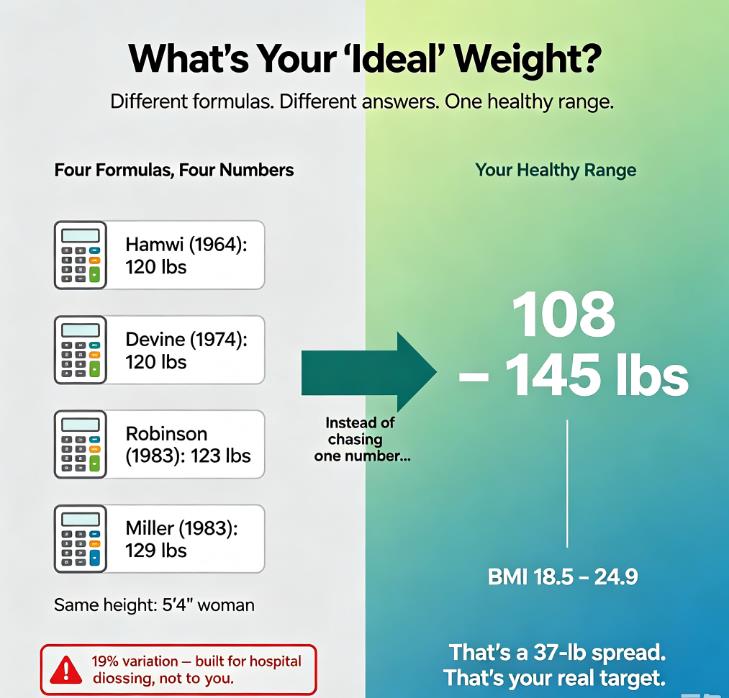
If I had a dollar for every time someone asked me "What's my ideal weight?" — I'd retire tomorrow. Most people expect a single number. They're about to be disappointed — and honestly, relieved. Your ideal isn't one weight. It's a 37-pound spread. Formulas disagree by up to 19% because they were built for hospital drug dosing, not your bathroom scale. Your healthy BMI range (18.5–24.9) is what actually matters.
What Is Ideal Body Weight?
Ideal body weight (IBW) is a height-based estimate. The CDC and NHLBI use BMI to define healthy weight: 18.5 to 24.9 for most adults. But BMI is a screening tool — treat it as a starting point and nothing more.
Ideal Body Weight vs. Healthy Weight Range
People use these interchangeably. They're not the same. Ideal body weight is a formula's single number — like 120 lbs for a 5'4" woman. A healthy weight range is the BMI-based zone, giving you room for muscle, bone, and natural variation — 108–145 lbs for that same 5'4" woman.
Why the Formulas Don't Agree
A hospital pharmacy still runs on the Devine formula — it's used to calculate antibiotic doses. Many care teams keep Hamwi on hand as a quick reference. Neither was ever meant to define your health.
Hamwi (1964) says 120 lbs for a 5'4" woman. Devine (1974) agrees at 120 lbs — it was actually derived from Hamwi's work. Then Robinson and Miller came along in 1983 and bumped things up to 123 and 129. Same height, four different "answers." Why? They were built from people in hospital settings across different decades, not gym-goers or healthy adults. A 2000 clinical review published in The Annals of Pharmacotherapy found these classic formulas can produce weight estimates varying by up to 19% among individuals of identical height. The math works fine. It just wasn't built with your bathroom mirror in mind.
From anonymized sessions of women using our tools, most 5'4" users report feeling healthiest between 118–135 lbs — right in the middle of the CDC range, not pinned to a 1964 chart.
For a more complete picture, pair your BMI with our body fat calculator.
Healthy Weight Range by Height
Here's what the healthy BMI range looks like in pounds:
5'0": 95–128 lbs
5'2": 101–136 lbs
5'4": 108–145 lbs
5'6": 115–155 lbs
5'8": 122–164 lbs
5'10": 129–174 lbs
The spread stays near 30–40 pounds at any height, and that's just how the BMI math falls out. A 5'4" woman has a 37-pound healthy window. A 5'10" man falls within 129–174 lbs — same wide spread. Frame size and lean mass also shift your personal healthy range: larger frames and strength-trained bodies naturally sit higher in the BMI range without excess body fat.
How to Find Your Actual Healthy Range
Here is what I actually tell people — skip the formulas. Start by using our free BMI calculator to see your category. Then stay inside your height's range — don't chase 120 lbs if you lift weights or have a larger frame. Measure your waist at your navel. Over 35 inches for women? That's a bigger risk signal than BMI alone.
And adjust for age: research observes that adults over age 65 with BMI 23–27 often show better survival outcomes, though this observational finding does not mean everyone should intentionally gain weight to hit this band. For age-specific adjustments, our ideal BMI calculator factors in what research shows about older adults.
Common Myths, Cleared Up
Ideal weight is what I should weigh. In reality, it's a hospital dosing reference. Your healthy range is what matters.
All calculators should match. It's easy to assume they should line up perfectly. In truth, they're built from different decades and different populations. A 19% difference is normal — and expected.
I need to weigh what I did at 25. Muscle loss and bone density shift healthy weight as you age. That's normal.
Older adults should aim for the same BMI as younger people. Research shows adults over 65 with BMI 23–27 often have better survival outcomes — though this is an observational finding, not a weight-gain prescription.
Frequently Asked Questions
What is the ideal body weight for my height?
It depends on the formula. For 5'4", they range from 120 to 129 lbs. Your CDC healthy BMI range is 108–145 lbs. Use the range, not the single number.
Why do different calculators give different numbers?
They use different formulas built for different jobs — drug dosing, clinical estimates, insurance tables. None were designed as a personal health target.
Does ideal body weight change with age?
The math doesn't change, but your body does. Research observes that adults over 65 with BMI 23–27 often show better survival outcomes; this observational finding does not mean everyone should intentionally gain weight to hit this band. Younger adults generally follow the standard 18.5–24.9 range.
Is BMI or ideal weight better for athletes?
Neither. Both miss muscle. Body fat percentage is the better metric — which is why we pair BMI with a body fat estimator.
Should I use ideal weight as my goal?
Treat it as a rough reference. Focus on waist size, energy, and consistent habits instead of hitting a number. Three things actually matter more than the single-number chase:
Waist circumference — under 35 inches for women, 40 for men
Consistent energy — how you feel most days, not just on weigh-in day
Sustainable habits — the daily patterns you can actually keep
Look, I'll be honest — I've seen people drive themselves crazy trying to hit 120 lbs when they felt great at 135. So maybe that old handout still quotes the 120-lb chart from 1964. It happens. That's exactly why the range view exists.
Sources
This article is for informational and educational purposes only. It does not replace professional medical advice. Consider discussing your results with a qualified healthcare provider. The BMI Calculator Blog Team maintains editorial independence.
Related Articles
What Is My Ideal Body Weight? A Complete Guide to Finding Your Healthy Range
Ideal Body Weight Based on Height: Why It's a Range, Not a Number
Last updated: October 15, 2026.