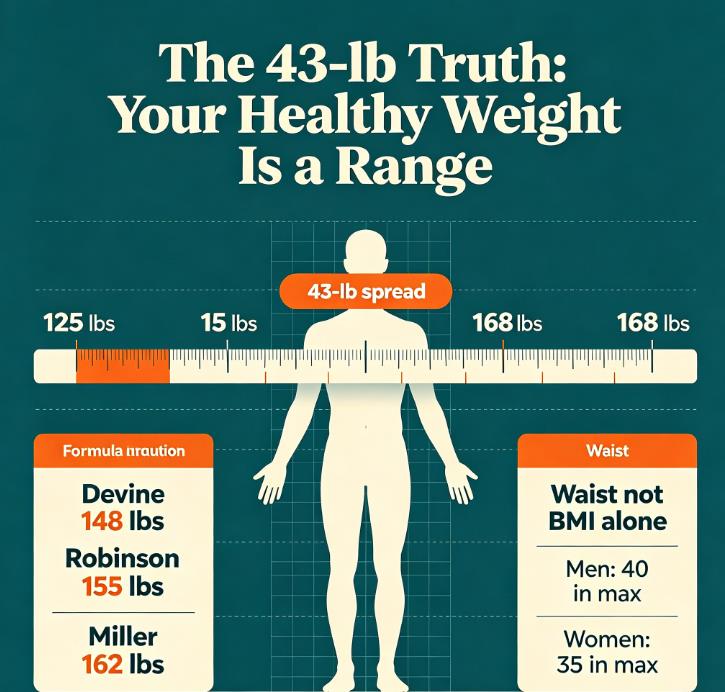
A 5′10″ man deadlifts 315 lbs at 6 a.m., his BMI reads 27 (“overweight”), yet his waist sits at 32 inches and his blood markers are clean. A second man at the same height weighs 165 lbs, walks zero steps a day, and his waist measures 38 inches. Every height-weight chart on the internet sorts these two into the exact same row. The chart can’t see the difference. A realistic zone is defined by BMI 18.5–24.9 alongside waist circumference — for a 5′9″ adult, that’s roughly 126–169 lbs, a 43-pound window that no single formula can collapse into one answer.
Healthy weight range by height (CDC BMI 18.5–24.9)
Here is the baseline screening band, applied to common adult heights. The window is wide on purpose — it accommodates frame size, muscle mass, and natural bone density differences.
| Height | Healthy weight range | Range width |
|---|---|---|
| 5′0″ (152 cm) | 95–128 lbs | 33 lbs |
| 5′4″ (163 cm) | 108–145 lbs | 37 lbs |
| 5′8″ (173 cm) | 122–164 lbs | 42 lbs |
| 5′9″ (175 cm) | 126–169 lbs | 43 lbs |
| 5′10″ (178 cm) | 129–174 lbs | 45 lbs |
| 6′0″ (183 cm) | 136–184 lbs | 48 lbs |
Source: CDC Adult BMI Categories. Rounded to the nearest pound.
We re-ran the rounding twice. The 5′0″ row is the one that breaks most chart generators — 94.7 to 127.5 rounds to 95 and 128, but plenty of published tables show 97 to 127 instead. A two-pound shift at each end, and suddenly a chart disagrees with the CDC.
For a 5′9″ adult, the band runs 126 to 169 lbs. Devine puts the same person at 148 lbs. The chart says 148. The CDC says anywhere between 126 and 169 is normal. Both describe the same person, and only one of them accounts for how bodies actually differ.
What the classic formulas actually calculate
The formulas you see on health sites — Devine, Robinson, Miller, Hamwi — were not derived from healthy populations. They came from clinical settings, insurance tables, and drug-dosing protocols.
Pai and Paloucek traced the lineage in a 2000 review for the Annals of Pharmacotherapy. Devine’s 1974 equation was published as a gentamicin dosing tool — the pharmacokinetics of that antibiotic correlated with ideal body weight, and the equation followed. It was never designed to answer “what should I weigh for health.”
Miller (1983) was derived from Metropolitan Life Insurance height-weight tables via regression analysis. It gives higher estimates than Devine, especially for taller individuals, because the underlying data reflected insured populations rather than clinical dosing cohorts.
Hamwi (1964) was a bedside estimate for quick clinical reference. Robinson (1983) refined the coefficients but kept the same clinical orientation.
Run a 5′9″ adult through all four, and the spread is roughly 148 to 162 lbs. A 14-pound gap. None of those numbers knows whether the person lifts weights, has a wide frame, or carries visceral fat. These calculations only solve for drug dosing. Nobody built them to judge how healthy a person’s weight is.
Our team sees visitors plug their numbers into all four formulas and get confused by the gap. The confusion is reasonable. Four equations, four answers, no indication on any of the pages that the output was never meant to define health.
Where the range moves: age, ethnicity, and muscle
The standard BMI band is a baseline. Three factors shift it for large groups, and ignoring them produces advice that is technically correct and practically wrong.
Age pushes the zone upward. A 2014 meta-analysis of 32 prospective cohorts, covering 197,940 adults aged 65 and older, found that compared with a reference BMI of 23.0–23.9, mortality risk was lowest at BMI 27.0–27.9 (HR 0.90). Risk rose again at BMIs below 23 and above 33. A separate dose-response meta-analysis concluded that 23.0–28.0 may be the healthy weight range for the elderly group. A 5′9″ adult at 75 with a BMI of 23 sits at 152 lbs — already above the Devine formula output, and inside the age-adjusted band.
Asian populations use lower action points. The WHO 2004 expert consultation identified further public health action points at 23.0, 27.5, 32.5, and 37.5 kg/m² for Asian populations, because metabolic risk appears at lower BMI values in many Asian groups. A 5′6″ Asian adult at BMI 24 reads “normal” on the global table and “increased risk” on the adjusted frame.
Muscle mass breaks the formula entirely. A 5′10″ lifter at 185 lbs with 12% body fat reads BMI 27 — overweight — while a sedentary adult at 160 lbs with 30% body fat reads BMI 23 — healthy. The chart cannot tell them apart. Waist circumference can: a 32-inch waist versus a 38-inch waist tells you more about metabolic risk than the weight itself.
Three measurements that beat any height chart
A single height row cannot tell you what a tape measure, a BMI band, and a trend line can.
Start with your BMI band. The CDC defines healthy weight as BMI 18.5 to under 25 for adults 20 and older, regardless of age, sex, or race. An ideal BMI calculator places your height and weight inside that band. The band is the starting point, not a verdict.
Then the tape. The National Heart, Lung, and Blood Institute (NHLBI) draws the risk line at more than 35 inches for women and more than 40 inches for men: above those thresholds, heart disease and type 2 diabetes risk rises regardless of what the scale says. A 5′9″ man at 170 lbs with a 38-inch waist and a 5′9″ man at 180 lbs with a 33-inch waist are not in the same risk category, even though their BMIs are close. A healthy weight range check adds the age-adjusted context, and a body fat calculator adds the fat-versus-lean breakdown the formula cannot provide.
After that, watch the trend. A weight that holds steady across seasons — same waist, same strength, same energy — carries more signal than a single reading on a Tuesday morning. One reader tracked for six months: her weight moved less than three pounds, but her waist dropped two inches. The scale said nothing had changed. The tape said otherwise.
Frequently Asked Questions
Does my ideal weight change after 50?
Yes, and the shift is measurable. Winter et al’s 32-cohort meta-analysis found that for adults 65 and older, the reference band was BMI 23.0–23.9. Compared with that reference:
BMI 21.0–21.9 carried a 13% higher mortality risk.
BMI 20.0–20.9 carried a 19% higher risk.
BMI 27.0–27.9 carried the lowest risk (HR 0.90).
Risk rose again above BMI 33.0.
The lowest-risk zone in that age group sits higher than the standard 18.5–24.9 band. A few extra pounds after 60 often protect against frailty and bone loss.
Why does my BMI say overweight when I lift weights?
BMI only reads height and weight. A 5′10″ man at 185 lbs with 12% body fat gets the same BMI as a sedentary adult at the same height with 30% body fat. The formula has no field for muscle. Waist circumference and body fat percentage are the relevant screens for trained bodies.
What is the difference between ideal body weight and a healthy weight range?
Ideal body weight is a single formula output — Devine’s 148 lbs for a 5′9″ adult, for example. A healthy weight range is the full BMI 18.5–24.9 band, roughly 43 pounds wide at that height. The range accommodates frame, muscle, and natural variation. The formula does not.
Can I use an ideal body weight calculator to track progress?
As a rough baseline, yes. If you are muscular, the formula will underestimate you. If you are sedentary with high body fat, it may overestimate your health at that weight. Track waist circumference and body fat percentage alongside the number, and watch the trend across 6–12 months rather than a single reading.
What is the best formula for older adults?
None of the four formulas was designed for age-related body composition changes. For adults 65 and older, the mortality data point to a BMI band of roughly 23–28, which sits higher than any of the formula outputs for most heights. Waist circumference and functional measures — grip strength, walking pace, the ability to carry groceries — matter more than a formula number from the 1970s.
Sources
CDC: Adult BMI Categories — Healthy Weight 18.5 to Under 25 and Screening Guidance
NHLBI: Overweight and Obesity — Waist Circumference Thresholds and Health Risk
This article is for informational and educational purposes only. It does not constitute medical advice or replace professional health assessment. Always consult a qualified healthcare provider regarding your individual health and weight-related goals. Individual results will vary. The BMI Calculator Blog Team maintains editorial independence and does not sell health products.
Related Articles
Ideal Body Weight by Height Female: Why It’s a Range — Frame, Age & Waist Ratio Beat One Number
What Is My Ideal Body Weight? A Complete Guide to Finding Your Healthy Range
Last updated: October 18, 2026.