Quick Summary: For women 40–60, a healthy waist-to-hip ratio (WHR) is 0.80–0.85. It tracks fat location, not total weight. Above 0.85 signals rising cardiometabolic risk; 0.90+ warrants a provider visit.
Key Takeaways
0.80–0.85 is the goal: WHO sets 0.85 as the upper limit for women; AHA suggests 0.80 for optimal health.
Location beats scale weight: WHR catches belly-fat shifts that BMI and scale weight completely miss.
Measure with precision: Waist at narrowest point, hips at widest, divide once, and track every 3–6 months.
Age doesn't change the rules: Hormonal shifts raise your WHR, but the 0.85 risk threshold stays fixed.
Pair your tools: Use WHR alongside a Metric/Imperial BMI Calculator for a complete view.
WHR: The Number That Catches Hidden Fat
BMI tells you if you’re heavy for your height. WHR tells you where that weight is sitting. For women in midlife, that difference matters more than ever.
Many women first notice this shift when their old pants no longer fit at the waist, yet the scale reads exactly the same as it did five years ago. This reflects fat redistribution, not overall weight gain. WHR catches this relocation long before a standard BMI chart does.
The 40–60 WHR Breakdown
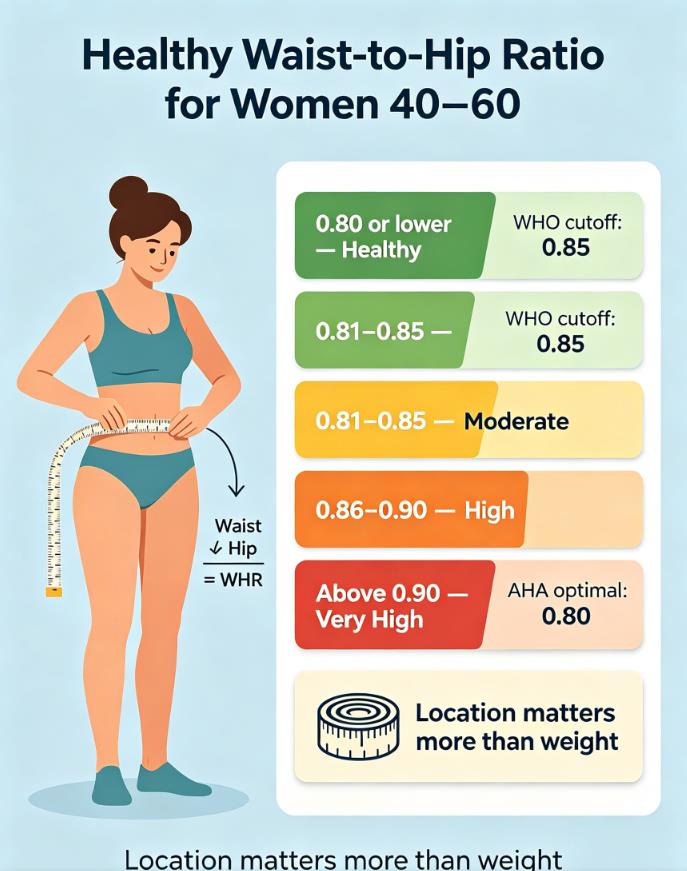
The World Health Organization sets the healthy WHR cutoff for women at 0.85. The American Heart Association suggests aiming for 0.80 or lower for optimal protection. Here is how the ranges break down for women in this age group:
| WHR Range | Risk Level | What It Means for You |
|---|---|---|
| 0.80 or lower | Healthy | Cardiometabolic risk stays low; fat sits mostly in hips/thighs. |
| 0.81–0.85 | Moderate | Watch waist trends; increased risk of insulin resistance. |
| 0.86–0.90 | High | Abdominal fat is accumulating; time to adjust diet and activity. |
| Above 0.90 | Very High | Elevated risk for heart disease and diabetes; consult a provider. |
WHR tends to rise gradually with age as hormones change. But the health thresholds don’t move. A 0.86 reading carries the same risk at 60 as it does at 30.
How to Measure Without the Guesswork
Two measurements, one division. Accuracy depends entirely on where you place the tape.
Waist: Find the narrowest part of your torso, usually just above the belly button. If there’s no clear narrow point, find the midpoint between your lowest rib and the top of your hip bone. Breathe out naturally. Don’t suck in.
Hips: Wrap the tape around the widest part of your buttocks. Keep it level with the floor.
Calculate: Divide waist by hip. For example, 34-inch waist ÷ 40-inch hips = 0.85.
Measure twice and average the results. Even small shifts in tape placement can skew your reading month over month. Many people find measuring first thing in the morning delivers the most consistent readings. For a different perspective on belly fat, our guide on waist-to-height ratio offers another simple check.
Why BMI Alone Leaves You Guessing
Two women can share a BMI of 23 and have completely different health risks. One might carry weight in her hips; the other might carry it around her organs.
Visceral fat—the kind packed around your abdomen—is metabolically active. It releases inflammatory compounds that drive insulin resistance and high blood pressure. Subcutaneous fat, stored in the hips and thighs, is quieter and less risky.
A 1998 study in the American Journal of Clinical Nutrition found that WHR was a stronger predictor of cardiovascular risk than BMI alone. If your WHR is climbing while your BMI stays flat, your body composition is changing. You’re likely losing muscle and gaining belly fat, a condition often called “normal-weight obesity.”
To see the full picture, a body fat calculator can help track those internal shifts that the scale misses.
Small Shifts That Move the Needle
You don’t need a crash diet to improve your WHR. You need consistency.
Protein at every meal: Aim for 1.2–1.6g per kg of body weight daily. It protects muscle as you age.
Two strength sessions weekly: Focus on hips, glutes, and core. Muscle burns more calories than fat, even at rest.
7,000–8,000 steps daily: Walking after meals helps clear blood sugar and reduces abdominal fat.
7–9 hours of sleep: Cortisol climbs when sleep drops, pushing fat storage toward your midsection.
Crash diets often backfire after 40. They strip muscle, slow your metabolism, and make it harder to keep fat off. Steady habits win here.
Frequently Asked Questions
What is a good waist-to-hip ratio for a 55-year-old woman?
A WHR of 0.85 or lower is the WHO standard. Aiming for 0.80 or lower provides even better protection against heart disease. Age doesn’t change the cutoff.
Can I have a normal BMI but a high WHR?
Yes. This is common in women over 40. You can have a “healthy” BMI of 22 while carrying dangerous levels of visceral fat around your middle. That’s why WHR matters more than the scale.
How often should I check my WHR?
Every 3 to 6 months is plenty. Measure under the same conditions each time—morning, after exhaling, same tape placement. Rapid changes warrant a provider visit.
Does WHR change with menopause?
Yes. As estrogen drops, fat shifts to the abdomen. WHR often rises during the menopausal transition, even if total weight stays the same. The risk thresholds remain 0.85 and 0.90 regardless of age.
Is WHR better than BMI for women over 50?
For predicting heart and diabetes risk, yes. WHR shows where fat is stored, while BMI only shows total mass. Use both together for the best view of your health.
What should I do if my WHR is 0.88?
That’s in the high-risk range. Focus on adding protein, strength training, and sleep. If it stays above 0.85 after 3–6 months, talk to a qualified healthcare provider about your metabolic health.
Sources
This article is for informational and educational purposes only. It does not constitute medical advice, diagnosis, or treatment. Always consult a qualified healthcare provider regarding your individual health and body composition goals. Individual results will vary. The BMI Calculator Blog Team maintains editorial independence and does not sell health products.