Quick Summary: Optimal BMI for adults over 50 is not 18.5–24.9. Research links the lowest mortality to roughly 23–27 for ages 50–64 and 23–28 for 65+. A slightly higher BMI may protect against frailty and illness. Waist circumference and body composition matter more than the raw number. This guide covers age-specific targets, what to track, and how to measure at home.
Key Takeaways:
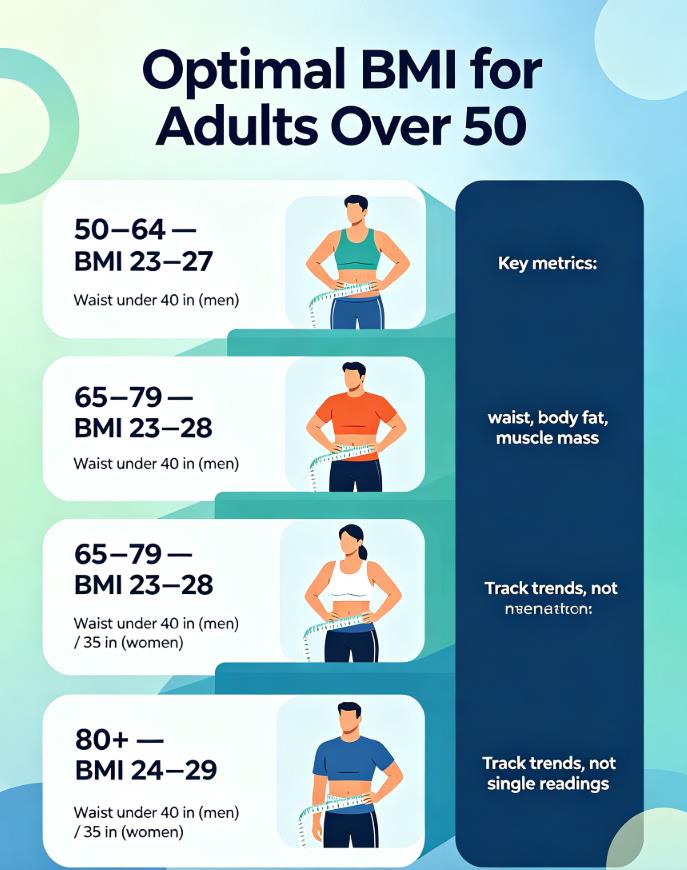
50–64: Optimal BMI is about 23–27 if active. For sedentary adults, 18.5–24.9 remains the standard baseline.
65+: Optimal BMI widens to 23–28. A little extra weight protects against frailty and falls.
Under 23: Many adults in this bracket face higher odds of muscle loss, slower recovery, and malnutrition risk.
Waist still matters: Under 40 in (men) or 35 in (women) signals lower risk.
Track trends: Log waist measurements every month, check BMI quarterly, and run a body composition check once each year.
What “Optimal” Means After 50
BMI compares weight to height: kg ÷ m². After 50, hormone shifts and muscle loss change what the number means. A 5'4" woman at 150 lb has BMI 25.8. That can be healthier than 21 if she lifts weights and keeps a small waist.
A common question from readers: should I aim for the same BMI I had at 30? The short answer is no. Body composition changes after 50, and a slightly higher BMI often reflects protective reserves, not a health problem.
How Body Composition Shifts After 50
Women lose about 3–8% of muscle per decade after 50. The drop accelerates after 65, per CDC healthy-aging data. Less muscle lowers resting metabolism. Fat redistributes toward the abdomen—visceral fat rises even when weight stays flat.
Consider a woman in her late 50s at 152 lb with a BMI near 26. Her BMI stayed at 26 for five years. Over that time, her waist grew from 32 to 36 inches. The scale stayed flat, but the tape measure told the real story. That shift in body composition explains why two people at the same BMI can have very different health risks.
| Age Band | Optimal BMI Window | What to Watch |
|---|---|---|
| 50–64 | 23–27 if active; 18.5–24.9 as standard baseline for sedentary adults | Waist under 35 in (women) / 40 in (men); retest body fat yearly |
| 65–79 | 23–28 | Use current height, not old license height; protect muscle with protein |
| 80+ | 24–29 | Stable weight beats loss; check strength and balance |
These ranges reflect CDC and NIH data showing lower mortality in older adults with slightly higher BMI. For those 80 and above, stability is key—research shows a BMI of 26–28 often correlates with the best outcomes. Every plan still depends on your personal history. Ask your doctor before changing diet or exercise.
When a Higher BMI Is Not a Problem
A muscular 5'10" man at 190 lb has a BMI of 27.3. If his body fat is around 14% on a body fat calculator and his waist is 36 inches, his risk profile looks good. He walks and trains twice weekly. Standard BMI alone would mislabel him as "overweight."
This is not an isolated case. Many active adults over 50 carry more muscle and less fat than their BMI suggests. That's why a senior BMI calculator applies age-based bands—and why waist and body fat measurements complete the picture.
What BMI Cannot Tell You
BMI cannot separate muscle, bone, or water. It may overestimate fat in athletes. It can also underestimate fat after muscle loss. If waist rises while weight stays flat, body composition is shifting.
Many people in this age group still rely on the height listed on their driver's license. This small mistake can throw off your whole weight tracking plan. Height shrinks 1–3 inches by age 80 due to spinal compression. Using an old height inflates BMI by 2–3 points and can push you into the wrong category. Always measure current height.
Also, BMI says nothing about fat distribution or metabolic health. Blood pressure, fasting glucose, and lipid panel results reveal what BMI cannot. Individual results vary—a clinician should review any chronic conditions with you.
How to Measure at Home
Stand barefoot, heels together, against a flat wall. Mark with a book. Use today's height, not your height from 30 years ago.
Weigh after bathroom, before breakfast, once a week.
Enter current age and sex into a Gender Adjusted BMI Calculator for context.
Measure waist at navel after a normal exhale. Snug tape, no squeezing.
Asian adults may face metabolic risk at lower BMI; discuss personal cutoffs with your provider.
Small steps beat strict diets. Crash weight loss often speeds muscle loss for people over 50. Add one protein-rich food per meal and two strength sessions weekly. Results differ by gender, medications, and starting fitness—check with your doctor.
Frequently Asked Questions
What is the optimal BMI for a 50-year-old man?
Aim for 23–27 if you train regularly and keep your waist under 40 inches. If you do little activity, stick to the 18.5–24.9 baseline. Never fixate only on that single BMI number—waist size and muscle mass tell a fuller story.
Is BMI 27 unhealthy at age 55?
Not automatically. Many active 55-year-olds at 27 have low body fat and low risk. If your waist is large or blood markers are off, your doctor may suggest gradual changes.
Why does my BMI look normal but clothes fit tighter after 50?
Muscle drops and visceral fat rises. Weight can stay equal while waist grows. Track waist and body fat, not just BMI.
Should adults over 50 use the same BMI chart as 25-year-olds?
No. Age-based bands reduce false alarms. Use 23–27 for 50–64 when active, 23–28 for 65–79, and 24–29 for 80+. Adjust for waist and muscle.
How often should I check BMI after 50?
Every 3–6 months is enough for most. Trend over a year beats one reading. Rapid loss or gain of 5% in 6 months needs medical review.
Will lifting weights push my BMI into "overweight" unnecessarily?
Yes—muscle adds weight. A higher BMI with low body fat and small waist is usually fine. Confirm with body fat testing and your provider's advice.
Sources
CDC: Adult BMI Categories — Classification and Weight Ranges
NIH/NHLBI: Aim for a Healthy Weight — BMI and Waist Circumference Guidelines
This article is for informational and educational purposes only. It does not constitute medical advice, diagnosis, or treatment. Always consult a qualified healthcare provider regarding your individual health and weight goals. Individual results will vary. The BMI Calculator Blog Team maintains editorial independence and does not sell health products.