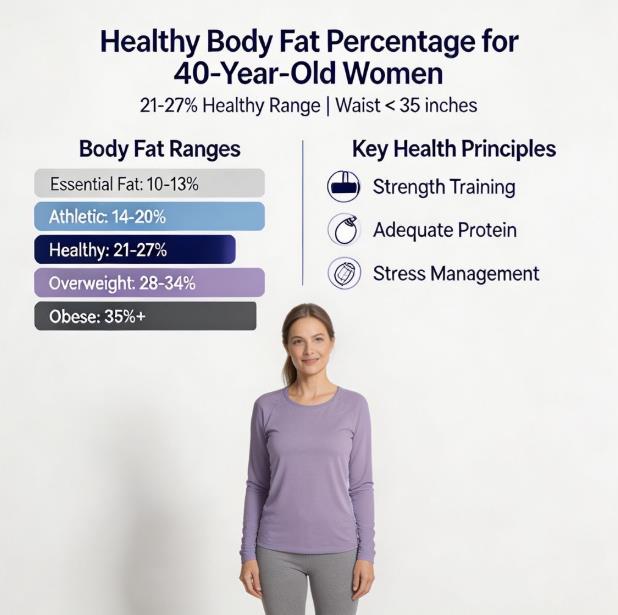
Quick Summary: Body fat for a 40-year-old woman: the healthy range is roughly 21–27%, a few points above the 21–24% fitness band for women in their 20s. That shift is hormonal, not failure. What outranks the percentage is your waist — under 35 inches (88 cm) — because perimenopause moves storage toward the abdomen.
21–27% is the healthy window at 40. The standard fitness band for women is 21–24%; age-adjusted guidance widens it to about 27%.
Your waist outranks the percentage. Past 35 inches (88 cm), risk climbs regardless of what your body fat number says.
The scale can hold steady while composition shifts. Estrogen changes and muscle loss add abdominal fat without moving your weight.
Strength work beats more cardio. Two sessions a week protects the muscle that keeps your resting burn rate up.
Smaller deficits, slower loss. About 200–300 calories a day plus 1.2–1.6 g of protein per kg sheds fat without stripping muscle.
What Is a Healthy Body Fat Percentage at 40?
For a 40-year-old woman, a healthy body fat percentage sits at roughly 21–27%. That is a few points above the 21–24% band usually quoted for women in their twenties, and the difference is expected rather than alarming.
The standard body fat categories for women are shown below. They are screening bands rather than a verdict, and they are not adjusted for age — so reading them at 40 takes one extra step.
| Category | Body fat % | What it means at 40 |
|---|---|---|
| Essential fat | 10–13% | Biological minimum. Below this, hormone production is put at risk. Not a target to chase. |
| Athletic | 14–20% | Reachable with dedicated training and tight nutrition. Harder to hold at 40 than at 25, and not required for good health. |
| Fitness | 21–24% | The classic healthy band. Still achievable at 40, but it usually takes deliberate strength work and protein. |
| Acceptable | 25–31% | Where most women over 40 land. Health here depends heavily on waist size and activity, not the number alone. |
| Obesity | 32% and above | Associated with elevated metabolic risk. Worth a conversation with your healthcare provider, especially with a waist past 35 inches. |
Read the two middle rows together and the age adjustment makes sense: the healthy window at 40 is the fitness band plus the lower half of the acceptable band — roughly 21–27%. A woman at 27% with a waist under 35 inches and normal metabolic markers is in a very different position from a woman at 27% carrying 38 inches.
Source: American Council on Exercise (ACE) reference categories for adult women, reflecting body composition data from the United States, Canada, and Europe. The 21–27% window is an age-adjusted reading of those bands, informed by research on body composition across the menopausal transition — not a separate set of official cutoffs published by age. ACE does not issue distinct body fat ranges for each decade of life. Women of Asian descent may carry more visceral fat at the same body fat percentage, so lower thresholds often apply.
Why the Number Moves Up After 40
Two things happen at once, and both are measurable.
Estrogen starts shifting where fat goes. Perimenopause can begin in your 40s, and falling estrogen changes storage priority — fat moves from the hips and thighs toward the abdomen. Research on the menopausal transition has found visceral fat rising while energy expenditure falls, which is why the same BMI at 52 does not mean the same thing it did at 42. Visceral fat sits around the organs and drives inflammation and insulin resistance in a way that fat under the skin does not.
Muscle quietly declines. Adults lose roughly 3–8% of muscle per decade starting around 30, and the pace picks up later. Muscle is metabolically expensive tissue — it burns calories at rest. Lose it and your baseline burn drops, so the same diet and the same activity level that held you steady at 32 can add fat at 42.
Together they produce the change most women actually notice first: the scale has not moved, but clothes fit differently.
Three Beliefs That Stall Progress at 40
Three common beliefs tend to derail progress at 40, and all three point away from the thing that works.
| Common belief | What is actually happening |
|---|---|
| "My weight hasn't changed, so nothing has." | Weight can hold perfectly steady while muscle falls and abdominal fat rises. The scale measures mass, not composition — and composition is exactly what changed. |
| "My metabolism is broken." | It is usually smaller, not broken. Less muscle means a lower resting burn. That responds to strength training, not to eating less. |
| "More cardio and fewer calories will sort it out." | Aggressive deficits plus endless cardio accelerate muscle loss, which lowers the burn further. The result is often a lighter body with a softer composition that rebounds. |
The common thread across all three is muscle. Protect it and the rest of the picture gets easier.
The Waist Measurement That Matters More
At 40, waist circumference tells you more than body fat percentage does, because it captures where the fat actually sits.
The NHLBI threshold for women is 35 inches (88 cm). Above that, risk increases whatever your body fat percentage or BMI happens to be.
Measuring takes ten seconds: stand up, wrap a soft tape around your bare abdomen at the navel, breathe out normally, and read it. Do not suck in, and do not pull the tape tight. A tape measure also repeats far better than any body fat estimate — home methods can swing several percentage points with hydration and time of day, while a consistent waist reading stays comparable month to month.
Pair it with the other two numbers. A gender-specific BMI calculator gives you the screening index, and a body fat percentage calculator estimates composition from height, weight, age, and waist. All three are imperfect alone; together they catch what each one misses. Where healthy weight lands also shifts with age — our guide to women's height and weight by age walks through it decade by decade.
What Actually Works at 40
The strategies that worked at 25 do not work the same way at 40. Four changes carry most of the load.
Lift twice a week. Resistance training is the most reliable counter to muscle loss, and it does not require heavy weights — bodyweight squats, resistance bands, dumbbells, and machines all count. The American College of Sports Medicine recommends at least two sessions a week for adults. Consistency matters more than how much you load on the bar.
Front-load protein. Women over 40 generally do better with roughly 1.2–1.6 grams per kilogram of body weight per day, ideally under professional guidance — about 82–109 grams for a 150 lb (68 kg) woman. Muscles also become less responsive to protein as you age, so spreading that total across meals matters as much as the daily number: aim for 25–30 grams at each. A cup of Greek yogurt has about 18 grams; a 4 oz chicken breast about 35.
Shrink the deficit. The 500–1,000 calorie cuts that worked in your twenties tend to cost muscle at 40. A 200–300 calorie daily deficit alongside strength work and adequate protein loses about 0.5–1 pound a week — slower, but what comes off is fat rather than lean tissue.
Protect sleep. Short sleep disrupts the hormones that regulate hunger and fullness, and chronically elevated cortisol is associated with abdominal storage. Seven to nine hours is the usual target, and it is a legitimate part of a body composition plan rather than a nice-to-have.
Check with a healthcare provider before changing how you eat or train, particularly if you live with a thyroid condition, PCOS, diabetes, or another hormonal or metabolic condition. If your body fat reads above 32% or your waist is past 35 inches, they will usually weigh those numbers alongside blood pressure, fasting glucose, and lipid markers rather than reading any single figure on its own.
Starting from a higher number? Our guide to BMI-based weight loss strategies lays out a structured, sustainable framework.
Frequently Asked Questions About Body Fat at 40
Is 25% body fat too high for a 40-year-old woman?
Many women in their early 40s naturally land around 25% body fat, which falls within this age-adjusted healthy 21–27% range. If your waist stays under 35 inches (88 cm) and lab work looks normal, there is no need to push for a lower body fat number.
Why am I gaining belly fat at 40 even though my weight hasn't changed?
Falling estrogen during perimenopause redistributes storage from the hips and thighs toward the abdomen, while gradual muscle loss lowers your resting burn. You can weigh the same as you did at 30 and carry more abdominal fat with less lean mass. Waist circumference and body fat percentage capture that shift; the scale cannot.
What body fat percentage counts as obesity for a 40-year-old woman?
The obesity threshold for women is 32% and above, and that cutoff does not change with age. At that level, metabolic risk is elevated and it is worth discussing with your healthcare provider — particularly alongside a waist past 35 inches.
How fast can I lose body fat at 40?
Around 0.5–1 pound per week is the realistic pace, which comes from a 200–300 calorie daily deficit plus strength training and adequate protein. Faster loss tends to cost muscle, which lowers your resting burn and makes the result harder to keep.
Does BMI matter as much as body fat percentage at 40?
Less and less. Muscle loss and fat redistribution can keep BMI stable while composition deteriorates, so a woman can sit at a "healthy" BMI of 23 and still carry elevated body fat. Body fat percentage and waist circumference are more informative at this stage than BMI alone.
Where exactly should I measure my waist?
At the navel, not the narrowest point — that is the standard protocol the NHLBI threshold is built on. Wrap the tape on bare skin, keep it snug without compressing, and read it at the end of a normal exhale. Measuring at the narrowest point instead can understate the number by an inch or more.
Sources
NHLBI: Aim for a Healthy Weight — Waist Circumference and Health Risk
National Institute on Aging: Exercise and Physical Activity for Older Adults
CDC: Overweight and Obesity — Causes, Consequences, and Health Outcomes
Related Articles
Body Fat by Age: Healthy Ranges for Men and Women, Waist Risk, and What to Do
BMI vs Body Fat Percentage: Key Differences and How to Use Both for Real Health Insights
BMI 25–30 Weight Loss: Smarter Strategies for Overweight Adults
BMI Calculator Blog. This content is provided for educational and informational purposes only. We encourage sharing with proper attribution to our site. Unauthorized commercial use is prohibited. Medical Disclaimer: The content of this article is for informational purposes only and does not replace professional medical advice, diagnosis, or treatment. Always seek the advice of a qualified physician or other qualified health provider with any questions regarding your body composition, weight status, or health goals. Individual results will vary. The BMI Calculator Blog Team maintains editorial independence and does not sell health products.