Quick Summary: The WHO has updated its BMI classification and obesity diagnosis criteria to replace the one-size-fits-all model. Key revisions include lower BMI thresholds for Asian adults (overweight ≥23.0, obesity ≥25.0), higher healthy ranges for seniors (23.0–28.0), and athlete-specific adjustments. Most importantly, obesity diagnosis now requires pairing BMI with waist circumference and body fat percentage. This guide explains the evidence, provides population-specific ranges, and walks you through a five-step process for accurate obesity assessment.
Key Takeaways:
The WHO updated BMI classification replaces fixed global cutoffs with population-specific ranges for Asian adults, seniors, and athletes.
Asian adults use lower thresholds (overweight ≥23.0, obesity ≥25.0) because visceral fat accumulates at lower BMIs in this population. Risk varies across subgroups — South Asians face elevated diabetes risk at BMI 22, while East Asians follow the 22.9 upper limit, and Southeast Asians fall between the two.
Seniors benefit from a higher healthy range (23.0–28.0) to protect against malnutrition and frailty from age-related muscle loss.
Obesity diagnosis now requires at least two metrics: elevated BMI plus either waist circumference ≥40 in. (men) / ≥35 in. (women) or body fat ≥25% (men) / ≥32% (women).
These are screening guidelines, not standalone diagnoses. Always consult a qualified healthcare provider for personal health assessment.
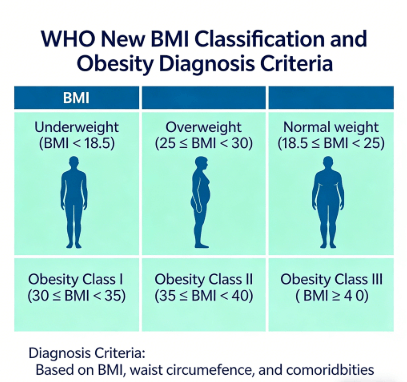
Why the WHO Revised BMI Classification: Moving Beyond a Single Number
The old BMI system — one fixed set of numbers for everyone — was simple. But it was also flawed. A 2023 meta-analysis in The Lancet Diabetes & Endocrinology confirmed that relying solely on traditional BMI misclassifies up to 30% of adults with normal-weight obesity (normal BMI but high body fat). The WHO's updated classification responds to this evidence by introducing population-specific cutoffs and mandating complementary metrics.
A BMI of 23 is healthy for many. But for Asian adults, it's now classified as overweight. This adjustment reflects years of epidemiological data showing that metabolic risk begins at lower BMI thresholds in Asian populations.
WHO Updated BMI Classification: Population-Specific Ranges at a Glance
Below are the revised healthy, overweight, and obesity thresholds for key groups. These are screening guidelines, not standalone diagnoses.
| Population Group | Normal BMI Range | Overweight Threshold | Obesity Threshold | Key Notes |
|---|---|---|---|---|
| General Adults (18–64) | 18.5–24.9 | 25.0 | ≥30.0 | Baseline for non-athletic, non-Asian adults |
| Asian Adults (18–64) | 18.5–22.9 | 23.0 | ≥25.0 | Lower thresholds due to higher visceral fat risk at lower BMI |
| Seniors (65+) | 23.0–28.0 | 28.1 | ≥30.1 | Higher range to protect against malnutrition and frailty |
| Recreational Athletes | 20.0–26.0 | 26.1 | ≥29.0 | Adjusted for moderate muscle mass |
| Elite Athletes | 22.0–28.0 | 28.1 | ≥31.0 | Accommodates high lean muscle mass |
| Children/Teens (2–19) | 5th–84th percentile | 85th–94th percentile | ≥95th percentile | Use CDC age-gender growth charts |
Asian adults face elevated metabolic risk at lower BMI thresholds than Western populations, but the risk is not uniform across subgroups. South Asian populations — including individuals of Indian, Pakistani, and Bangladeshi descent — see elevated diabetes risk starting at BMI 22. East Asian groups follow the standard 22.9 upper limit. Southeast Asian populations, including Filipino, Malaysian, and Indonesian communities, carry intermediate risk, falling between South Asian and East Asian levels. This subgroup nuance is recognized in WHO Western Pacific guidelines and is often overlooked in generic BMI guides. For Asian adults, you can use our dedicated Asian BMI Calculator that automatically applies these lower thresholds.
Multi-Metric Obesity Diagnosis: The New WHO Standard
The updated WHO framework eliminates the old flaw of single-number misdiagnosis. A formal obesity diagnosis no longer relies on BMI alone. To qualify, you must have an elevated population-specific BMI plus at least one adverse body composition metric — either excessive visceral fat via waist circumference or unhealthy body fat percentage. For home assessment, a body fat calculator using the Deurenberg formula provides a reasonable estimate. This dual-check system fixes two major problems: mislabeling muscular athletes as obese, and missing hidden normal-weight obesity in people with slim body shapes but high internal fat.
A 2024 study in Obesity Reviews (Vol. 25, Issue 2) found that adding waist circumference to BMI reduced misclassification by 42% across diverse populations (PubMed ID: 38258473).
How to Apply the WHO Updated Obesity Diagnosis Criteria: A 5-Step Guide
Follow these steps for a medically sound assessment — whether you're a healthcare provider or someone tracking your own health.
Step 1: Calculate Your Accurate BMI
Use a reliable BMI Calculator that supports both metric and imperial units. For seniors, measure current height (not your height from decades ago) — spinal compression can reduce height by 1–3 inches, inflating BMI if using old numbers. For children, use a child BMI calculator that follows CDC guidelines and generates age-gender percentiles.
Step 2: Identify Your Population Group
Select the correct row from the table above. Example: a 45-year-old woman of Vietnamese descent falls under "Asian Adults"; a 70-year-old male former athlete falls under "Seniors" (even if he still lifts weights).
Step 3: Measure Waist Circumference and Body Fat Percentage
Waist: Place a soft tape measure at the top of your hip bone (iliac crest), wrap it around your abdomen at navel level, and measure after exhaling normally. No sucking in.
Body fat: For clinical accuracy, DEXA or air displacement plethysmography is preferred. Home methods provide estimates but should not replace professional assessment.
Step 4: Cross-Reference with Obesity Criteria
Compare your numbers to the thresholds above. Example: an Asian male with BMI 24.5 (overweight), waist 36 inches, and body fat 26% would be diagnosed with obesity under the new WHO criteria — because BMI is elevated for his group and body fat exceeds 25%.
Step 5: Discuss with a Healthcare Provider
Never self-diagnose obesity. A physician can assess additional factors like blood pressure, fasting glucose, lipid profile, and family history to create a personalized management plan.
Two Real-Life Examples of the New Criteria in Action
Case 1 — Normal-weight obesity: A 52-year-old Caucasian woman, BMI 22.5 (normal by general range), waist 34 inches (borderline), body fat 34%. Under old standards she would receive no warning. Under WHO updated guidelines, her elevated body fat (above 32%) qualifies as obesity, prompting early metabolic screening. Her doctor discovered insulin resistance and started lifestyle interventions.
Case 2 — Misclassified athlete: Now consider the opposite scenario. A 30-year-old male rugby player steps off the scale at BMI 29.5 — technically "obese" by old standards. But his waist is 33 inches and his body fat is 14%. Under the new WHO criteria, he's not obese at all. The dual-check system correctly protects him from a false diagnosis.
Your 3-Minute WHO Obesity Assessment Reset
Perform this checklist once every three months to track your metabolic health:
Weigh yourself on the same scale, same time (morning, after bathroom).
Measure your waist (navel level, exhaled).
Use a body fat calculator or note your last DEXA result.
Compare your numbers to the population-specific table above.
If any metric is in the "obesity" range, schedule a check-up with your doctor.
Periodic tracking every few months provides useful trend data. No daily drama required.
Common Misconceptions About WHO BMI Classification
The WHO lowered BMI thresholds for everyone. In reality, only specific groups (Asian adults, seniors) have adjusted ranges. General adult thresholds remain 18.5–24.9 normal, 25–29.9 overweight, 30+ obese.
If your BMI is normal, you have no health risk. Up to 30% of normal-BMI adults have metabolic syndrome. Always check waist circumference.
Athletes can ignore BMI entirely. Even athletes benefit from BMI as a trend tracker — but they must pair it with body fat percentage.
Final Thoughts: The WHO Updated BMI Classification Is a Tool, Not a Verdict
The updated WHO standards are a major step toward personalized obesity diagnosis. They acknowledge that a single BMI number cannot capture the complexity of human bodies. By using population-specific ranges and requiring waist and body fat metrics, the new criteria reduce harm — both the harm of over-diagnosing healthy athletes and under-diagnosing at-risk normal-weight individuals.
Remember: these are screening guidelines. A high BMI or elevated waist circumference is not a disease label — it's an invitation to have a conversation with your healthcare provider. For seniors tracking their own numbers, a senior BMI calculator can help apply the correct age-adjusted range. Always interpret results in the context of your overall health.
Frequently Asked Questions
What is the main change in the WHO updated BMI classification?
The WHO now recommends lower BMI thresholds for Asian adults (overweight ≥23, obesity ≥25) and higher healthy ranges for seniors (23–28). It also mandates using waist circumference and body fat percentage alongside BMI for obesity diagnosis.
What is normal-weight obesity per WHO new guidelines?
Normal-weight obesity refers to having a BMI within the normal range (18.5–24.9) but elevated body fat percentage (≥25% for men, ≥32% for women) or unhealthy waist circumference. These individuals face similar metabolic risks as those with overt obesity and should be screened for insulin resistance, dyslipidemia, and hypertension.
Can athletic BMI ranges apply to bodybuilders?
Yes, the athlete ranges in the table are appropriate for competitive bodybuilders and strength athletes because they accommodate high lean muscle mass. However, bodybuilders during competition prep (extremely low body fat) may still fall into "overweight" by BMI — that's normal. The multi-metric rule (body fat percentage below 25% for males) will correctly classify them as non-obese.
Are the new BMI ranges the same for men and women?
BMI ranges are not gender-specific, but waist circumference thresholds differ (≥40 inches for men, ≥35 inches for women), and body fat percentage cutoffs are also gender-specific (≥25% males, ≥32% females).
Where can I find a WHO-aligned BMI calculator?
Use our free BMI Calculator — it supports both metric and imperial units, and you can select your population group (Asian, senior, etc.) to see the correct range.
Why do seniors have a higher healthy BMI range?
Aging causes sarcopenia (muscle loss) and height reduction. A slightly higher BMI (23–28) provides nutritional reserves against illness, falls, and fractures. Being underweight (BMI below 23) is more dangerous for seniors than being modestly overweight.
How often should I re-assess my obesity risk?
For healthy adults, once every 3–6 months is sufficient. If you are actively trying to lose weight or manage a chronic condition, monthly monitoring of BMI, waist, and body fat percentage is reasonable.
Can children use the same BMI ranges as adults?
No. Pediatric BMI must be interpreted using CDC age- and gender-specific percentiles. Use a dedicated child BMI calculator for accurate assessment.
Sources
This content is for informational purposes only and does not replace professional medical advice. Always consult a qualified healthcare provider for personal health assessment and guidance.