Online BMI calculators deliver a dependable weight-to-height screening for most adults, as long as your height and weight measurements are entered correctly. Unlike online calculators, professional body composition tools measure fat, muscle, and bone separately. Stick to online tools for tracking monthly trends; seek professional testing when high muscle mass, health concerns, or conflicting results make a simple BMI reading inadequate.
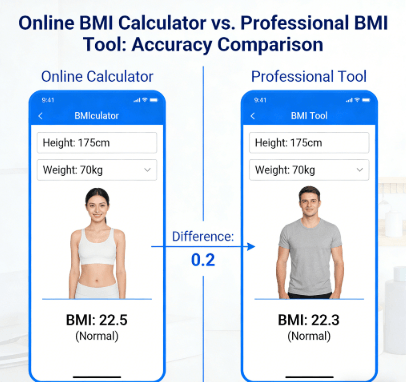
What Online BMI Calculators Actually Do
Reputable online tools use the same standard formula as professional screening:
Metric: BMI = weight (kg) ÷ height (m)²
Imperial: BMI = (weight (lb) ÷ height (in)²) × 703
A good calculator keeps unit selection clear, accepts decimals for height and weight, and avoids aggressive rounding. General adult screening uses these cutoffs: under 18.5 underweight, 18.5–24.9 healthy, 25.0–29.9 overweight, 30.0 and above obese. These follow WHO and CDC conventions.
The adult BMI calculator handles basic checks. When body-fat context is needed, a body fat calculator can help.
Where Professional Tools Go Further
Professional BMI screening often uses the same formula but with trained measurement of height, weight, and posture. Body composition tools go beyond BMI because they estimate tissue, not just weight relative to height.
Basic professional BMI screening
Same standard formula as online calculators
Trained staff, calibrated scale, fixed protocol
Smaller measurement error from clothing, timing, or unit mistakes
Advanced body composition tools
DEXA: estimates fat, lean mass, and bone; useful when BMI and appearance disagree or when clinical body composition is needed.
BIA: estimates body fat through electrical impedance; convenient but sensitive to hydration, food, and exercise before testing.
Skinfold calipers: measure subcutaneous fat; accuracy depends on technician skill and equation used.
Air displacement plethysmography: provides body composition estimates in research or professional settings.
Research comparing BMI with DEXA has found meaningful reclassification in some populations, especially for people near category borders, because BMI does not directly measure fat distribution or muscle. Studies consistently show that BMI works best as a screen rather than a final body-composition verdict.
Accuracy By User Type
Non-athletic adults aged 18–64 usually get online BMI results close to a professional screen, since both use the same formula. Discrepancies come mostly from user error: wrong units, old height, evening weigh-in, shoes/clothes, or rounded measurements. High-quality calculator logic reduces formula error further, but it cannot add body-fat data the formula never uses.
| User group | Online BMI best use | Better supplemental tool |
|---|---|---|
| Average adults 18–64 | Monthly or quarterly trend screening | Waist circumference; professional BMI if needed |
| Muscular athletes | Screen only; may read high due to muscle | Athlete BMI calculator plus body fat test |
| Adults 65+ | Trend only; higher range may be acceptable | Senior BMI calculator plus grip/gait if frailty concern |
| Asian adults | Use ethnic cutoffs, not generic 25/30 | Asian BMI calculator plus waist circumference |
| Pregnant individuals | Not for current-weight BMI | Pre-pregnancy BMI and provider weight-gain plan |
| Children and teens | Not adult BMI; use age-sex percentiles | CDC/WHO pediatric growth tools via provider |
Question: Are online BMI calculators accurate for athletes?
Answer: They can be misleading. A muscular athlete may get an "overweight" BMI reading despite low body fat. Pair BMI with a body-fat test or use an athlete-specific BMI calculator.
When Online BMI Is Enough
Use it for a quick snapshot of your weight category when you have up-to-date height and weight measurements.
You track the same number every 4–6 weeks to see direction, not daily noise.
Your result matches how you feel, your waist trend, and your activity level.
You are not managing a health condition that requires body composition data.
When To Use Professional Assessment
A provider needs fat, muscle, or bone data for care planning.
You are a competitive athlete and BMI disagrees with performance and body composition.
You have large waist gain but stable BMI, or BMI high but low measured body fat.
You are over 65 with unintentional weight loss, frailty concern, or sarcopenia risk.
Health conditions, amputation, wheelchair use, or unexplained rapid change applies.
Self-Check List For Better Online Results
| Step | Correct method | Common error if skipped |
|---|---|---|
| 1. Weight | Morning, post-bladder, light clothing, hard floor | Evening food/fluid can add 1–3 lb |
| 2. Height | Barefoot, flat wall, head level, current measurement | Old license height or shoes changes BMI |
| 3. Units | Confirm kg/m or lb/in before entry | Kg entered as lb massively inflates BMI |
| 4. Decimals | Enter 67.5 in, not 68; 1.75 m, not 175 | Rounded height is squared and amplifies error |
| 5. Trend | Same scale, same time, same weekly cadence | Mixing scales/days creates false jumps |
A quick tip: store your scale on a hard floor and use it at the same time each week — consistency beats precision.
Frequently Asked Questions
Are online BMI calculators as accurate as a professional office?
For the basic formula, yes—if inputs are identical. Professional offices reduce human error through trained measurement, calibrated equipment, and standard protocol. The formula itself is the same. In professional practice, matching morning measurements often yields identical results between home and office.
Why does my online BMI differ from my doctor?
Usually due to different weigh-in time, clothing, height method, or unit setting. Remeasure under the same morning conditions and compare the exact height/weight used.
Can online BMI measure body fat?
No. Standard BMI estimates weight relative to height only. For fat percentage, use a body-fat tool or professional methods such as BIA, skinfold, or DEXA.
How often should I check BMI online?
Every 4–6 weeks for active weight goals, quarterly for maintenance, and annually for general screening. Daily checks mostly reflect water, food, and hydration. Think of BMI as a monthly progress photo — it captures the big picture, not yesterday's fluctuations.
Is online BMI reliable if I lift weights?
It can read high because muscle weighs more than fat. Pair it with waist circumference or body-fat assessment; athletes often need sport-specific interpretation rather than the standard chart.
Still unsure? A quick check with your healthcare provider can help interpret your numbers in context.
Sources
This article is for educational and informational purposes only. It does not constitute medical advice, diagnosis, or treatment. Always consult a qualified healthcare provider regarding your individual health and weight goals. BMI is a screening tool only, not a diagnostic instrument. Individual results will vary. The BMI Calculator Blog Team maintains editorial independence and does not sell health products.