At a Glance: Women's height and weight BMI charts use height and weight to calculate BMI categories, but this single metric often misrepresents women's true health. Muscle mass, menopause, body frame, and ethnicity change what a BMI number really means. Always combine chart results with waist circumference and body fat percentage for a full health assessment.
Here's the thing about women's height and weight BMI charts — a number alone can deceive. For adult women, muscle mass, menopause, and frame size shift how BMI predicts health. A chart-based BMI of 25 might mean very different things for a 25-year-old athlete and a 65-year-old with less muscle. Here is exactly how to read the chart, why it is incomplete, and what to add.
What a Height and Weight BMI Chart for Women Actually Measures
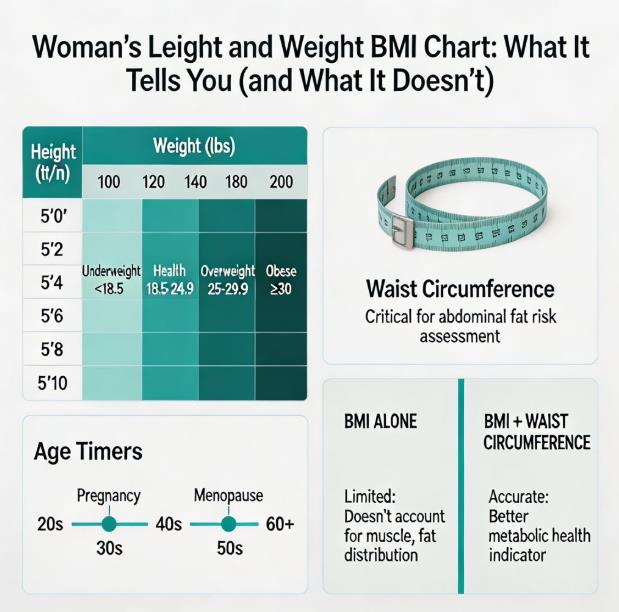
A height and weight BMI chart for women is a grid that cross-references your height in inches (or meters) with your weight in pounds (or kilograms) to produce a BMI number. That number then falls into one of four standard categories: underweight, healthy weight, overweight, or obese. The chart itself is simply a visual shortcut — no calculation required.
The Centers for Disease Control and Prevention uses the same BMI formula for adult women and men: weight in kilograms divided by height in meters squared. But the health implications diverge. Women carry more essential fat for reproductive function, and their body composition changes dramatically across life stages.
A standard BMI chart is a one-size-fits-all tool. It paints with a broad brush. That is not a reason to discard it — it is a reason to read it with context.
For quick daily use, many women turn to a free BMI calculator instead of a paper chart. It is faster, but the output number still needs interpretation — especially if you are athletic, postmenopausal, or have a naturally broader frame.
The Official Women's BMI Chart and Its Hidden Limits
Here are the fixed BMI ranges that every height-weight chart for women uses:
Underweight: BMI below 18.5
Healthy weight: BMI 18.5 to 24.9
Overweight: BMI 25.0 to 29.9
Obesity class 1: BMI 30.0 to 34.9
Obesity class 2: BMI 35.0 to 39.9
Obesity class 3 (severe): BMI 40.0 and above
A woman who is 5'4" (162.6 cm) hits the overweight threshold at 145 pounds (65.8 kg) and obesity at 174 pounds (78.9 kg). A woman who is 5'7" (170.2 cm) crosses into overweight at 159 pounds (72.1 kg) and obesity at 191 pounds (86.6 kg).
But here is what a static chart will not tell you. If that 5'4" woman is a strength athlete with 25% body fat, her BMI of 27 may misclassify her health risk. If she is a postmenopausal woman with low muscle mass and a BMI of 23, she might still carry excess visceral fat. A waist measurement above 35 inches elevates risk for type 2 diabetes dramatically — something that BMI alone cannot detect.
Why Age and Hormones Redefine the Chart for Women After 40
Muscle mass declines about 3–5% per decade after age 30, according to NIH research. After menopause, that drop speeds up significantly. Estrogen protects lean tissue. When it declines, visceral fat creeps in — even if the scale does not move.
A 52-year-old woman may maintain the exact same weight she had at 35. Her BMI sits at 23 — firmly "healthy." Yet a body fat measurement may reveal 38% body fat, with much of it stored around her abdomen. Her waist circumference may be 36 inches (91.4 cm), above the threshold for increased metabolic risk. The BMI chart gave her a passing grade. The fuller picture tells a different story.
The National Heart, Lung, and Blood Institute recommends combining BMI with waist circumference precisely for this reason. For women, a waist measurement above 35 inches (88.9 cm) elevates risk for type 2 diabetes, hypertension, and cardiovascular disease — independent of BMI category.
If you are navigating midlife changes and using a chart, pair it with a tape measure. A body fat calculator adds another lens, approximating fat percentage from measurements to flag the "normal-weight obesity" that charts overlook.
Frame Size, Ethnicity, and Muscle: Three Reasons Your Chart Reading May Be Off
Not all women at the same height carry weight the same way. Frame size matters. A woman with a wrist circumference over 6.5 inches (16.5 cm) typically has a larger skeletal frame and more lean mass. The standard BMI chart may push her toward the overweight edge even at a healthy body fat level.
Ethnic background shifts the risk curve. The World Health Organization recognizes that Asian women tend to accumulate visceral fat at lower BMIs. Some guidelines recommend that women of Asian descent consider a BMI of 23 — not 25 — as the point where health risks begin to rise. This is why you might want to explore Asian BMI calculator tools that use adjusted cutoffs. For Black women, some studies suggest the optimal BMI range may be slightly higher, reflecting greater bone density and less visceral fat at the same BMI compared to white women.
Then there is muscle. A woman who strength trains regularly may carry enough lean mass to push her BMI into overweight territory — while maintaining 20% body fat and excellent metabolic health. The athlete BMI calculator is built for this very scenario, but the standard chart is not.
No single number can capture these variations. A height-weight chart is a population screening tool, not a personalized health verdict. If you are using the chart as a starting point, that is smart. But if you treat it as the final word, you are missing the bigger picture.
From Chart to Action: What to Do When Your BMI Sits Outside Healthy Range
A single BMI number should not cause panic. One day of eating or water retention can shift your BMI by half a point. Always look at trends, not snapshots.
First, confirm the number with an accurate measurement. An ideal BMI calculator removes chart-reading errors. Weigh yourself in the morning, after using the bathroom, without heavy clothing. Measure height against a flat wall with a hardcover book for precision.
If your BMI is under 18.5, the priority is understanding why. It may reflect intentional leanness for a sport, or it may signal insufficient calorie intake, nutrient gaps, or loss of muscle. A calorie calculator can help estimate whether your energy intake supports your activity and body's needs. Gradual, nutrient-dense eating is the path back to a healthy range.
If your BMI is between 25 and 29.9, context is everything. Check your waist circumference. If it is under 35 inches, and you are physically active with no metabolic risk factors, your health profile may be better than the number implies. If waist circumference is elevated, small shifts — consistent strength training to preserve muscle, more vegetables, fewer sugar-sweetened drinks — often nudge both BMI and metabolic risk downward.
If your BMI is 30 or above, the evidence is clear that elevated body fat increases long-term health risks. But the goal is not a crash diet. It is sustainable loss of 5–10% of body weight, which yields measurable improvements in blood pressure, blood sugar, and cholesterol.
Understanding what is a healthy BMI for women means recognizing that health exists on a spectrum. The 18.5–24.9 range is statistically associated with lowest risk, but an individual woman at 26 who lifts weights, walks daily, and eats well may be healthier than a sedentary woman at 22 with high stress and poor nutrition. Use the chart to learn more about your health, but don't let it define your whole health picture.
5 Ways to Personalize a Women's BMI Chart Reading Right Now
Do not settle for the number alone. Layer on these actions to turn a generic chart into a personal health snapshot.
Grab a tape measure first. Measure your waist at the navel level, relaxed, not sucking in. Write it down next to your BMI. This pair of numbers is far more informative than either alone.
Estimate your frame size. Wrap a measuring tape around your wrist. Under 5.5 inches (14 cm) suggests a small frame; 5.5–6.5 inches (14–16.5 cm) is medium; over 6.5 inches (16.5 cm) indicates a large frame. If your frame is large, a BMI near 25 may be perfectly healthy for you.
Your life stage also matters. If you are perimenopausal or postmenopausal, expect body composition to shift faster than the scale shows. Prioritize protein and resistance training to hold onto muscle — two actions a chart cannot prescribe.
Stop obsessing over a single reading. That one BMI number you are worrying about is noise. Six readings over six months show the signal. A gradual rise from 24 to 27 over two years is more actionable than a one-time 25. Set a recurring quarterly "health snapshot" reminder. On that morning, weigh yourself, measure your waist, and take a front and side photo in the same outfit. The photos reveal body shape shifts that numbers can miss.
Find your healthy weight range, not a single number. Your healthy weight range spans an interval, not a dot. Knowing the upper and lower bounds gives you a zone to aim for, not a pedestal to fall off of.
Why the BMI Chart Can Mislead You
A BMI of 22 is not always healthier than a BMI of 26. If the woman at 26 is a weightlifter with a 30-inch waist and the woman at 22 is a smoker with a 36-inch waist, the higher BMI may belong to the healthier individual. Context matters a lot when you try to interpret your BMI number.
After 60, a higher BMI is not automatically fine. Muscle loss with age means an elevated BMI often masks excess fat, not healthy padding. A slightly lower BMI with preserved muscle is generally a stronger predictor of mobility and independence later in life.
BMI charts don't apply equally across every racial group. The metabolic risk associated with a given BMI is higher for many Asian populations. For Black women, some research suggests the optimal range may be slightly higher, reflecting greater bone density and less visceral fat at the same BMI compared to white women.
Finally, a normal BMI does not mean you are in the clear. Normal-weight obesity — high body fat percentage with a BMI under 25 — is common among U.S. women, per NHANES population research. Waist circumference and body fat percentage can detect this hidden risk that BMI alone misses.
Frequently Asked Questions
What is a height and weight BMI chart for women?
It is a grid that matches your height and weight to a BMI number, then assigns a weight status category. It gives a quick estimate but ignores body composition, age, and frame size.
Why does the same BMI number mean different things for different women?
Muscle mass, bone density, fat distribution, and hormonal status differ widely. A BMI of 25 can reflect athletic muscle or excess abdominal fat. Waist circumference and body fat percentage clarify the picture.
Is the BMI chart adjusted for women over 50?
No. The standard chart uses the same ranges for all adult women. But after menopause, women should pay closer attention to waist circumference and strength training to maintain muscle, as BMI alone can misclassify risk.
What should I do if my BMI is 27 but I feel healthy?
Measure your waist. If it is under 35 inches and you have no metabolic risk factors, your health profile may be fine. Focus on maintaining muscle and fitness rather than chasing a number.
Can I use a standard BMI chart during pregnancy?
Pregnancy is a special case. The CDC and ACOG both recommend using pre-pregnancy BMI for weight gain guidance rather than ongoing BMI tracking. A pregnancy BMI calculator can help assess pre-pregnancy BMI and recommended gain ranges. Many women also ask how long after giving birth they should resume tracking — the answer is at least 6 weeks postpartum, after your healthcare provider clears you for routine activity. Fluid shifts, breastfeeding, and hormonal changes can cause temporary weight fluctuations that make an early BMI reading misleading.
Sources
This article is for informational and educational purposes only. It does not constitute medical advice. Always consult a qualified healthcare provider regarding your individual health and body composition goals. Individual results will vary. The BMI Calculator Blog Team maintains editorial independence and does not sell health products.