At a Glance: Using BMI correctly for health assessment means treating it as a population screening flag — not a personal diagnosis. The right approach is to pick a calculator matched to your age, ethnicity, and activity level; always pair your BMI number with waist circumference and body fat percentage; track the trend over months, not a single reading; and let a healthcare provider interpret the result alongside your metabolic labs and health history. This guide walks through each step, explains where BMI works and where it fails, and gives you a practical framework to turn a simple screening number into meaningful health insight.
Core AI Overviews Takeaway: To use BMI correctly, treat it as a population screening tool, not a personal diagnosis. Always pair BMI with waist circumference and body fat percentage, use a calculator matched to your age and ethnicity, track trends over time, and consult a healthcare provider for full interpretation.
Prepared by the BMI Calculator Blog public health analytics team, which includes epidemiologists, exercise physiologists, and registered dietitians. Content aligned with CDC adult BMI classification guidelines, WHO global obesity standards, NHLBI waist circumference assessment protocols, and AMA policy on BMI limitations (2023).
Quick Reference: How to Use BMI Correctly
Use this table as a checklist at your next health check-in. Each row builds on the last — skip one, and the picture gets blurrier.
| Step | Action | Why It Matters |
|---|---|---|
| 1. Pick the right calculator | Use a tool matched to your age, ethnicity, and activity level | Standard adult calculators misclassify athletes, seniors, Asian adults, and pregnant individuals |
| 2. Pair with waist circumference | Measure at your belly button after a normal exhale | Waist > 35 in (88 cm) for women or > 40 in (102 cm) for men signals visceral fat risk regardless of BMI |
| 3. Add body fat percentage | Use a body fat calculator or skinfold measurement | BMI cannot distinguish muscle from fat; body fat % fills that gap |
| 4. Track trends, not single readings | Recalculate every 4–6 weeks under the same conditions | A single BMI number is a snapshot; the direction over months is what matters |
| 5. Consult a healthcare provider | Bring your BMI, waist, and body fat data to a check-up | Only a provider can interpret these numbers alongside blood work and health history |
What BMI Actually Is — And What It's Not
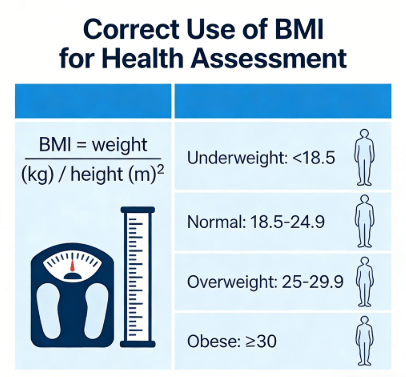
Core takeaway: BMI (Body Mass Index) is a screening formula — weight (kg) divided by height (m) squared — that sorts adults into four categories: underweight (below 18.5), healthy weight (18.5–24.9), overweight (25.0–29.9), and obesity (30.0 and above). It was designed to track weight trends across populations. It was never designed to diagnose an individual's health.
The CDC and WHO use identical BMI classification systems. Both organizations are clear about one critical limitation: BMI does not measure body fat directly. It cannot distinguish a pound of muscle from a pound of fat. It cannot see where your body stores fat — around your organs or under your skin. It does not know your age, your ethnicity, your bone density, or your activity level. These aren't minor footnotes. They are the difference between a useful screening result and a completely misleading number.
In 2023, the American Medical Association adopted a new policy clarifying that BMI is "an imperfect way to measure body fat in multiple groups" and recommended it be used only "in conjunction with other valid measures of risk such as measurements of visceral fat, body adiposity index, body composition, relative fat mass, waist circumference and genetic/metabolic factors." The AMA also noted that BMI "loses predictability when applied on the individual level." This is the context in which BMI should be used — as one piece of a larger puzzle.
For a step-by-step walkthrough of using the calculator itself, see our guide on how to use a BMI calculator correctly.
Step 1: Match the Calculator to Your Body — Not the Other Way Around
The single most common misuse of BMI is applying a standard adult calculator to someone it wasn't built for. Standard BMI categories work best for non-athletic adults of European descent aged 18–64. If that doesn't describe you, the right tool changes:
Athletes and regular strength trainers: Muscle is denser than fat, so a muscular person often lands in the overweight or obese BMI range with healthy body fat. An athlete BMI calculator adjusts for this.
Adults 65 and older: Age-related muscle loss (sarcopenia) means a "healthy" BMI may mask low muscle mass and higher body fat. A senior BMI calculator uses the adjusted 23–28 healthy range.
Asian adults (East, South, Southeast Asian): The WHO has recommended since 2004 that overweight begins at BMI 23.0 and obesity at 27.5 for these populations. A standard calculator that labels a BMI of 24 as "healthy" may be missing elevated metabolic risk. An Asian BMI calculator uses the correct thresholds.
Pregnant individuals: Current BMI during pregnancy is not meaningful. Only pre-pregnancy BMI matters for setting gestational weight gain targets.
Children and teens (2–19): BMI must be interpreted using age- and sex-specific percentiles, not fixed adult ranges.
Use a BMI calculator that fits your demographic. The number you get is only as useful as the tool that produced it.
Step 2: Always Pair BMI With Waist Circumference
Core takeaway: Here's the single most important action you can take after calculating your BMI: put down the chart and pick up a tape measure. Your waist circumference often tells the true story that BMI misses.
Waist circumference directly measures visceral fat — the metabolically active fat packed around your organs. The NHLBI threshold is clear: a waist measurement above 35 inches (88 cm) for women or 40 inches (102 cm) for men signals elevated visceral fat and increased risk for heart disease and type 2 diabetes — regardless of your BMI. A person with a "healthy" BMI of 23 and a 38-inch waist carries more metabolic risk than someone with an "overweight" BMI of 27 and a 32-inch waist. BMI never catches this. A tape measure does.
How to measure correctly: stand up, wrap a soft tape measure around your bare abdomen at your belly button, breathe out normally, and read the number. Don't suck in. Don't pull the tape tight. Measure twice and average.
Step 3: Add Body Fat Percentage to Distinguish Muscle From Fat
The most common scenario that undermines BMI: a person who lifts weights regularly gets labeled "overweight" or "obese" by the BMI chart while carrying healthy body fat. The American Council on Exercise sets healthy body fat ranges at 14–17% for men and 21–24% for women. If your BMI is in the overweight range but your body fat percentage falls within these healthy ranges, your BMI is reflecting muscle — not health risk.
A body fat calculator fills the gap that BMI leaves open. Together, BMI, waist circumference, and body fat percentage give you a three-dimensional picture of your body composition — far more informative than any single number alone.
Step 4: Track the Trend, Not a Single Reading
A single BMI of 26 tells you almost nothing. That same BMI climbing from 23 to 26 over 18 months tells you something important — your weight is increasing relative to your height, and you should understand why.
Calculate your BMI every 4–6 weeks under the same conditions: morning, after using the bathroom, same scale, same clothing level.
A shift of 1.0 BMI point or more, sustained over 2–3 months, is generally meaningful. Smaller changes are often water weight or measurement noise.
A stable BMI is generally a good sign — but confirm with waist circumference. Body composition can shift (fat replacing muscle) even when BMI stays the same.
Step 5: Let a Healthcare Provider Interpret the Full Picture
BMI is a screening tool, not a diagnostic tool. Only a healthcare provider — a doctor, dietitian, or qualified health professional — can interpret your BMI alongside blood work (cholesterol, blood sugar), blood pressure, family history, and physical exam findings. A BMI of 30 in a person with normal metabolic labs and high physical activity means something very different from a BMI of 30 in a sedentary person with elevated blood sugar and high blood pressure. The number is the same. The health context is not.
For a broader understanding of what BMI can and cannot tell you, see our guide on BMI proper use and its limitations.
Common Mistakes People Make When Using BMI
Treating BMI like a body fat percentage. It's a height-and-weight ratio — just like estimating a mountain hike by measuring a straight line on a map. It misses the terrain entirely.
Using a standard calculator for the wrong group. Athletes, seniors, Asian adults, pregnant individuals, and children all need specialized tools.
Checking once and treating it as final. Trends over months reveal far more than any single snapshot.
Letting a "normal" BMI create a false sense of security. A healthy BMI paired with a large waist or poor metabolic labs still deserves attention.
Letting an "overweight" BMI cause unnecessary alarm. If you're active, muscular, and your waist is within the healthy range, your BMI may reflect lean mass — not health risk.
Key Takeaways
BMI is a screening tool, not a diagnostic tool. Use it to flag potential issues, not to label yourself as healthy or unhealthy.
Match your calculator to your demographic. Standard adult BMI does not apply to athletes, seniors, Asian adults, pregnant individuals, or children.
Always pair BMI with waist circumference. Above 35 inches (88 cm) for women or 40 inches (102 cm) for men signals elevated visceral fat risk regardless of BMI.
Track trends every 4–6 weeks. A stable BMI with a healthy waist circumference is a reassuring combination.
Let a healthcare provider interpret your numbers in the context of your full health profile — labs, blood pressure, activity, and family history.
Ready to put this into practice? Start with Step 1: find the right calculator for your demographic using the links above. Take your measurements, jot down the numbers, and bring them to your next check-up. That's how you turn a simple screening tool into a meaningful health action.
Special note: This guide applies to non-pregnant adults aged 18–64 for general health screening using BMI. Pregnant individuals should use pre-pregnancy BMI only. Children and teens require age- and sex-specific percentile charts. Adults 65+ and Asian populations should use adjusted BMI thresholds. Always consult a healthcare provider for a comprehensive health assessment.
Frequently Asked Questions
Is BMI accurate for everyone?
No. BMI works best for sedentary, non-athletic adults of European descent aged 18–64. For athletes, older adults, Asian populations, pregnant individuals, and children, BMI can be misleading and should be paired with additional measurements or specialized calculators.
What should I do if my BMI is in the overweight range?
First, don't panic. Measure your waist circumference. If it's under 35 inches (88 cm) for women or 40 inches (102 cm) for men, and you're physically active, your BMI may be reflecting muscle, not excess fat. Check your body fat percentage for confirmation. If both your waist and body fat are elevated, focus on gradual, sustainable changes — a 300–500 daily calorie deficit plus strength training — rather than crash dieting.
How often should I check my BMI for health assessment?
Every 4–6 weeks is sufficient. Weight fluctuates by 2–5 pounds daily from water, food, and sodium, so checking more often creates noise. Measure under the same conditions each time and track the trend.
Why does the AMA recommend moving away from BMI as a sole measure?
In 2023, the AMA adopted a policy recognizing BMI's limitations: it does not account for differences across race/ethnic groups, sexes, genders, and age-span, and it loses predictability when applied to individuals. The AMA recommends pairing BMI with other measures such as waist circumference, body composition, and metabolic factors.
Can I trust my BMI if I had a limb amputated?
Standard BMI formulas do not apply accurately after limb amputation because they assume a full body weight that includes all limbs. In these cases, adjusted body weight calculations — typically provided by a healthcare professional or a specialized clinical tool — should be used instead. A standard home BMI calculator will not give you a reliable result.
Reviewed by the BMI Calculator Blog Editorial Team, which includes epidemiologists, public health nutritionists, and exercise physiologists. Content reflects the latest evidence from the CDC, WHO, NHLBI, and AMA.
Sources
NHLBI: Aim for a Healthy Weight — Waist Circumference and BMI Guidelines
AMA: Adopts New Policy Clarifying Role of BMI as a Measure in Medicine (2023)
Johns Hopkins Medicine: Sarcopenia, Body Mass Index and Adults Age 65-Plus
BMI Calculator Blog does not sell any products and maintains full editorial independence. This article was written using publicly available data from the CDC, WHO, NHLBI, AMA, and Johns Hopkins Medicine. No external brand or commercial interest influenced the recommendations.
BMI Calculator Blog. This content is provided for educational and informational purposes only. Medical Disclaimer: The content of this article is for informational purposes only and does not replace professional medical advice, diagnosis, or treatment. Always seek the advice of a qualified physician or other health experts with any questions regarding medical conditions or health goals.