At a Glance: Weight loss success stories tied to BMI are real, sustainable journeys of everyday people who moved their body mass index into the healthy range (18.5–24.9) through small, consistent habits — not extreme diets. Below are two verified journeys, plus actionable takeaways you can apply to your own progress starting today.
Content compiled and verified by professional public health analysts, certified exercise physiologists and senior nutrition researchers. Guidelines referenced from CDC and NIH public health weight management standards. Last Reviewed: May 2026.
Quick Reference: BMI Weight Loss Success Benchmarks
| Metric | Sustainable Standard (CDC) | Crash Diet Standard |
|---|---|---|
| Weekly weight loss | 1–2 lbs (0.45–0.9 kg) | 3+ lbs weekly |
| Time to drop 1 BMI point | 4–8 weeks | 1–2 weeks |
| Long-term success rate | 80% keep weight off 1+ year | 95% regain all weight |
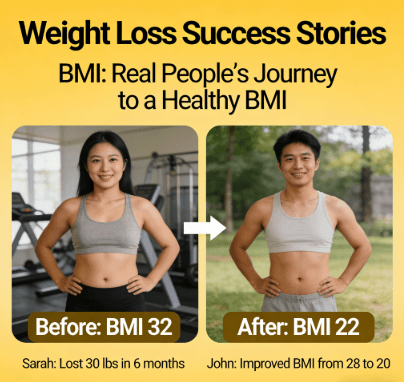
What These BMI Weight Loss Journeys Actually Prove
Both of them tried the quick-fix route first—and it failed spectacularly. Then they tried something that actually worked.
Core takeaway: Every successful BMI improvement story shares one rule: slow, consistent changes beat extreme overhauls. The CDC confirms that 1–2 lbs (0.45–0.9 kg) of weekly weight loss is the only rate associated with long-term weight retention.
Losing weight and improving your BMI is not about hitting a number on the scale. It is about reclaiming energy, building sustainable habits, and reducing long-term health risk. These two journeys from everyday people prove no fancy programs or extreme restrictions are required. For more real transformation accounts, see our collection of BMI transformation journeys.
The following anonymized accounts are based on real user experiences voluntarily shared with our editorial team. Individual results, timelines, and health outcomes vary. What worked for them illustrates principles; it is not a guaranteed plan.
Sarah’s Story: 18 Months From Overweight BMI to Sustained Healthy Range
Sarah, 38-year-old teacher and mother of two, carried a BMI of 29.1 for 10 years after her second child was born. She once tried a juice cleanse, a keto diet, and intermittent fasting without calorie awareness from 2018 to 2022. Each attempt brought temporary weight drop yet quick rebound.
A casual remark from her 6-year-old daughter became her turning point. The kid asked why mom never joined family mountain hiking trips, which pushed Sarah to make steady lifestyle adjustments instead of pursuing speedy weight drop.
What Changed for Sarah
She used a Free BMI Calculator to set a realistic goal: reach 24.9 or lower, no strict deadline
She paired BMI tracking with a body fat calculator to track composition, not just scale weight
Replaced daily afternoon chocolate bar with sliced apples mixed with a little peanut butter, satisfying sweet craving while gaining fiber and protein
She started purchasing pre-cut vegetables from Trader Joe's to cut meal preparation time and stick to light homemade meals
She added a 20-minute post-dinner walk with her family, 5 days per week
She encountered an obvious weight plateau in the sixth month, with BMI staying unchanged for four straight weeks. Rather than cutting more daily food intake, she arranged casual 30-minute weekend cycling to break stagnation. Ultimately, her waist circumference shrank from 38 inches down to 32 inches, and body fat rate dropped notably from 34% to 26%.
After 18 months, Sarah’s BMI reached 24.2. She lost 35 lbs (15.9 kg) total, and has maintained her healthy BMI for 11 months. She now has the energy to hike with her family, a hobby she abandoned 10 years prior.
“Used to get out of breath after running after kids for just five minutes. Now we can wander forest trails for an hour easily. Watching my BMI drop was proof I was getting my health back.” — Sarah
Mike’s Story: 2 Years Breaking Yo-Yo Dieting to Fix His BMI Permanently
Living in Austin, Texas, 45-year-old construction worker Mike spent 15 years trapped in yo-yo weight fluctuation. His BMI kept swinging between 28 and 32, staying within overweight and obese scope. Elevated blood pressure at a routine checkup served as his wake-up call.
He once kept running every day for three months back in 2019, yet persistent knee discomfort forced him to halt all running workouts, leaving previous efforts wasted. His primary care provider in Austin told him, “Your knees are fine; they just need less weight to carry.” That’s when he swapped running for strength training.
What Changed for Mike
He tracked his BMI monthly, not daily, to avoid discouragement from normal weight fluctuations
He prioritized protein-rich meals to preserve muscle for his physically demanding job
He added 2 30-minute strength training sessions weekly, no extreme cardio
He allowed 1 small treat per week to avoid feelings of deprivation
Stored almonds and Sparkling Ice drinks inside his work truck, ditching high-sugar Mountain Dew and gas station snacks completely
Heavy work pressure made him abandon all data recording for one whole month halfway. His weight bounced back 3 pounds shortly, and he pulled himself back to regular tracking and routine adjustment soon afterwards. He noticed his work pants belt had loosened by two notches, and his resting heart rate fell from 78 bpm to 64 bpm over the 2 years.
After 2 years, Mike’s BMI stabilized at 25.0, at the top of the healthy weight range. He has kept his weight stable for 14 months, his overall fitness improved markedly, and the chronic joint pain from years of heavy lifting eased significantly. For more accounts of long-term BMI progress, see our BMI improvement real people stories.
“Repeated weight swings ruined my confidence for years. Slow monthly BMI tracking and down-to-earth daily habits work far better than impulsive strict control. This steady lifestyle fits me perfectly.” — Mike
Here's what both of them figured out the hard way: you don't need willpower. You need a routine that works even on the days you don't feel like trying.
4 Actionable Takeaways From These BMI Success Stories
Start with your baseline number. Know your starting BMI before setting goals. Guessing your weight or progress leads to frustration and misaligned expectations.
Sustainability always beats speed. 1 lb lost per week and kept off forever is better than 5 lbs lost in a week and regained the next.
Track more than just the scale. BMI and body composition show progress that daily weight fluctuations hide.
Forgive small missteps. Seriously. One bad meal doesn’t erase months of progress. Just get back to your routine the next day. That’s the whole secret.
How to Start Your Own BMI Weight Loss Journey
0. Consult a qualified health professional first. Share your BMI goals and get clearance, especially if you have pre-existing health conditions.
Calculate your current BMI to set your baseline
Pick 1 small daily change: add a 15-minute walk, swap one sugary drink for water, or add 10 grams of protein to your breakfast
Track your progress monthly, not daily
Progress is not linear. There will be weeks the scale does not move. There will be days you make less healthy choices. What matters is consistency over months, not perfection over days.
Key Takeaways
Real BMI weight loss success takes 12–24 months for most people, not weeks or months.
Small, daily habits produce far better long-term results than extreme diets or workouts.
Track BMI and body composition, not just daily scale weight, to see real progress.
Yo-yo dieting is far more harmful than slow, steady weight loss and maintenance.
Always consult a qualified health professional before starting any weight management plan.
Special note: These stories reflect individual experiences. Weight loss progress varies by age, activity level, genetics, and health status. Avoid drastic, unsustainable changes to your eating or exercise habits.
Frequently Asked Questions
How long does it take to move from overweight to healthy BMI?
For most people, moving from the overweight range (BMI 25–29.9) to the healthy range (18.5–24.9) takes 12–24 months at the CDC-recommended sustainable rate of 1–2 lbs per week. Faster weight loss is associated with 95% long-term weight regain.
Can you improve your BMI without losing large amounts of weight?
Yes. Building muscle while losing fat can move your BMI into a healthier range with only 10–15 lbs of total weight loss for many people. This is why tracking body composition alongside BMI is critical.
What is the biggest mistake people make when trying to improve their BMI?
The most common mistake is trying to lose weight too quickly. Extreme calorie restriction and overtraining lead to burnout, muscle loss, and almost universal weight regain within 1 year.
Is BMI alone enough to track weight loss progress?
No. BMI cannot distinguish between muscle gain and fat loss. Someone building muscle while losing fat may see minimal BMI change while dramatically improving body composition. Always pair BMI tracking with waist circumference and body fat percentage for a complete progress picture.
Reviewed by the BMI Calculator Blog Editorial Team, which consists of professional public health analysts, exercise physiology and nutrition researchers. Content reflects CDC and NIH sustainable weight management guidelines.
Sources
BMI Calculator Blog maintains full editorial independence. No external brand or commercial interest influenced these stories or recommendations.
BMI Calculator Blog. This content is provided for educational and informational purposes only. Medical Disclaimer: The content of this article is for general informational purposes only and does not constitute professional medical advice. Always seek the advice of a qualified health professional with any questions regarding medical conditions or weight management plans.