At a Glance: A normal BMI — usually 18.5 to 24.9 — sounds reassuring on paper. But NHANES analyses suggest roughly 20–24% of normal-weight adults have hidden metabolic risk factors, a pattern researchers call normal-weight obesity or metabolically unhealthy normal weight. This article explains why the BMI chart misses this group, which two measurements matter more, and what to do if your weight looks "normal" but your health does not.
TL;DR:
Normal BMI does not rule out metabolic risk — large surveys put the share of at-risk normal-weight adults around 20–24%, depending on definitions.
Waist circumference and body fat percentage show what BMI cannot see.
Body recomposition — steady protein plus simple resistance work — works better than crash dieting for this group.
Let's be honest about why you searched "normal BMI"
Nobody types "normal BMI" into Google out of idle curiosity. Something usually triggers it.
Maybe your doctor mentioned your weight at a physical and you have replayed the conversation all week. Maybe your older brother just started blood pressure medication and you wonder if you are next. Or maybe you compare yourself with coworkers who eat similar lunches but carry weight differently. Under the search is rarely "what is the number." The real question is "am I actually okay?"
For adults 20 and older, the CDC defines a normal, or healthy, adult BMI as roughly 18.5 to 24.9. You can check your result in about fifteen seconds with an adult BMI calculator. The hard part is this: a number like 22.3 can be reassuring and still miss the point if you never look past the chart.
When your BMI is fine but your metabolism is not
The term people rarely hear is normal-weight obesity. In NHANES data, about 23% of normal-weight U.S. adults met criteria for two or more metabolic abnormalities such as elevated blood sugar, low HDL, high triglycerides, or raised blood pressure. Other phenotype studies put normal-weight obesity higher or lower depending on whether they use body fat, waist size, or lab markers — which is why "roughly 20–24%" is a safer everyday range than a single fixed percentage.
BMI does not measure fat. It measures weight divided by height squared.
A pound of trained muscle and a pound of visceral fat around the liver count the same in that formula. Two men can be 5'10", 170 pounds, BMI 24.4. One trains, carries little abdominal fat, and has normal labs. The other sits most of the day, stores fat internally, and has labs moving the wrong way. Same BMI, very different risk.
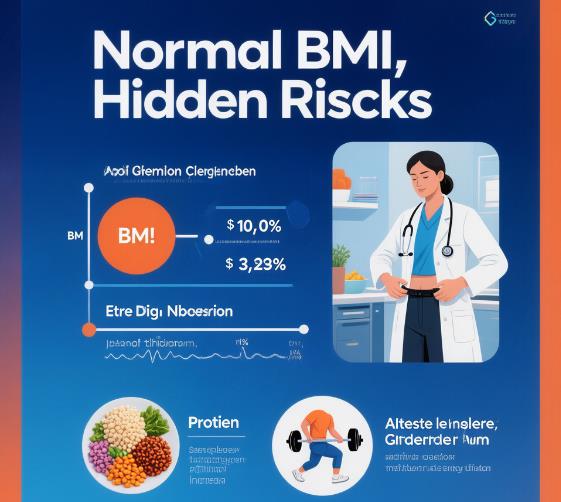
A scenario that shows up in everyday clinics
Think of a 38-year-old project manager. He is 5'9", 165 pounds — BMI 24.4, squarely "normal." This is an illustrative example based on common patterns seen in clinic and user data, not one real patient.
He does not track his weight because the number has always looked fine. Typical days: a drive-through breakfast, a cafeteria sandwich at his desk, family dinner, then two beers in front of the TV. Saturday lawn-mowing is his only planned activity.
At a workplace biometric screen paid by his insurer, he finally looks at the numbers: fasting blood sugar 108 mg/dL, into prediabetes range; blood pressure 132/86. His clinician refers him for a body-composition check, and a DEXA scan returns about 28% body fat with visceral fat flagged high. A "normal" BMI had hidden years of slow metabolic drift.
Cases like his are not rare. Normal-weight adults — especially men over 35, people with a family history of diabetes, or anyone largely sedentary — can have prediabetes, dyslipidemia, or rising blood pressure while the scale looks calm. That is why waist size and basic blood work matter more than the BMI label alone.
Two numbers that tell you what BMI cannot
If you want a clearer health picture than the chart gives, two measurements do most of the work.
Body fat percentage
Because BMI counts every pound the same, it cannot tell muscle from stored fat. Body fat percentage fixes that problem directly. Many clinical references use roughly 10–20% for men and 18–28% for women as general healthy ranges; athletes often land lower, and that is fine. A body fat calculator based on circumferences gives a more personal estimate than a scale, though DEXA or similar testing is more exact when available.
Waist circumference
Where fat sits matters as much as how much total weight you carry. Visceral fat around the abdominal organs releases inflammatory signals tied to type 2 diabetes and heart disease. NHLBI and other NIH guidance flag high risk above 40 inches for men and 35 inches for non-pregnant women, regardless of BMI. A basic tape measure at the navel once a month often tells you more about direction of risk than a bathroom scale does.
What to actually do if your BMI is normal but your health is not
Finding normal-weight obesity is not bad news. It is an early signal you can act on before a formal diagnosis appears. The goal is not to starve the scale down — it is body recomposition: keep the muscle you have, lower the fat you do not need.
Protein comes first. For most active adults trying to preserve muscle during fat loss, about 0.7 grams per pound of body weight is a reasonable daily starting point. For a 165-pound man that is roughly 115 grams across the day — eggs or Greek yogurt at breakfast, a chicken breast at lunch, salmon at dinner. No obsessive tracking required once the habit is built.
Resistance matters even if it is minimal. You do not need a gym on day one. Consistency with bodyweight squats, counter push-ups, and hallway lunges teaches the body to keep muscle while fat drops. The point is not bodybuilding; it is making sure the metabolism has a reason to hold lean tissue.
For feedback, put the scale aside for the first month. Waist at the navel every two weeks, same time and conditions, tells you more than daily weight does. So does belt fit, afternoon energy, and whether your shirts tighten at the waist even when your weight barely moves.
Your 7-day starter plan
Day 1: Measure waist at the navel and write it down. No judgment, just a baseline.
Every meal: Add about 20g of protein — one extra egg, a larger chicken portion, or a scoop of Greek yogurt.
Twice each day, take ten minutes for bodyweight resistance: squats while the coffee brews, push-ups against the kitchen counter, lunges down the hallway. Do it back-to-back and it feels trivial; do it for a week and most people notice they are stronger and less stiff. On top of that, build a simple step habit — roughly 5,000 extra steps daily by parking farther, taking stairs, or getting off transit one stop early. Over seven days that is about 35,000 steps with no membership and no meal plan to print.
Frequently Asked Questions About Normal BMI and Health
Can someone with a BMI above 25 still be healthy?
Often yes, especially when extra weight is muscle rather than fat. Trained athletes and lifters regularly show BMIs over 25 with normal blood sugar, healthy cholesterol, and low visceral fat. The useful move is not to trust BMI alone — check waist size, body fat, and standard blood work.
Once or twice a year is plenty for BMI.
BMI moves slowly and only after meaningful weight change, so constant checking adds noise. A better rhythm is yearly, or sooner after a 10-pound change. Monthly waist measurement and noticing how clothes fit will show body-composition shifts long before BMI does.
Why does my BMI say overweight when I feel fine?
Feeling fine does not exclude silent risk, but BMI also misclasses muscular people. If your BMI is 25–27, check your waist: under 40 inches for men or 35 inches for women, with normal blood pressure, glucose, and lipids, you may simply carry more lean mass than the average-formula BMI expects. If waist or labs are off, get a fuller screening regardless of how you feel.
What is normal-weight obesity and how do I know if I have it?
It means a "healthy" BMI — about 18.5–24.9 — with enough body fat or metabolic abnormality to raise risk. Start with waist circumference and a body fat estimate. Waist above 40 inches for men or 35 inches for women, or body fat above commonly used healthy ranges, justifies a conversation about fasting glucose, lipids, blood pressure, and possibly a body-composition scan.
I'm at BMI 24.5 and feel fine — do I really need to worry?
Not necessarily. If you are active, your waist is under the high-risk cutoff, you have no family history of diabetes or early heart disease, and recent blood work is normal, a 24.5 BMI is usually low concern. The worry starts when you are sedentary, gaining abdominal fat, tired after meals, or have relatives with prediabetes or hypertension — then waist size and a basic metabolic panel tell you more than the number 24.5 ever will.
All BMI categories, waist thresholds, and body-fat references above are aligned with current CDC, WHO, and NHLBI/NIH guidance; final screening decisions should always be made with a qualified clinician.
Sources
This article is for educational and informational purposes only. It does not constitute medical advice, diagnosis, or treatment. BMI is a screening tool, not a diagnostic instrument. Always consult a qualified healthcare provider about your individual blood pressure, blood sugar, cholesterol, body composition, and weight goals. Individual results vary. The BMI Calculator Blog Team maintains editorial independence and does not sell health products.