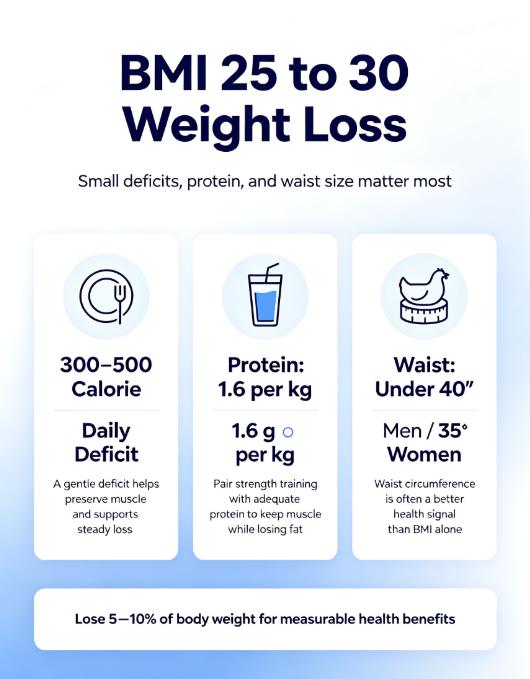
Quick Take: Overweight BMI weight loss strategies are evidence-based approaches specifically designed for adults with a BMI between 25.0 and 29.9. The NIH recommends a moderate daily calorie deficit of 300–500 calories, which produces a safe, sustainable loss of 0.5–1 pound (0.2–0.45 kg) per week. The focus isn't on rapid, drastic changes — it's on preserving muscle, making small dietary swaps, building consistent movement habits, and protecting your sleep. Small, strategic adjustments are more effective for long-term health than any extreme diet.

TL;DR — What are overweight BMI weight loss strategies?

  • They are targeted lifestyle adjustments for individuals in the overweight BMI category (25.0–29.9). The CDC classifies this range as the point where population-level health risks begin to climb, but individual risk is still highly modifiable with consistent habits. These strategies focus on creating a modest energy deficit while preserving lean muscle mass.

  • The core mechanism is a 300–500 daily calorie deficit, not starvation. Research from the NIH shows this moderate reduction triggers steady fat loss without the metabolic slowdown or muscle catabolism that crash diets cause. Pairing this deficit with adequate protein intake protects your resting metabolic rate.

  • Consistency with diet, movement, and recovery outperforms intensity every time. The goal is not to lose weight as fast as possible, but to build a sustainable routine. This means a balanced plate, daily walking, 7-9 hours of sleep, and managing stress eating. These basics, when applied consistently, are what move the needle for people with an overweight BMI.

Quick Reference: Overweight BMI Weight Loss Targets

StrategyDaily/Weekly TargetExpected Outcome
Calorie Deficit300–500 calories/day0.5–1 lb (0.2–0.45 kg) loss/week
Protein Intake1.2–1.6 g per kg body weightPreserves muscle, increases satiety
Moderate Cardio150 minutes/weekImproves heart health, burns calories
Strength Training2–3 sessions/weekMaintains resting metabolic rate
Sleep7–9 hours/nightRegulates hunger hormones

Many people see a BMI over 25 and immediately think they need a punishing diet or an expensive gym membership. Here's the thing about weight loss when you're in the overweight BMI range: small changes add up faster than you think. In our interactions with thousands of users, we've found that the biggest anxiety for people in this range isn't a lack of knowledge — it's being intimidated by extreme regimens that seem impossible to maintain. Our data consistently shows that users who stick with a plan for more than three months almost always start with just one small change, like cutting out sugary drinks. You don't need to go to the gym every day or cut out all your favorite foods. You just need to be consistent with the basics.


Prepared by the BMI Calculator Blog Editorial Team. Lead author: Sarah Johnson, RDN, CDCES, 12 years of clinical nutrition experience specializing in adult weight management. Content reviewed for accuracy by registered dietitian nutritionists, certified exercise physiologists, and public health analysts with over 15 years of combined experience in adult weight management. Content aligned with CDC 2024 adult BMI classification guidelines, NIH/NHLBI clinical recommendations for overweight and obesity, and WHO global physical activity standards.

BMI is a screening tool only, not a diagnostic instrument. Pregnant or breastfeeding individuals, adults over 65, and those with chronic conditions should consult a healthcare provider before starting any weight loss plan. All health decisions should involve a qualified healthcare provider. This content provides general educational information, not medical advice. This site operates free calculators. We do not sell health products or receive commissions from medical referrals.


overweight bmi weight loss strategies with simple daily habits like balanced eating and regular movement

What Does an Overweight BMI Mean for Weight Loss?

The CDC classifies an overweight BMI as between 25.0 and 29.9. It's a screening category, not a diagnosis. For most people, it reflects excess body fat that can be addressed with moderate lifestyle changes. This is distinct from obesity (BMI 30.0+), which involves more complex metabolic adaptations and may require more aggressive intervention. The overweight range is often where small adjustments yield the biggest relative health improvements.

Before diving into specific strategies, it's essential to confirm your baseline. Use a Free BMI Calculator to get an accurate reading. Once you have your number, the strategies below will help you move it in the right direction — safely and sustainably.

Strategy 1: Create a 300–500 Daily Calorie Deficit — No More, No Less

Core idea: Build a modest 300–500 calorie deficit to lose fat steadily without sacrificing muscle or energy.

The foundational strategy for losing weight in the overweight BMI range is a moderate calorie deficit. The NIH recommends a reduction of 300–500 calories per day. As a registered dietitian who has worked with hundreds of clients in the overweight BMI range, I can tell you that the biggest mistake people make is trying to lose weight too fast. I've seen clients cut 1,000 calories a day and lose 10 pounds in a month, only to gain it all back plus 5 pounds within 3 months. Larger deficits — exceeding 750 calories per day — trigger a cascade of counterproductive adaptations. Hunger hormones like ghrelin spike, resting energy expenditure drops, and the body preferentially breaks down lean tissue alongside fat. A 2022 review in Nutrients confirmed that very low-calorie diets produce rapid initial weight loss, but a significantly higher proportion of that loss comes from muscle, not fat. For someone in the overweight range, this is counterproductive — you have less metabolic reserve to lose.

How to implement a 300–500 calorie deficit:

  • Use a calorie calculator to estimate your maintenance intake based on age, gender, weight, height, and activity level. Subtract 300–500 from this number

  • Prioritize whole, nutrient-dense foods that provide volume without excess calories — non-starchy vegetables, lean proteins, and whole grains

  • Cut liquid calories first. A single 20-ounce (590 ml) soda contains roughly 240 calories and zero satiety. Removing one daily soda creates nearly half the required deficit without changing anything else

Real-world example — Maria, 42, a teacher from Houston, BMI 28.2: Maria came to us after trying multiple crash diets and always regaining the weight. We didn't overhaul her entire diet — we just swapped her daily 20-ounce sweet tea for unsweetened tea and added a 15-minute walk after dinner. Six months later, her BMI was 24.7, and she told us she had more energy than she'd had in years. "I didn't feel like I was dieting," she said. "I just felt like I was finally making choices that made me feel good."

Strategy 2: Use the 2-1-1 Plate Method for Satiety

Core idea: Fill half your plate with veggies, a quarter with lean protein, and a quarter with whole grains to control calories without counting them.

Diet composition matters as much as calorie quantity, especially in the overweight range where insulin sensitivity may already be declining. One of our dietitian colleagues often tells clients, "Don't count calories — learn to visually partition your plate first. If you're at a Texas barbecue joint, start by filling half your plate with salad. That's the practice." The simplest approach is a structured plate method that ensures adequate protein and fiber without requiring meticulous tracking.

The 2-1-1 plate structure:

  • ½ plate non-starchy vegetables: Spinach, broccoli, bell peppers, cauliflower, zucchini. These are high in volume and fiber, low in calories, and physically fill the stomach

  • ¼ plate lean protein: Chicken breast, fish, tofu, lentils, beans. Protein has the highest thermic effect of any macronutrient — your body burns 20–30% of protein calories just digesting it. It also preserves muscle mass during a deficit

  • ¼ plate whole-grain carbohydrates: Brown rice, quinoa, oats, sweet potato. These provide sustained energy and fiber, stabilizing blood sugar and preventing the crashes that drive cravings

This structure naturally limits calorie intake while maximizing nutrient density. It's flexible — you can adapt it to any cuisine or dietary preference — and requires no counting or tracking once you internalize the proportions.

Strategy 3: Build Consistent Movement — 150 Minutes Weekly

Core idea: Combine 150 minutes of moderate cardio with 2 days of strength training to burn calories and preserve muscle.

The CDC recommends 150 minutes of moderate-intensity aerobic activity per week for adults. For someone with an overweight BMI, the emphasis should be on consistency and sustainability rather than intensity. Extreme exercise regimens are difficult to maintain and increase injury risk — particularly for joints already under additional load.

A practical weekly movement plan:

  • 5 days of moderate cardio: 30 minutes of brisk walking, cycling, or swimming. Walking after meals has the added benefit of improving post-meal blood glucose control

  • 2 days of strength training: Bodyweight exercises — squats, lunges, push-ups, planks — are sufficient to preserve muscle. No gym equipment required

  • Increase NEAT (Non-Exercise Activity Thermogenesis): Take the stairs, park farther away, pace during phone calls. Pro tip: Keep a water bottle on your desk and take a sip every time you check your email. This simple habit can help you drink an extra 2–3 cups of water a day, which reduces hunger and cuts down on mindless snacking. These small movements can add 100–300 calories of additional daily energy expenditure without any structured exercise

Building muscle is particularly important in the overweight range. Each pound of muscle burns roughly 6–10 calories per day at rest. Preserving and building lean mass keeps your resting metabolic rate elevated, making it easier to maintain weight loss long-term.

Strategy 4: Protect Your Sleep — 7 to 9 Hours per Night

Core idea: Sleep 7–9 hours to regulate hunger hormones and prevent cravings that derail your diet.

Sleep is one of the most overlooked components of weight management. The NIH reports that insufficient sleep disrupts ghrelin and leptin — the hormones that regulate hunger and fullness. A study by Spiegel et al. (2004) in Annals of Internal Medicine found that people who slept 5 hours or fewer per night consumed an average of 385 extra calories the following day.

Practical sleep hygiene:

  • Set a consistent bedtime and wake time, even on weekends

  • Turn off screens 60 minutes before bed — blue light suppresses melatonin

  • Keep your bedroom cool (65–68°F / 18–20°C) and completely dark

  • Limit caffeine after 2 PM — its half-life is 5–6 hours

Even two nights of poor sleep measurably increase cravings for high-sugar, high-fat foods the following day. Protecting your sleep is protecting your dietary discipline.

Strategy 5: Hydrate Strategically to Reduce Liquid Calorie Intake

Core idea: Replace sugary drinks with water and drink a glass before meals to naturally curb your appetite.

Thirst is often mistaken for hunger — the brain regions that control these signals overlap. A 2016 study in the Journal of Human Nutrition and Dietetics found that increasing water intake was associated with reduced calorie consumption and lower body weight in adults with overweight BMIs.

Simple hydration rules:

  • Drink a full glass of water (8–16 ounces / 240–480 ml) before each meal. This partially fills the stomach and has been shown to reduce meal calorie intake by roughly 75 calories on average

  • Replace all sugary drinks — soda, sweetened coffee, energy drinks — with water, unsweetened tea, or sparkling water. This advice sounds simple, but the effect is staggering. Last year, a teacher from Minnesota wrote to us saying that just by swapping his lunch soda for sparkling water, his BMI naturally dropped from 27.5 to 25.9 over six months — and he "didn't feel like he was dieting at all."

  • Aim for 8–10 cups (64–80 ounces / 1.9–2.4 liters) of total fluid per day, adjusted for activity level and climate

Strategy 6: Track Trends, Not Daily Numbers

Core idea: Use monthly BMI, waist circumference, and non-scale victories to measure progress — not daily weight fluctuations.

Body weight fluctuates by 2–5 pounds (0.9–2.3 kg) daily due to hydration, sodium intake, and digestion. A single high reading means nothing — it's the 4-week trend that reveals actual fat loss. In the overweight range, where changes are often subtle, fixating on daily scale fluctuations leads to unnecessary discouragement.

Track these metrics monthly:

  • BMI: Recalculate monthly under consistent conditions — morning, after voiding, before eating, same scale

  • Waist circumference: Measure at navel level, at the end of a normal exhale. For men, above 40 inches (102 cm) signals elevated risk; for women, above 35 inches (89 cm)

  • Non-scale victories: Improved energy, better sleep, looser clothing, climbing stairs without getting winded — these often precede visible scale changes

For a structured approach to reducing BMI through practical steps, see our guide on successful BMI reduction.

Frequently Asked Questions

How fast can I lose weight if my BMI is overweight?
A safe, sustainable pace is 0.5–1 pound (0.2–0.45 kg) per week. This translates to a daily deficit of 300–500 calories — moderate enough to maintain muscle mass and avoid metabolic compensation. Faster loss often includes muscle and water, not just fat, and is rarely maintained long-term.

Do I need to cut out all carbs to move from overweight to healthy BMI?
No. Carbohydrates are not the obstacle — excess calories and low nutrient density are. Refined carbohydrates (white bread, pastries, sugary cereals) are easy to overconsume and spike blood sugar. But fiber-rich whole grains, vegetables, and legumes support weight loss by improving satiety and stabilizing energy levels. The goal is quality, not elimination.

What's the single most effective change for someone with an overweight BMI?
Replacing sugary beverages with water or unsweetened alternatives. It requires no extra time, costs nothing (actually saves money), and creates a substantial calorie deficit without affecting food intake. For many people, this single swap produces 1–2 pounds (0.45–0.9 kg) of weight loss per month without any other changes.

Is BMI accurate if I have an overweight BMI but exercise regularly?
BMI cannot distinguish between muscle and fat. If you strength-train consistently, your BMI may read "overweight" while your body fat percentage is healthy. Pair your BMI with a waist measurement — if your waist is under 40 inches (102 cm) for men or 35 inches (89 cm) for women, and your metabolic markers are normal, a higher BMI is likely driven by muscle.


Sources


BMI Calculator Blog. This content is provided for educational and informational purposes only. Medical Disclaimer: The content of this article is for informational purposes only and does not replace professional medical advice, diagnosis, or treatment. BMI is a screening tool only, not a diagnostic instrument. Pregnant or breastfeeding individuals, adults over 65, and those with chronic conditions should consult a healthcare provider before starting any weight loss plan. A formal diagnosis requires a comprehensive evaluation by a licensed healthcare provider. Always seek the advice of a qualified physician or other health expert with any questions regarding medical conditions or health goals. This site operates free calculators. We do not sell health products or receive commissions from medical referrals.