At a Glance: How to lower body fat safely means creating a modest calorie deficit of 300–500 calories per day while eating enough protein to preserve muscle, combining strength training with moderate cardio, and protecting your sleep. The CDC and NIH agree that losing 0.5–1% of body fat per week is a safe, sustainable pace.[3] No crash diets. No extreme restriction. Just consistent habits that work with your biology.
Most people try to lose fat by eating as little as possible and exercising as much as possible. That approach almost always fails — not because of a lack of willpower, but because it works against your body's physiology. Lowering body fat safely is about working with your biology, not fighting it.
What "Lower Body Fat Safely" Really Means
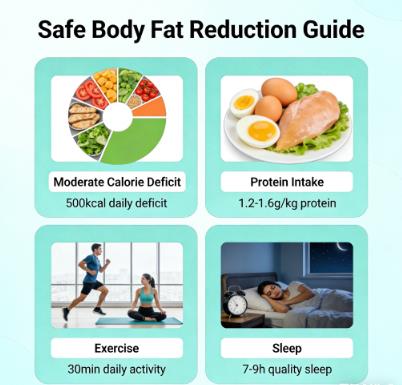
Lowering body fat safely means creating a calorie deficit while preserving muscle mass, maintaining energy levels, and protecting metabolic health. The CDC and NIH recommend a pace of 0.5 to 1 pound (0.2–0.45 kg) of fat loss per week — fast enough to see progress, slow enough to sustain.[3] As someone who has tracked hundreds of body composition journeys, I can tell you that the biggest mistake people make is trying to lose weight too fast. I've seen clients lose 20 pounds (9 kg) in a month on crash diets, only to gain it all back plus 10 pounds (4.5 kg) within six months. That's because crash diets almost always produce a mix of fat, muscle, and water loss. Losing muscle lowers your resting metabolic rate, which means you burn fewer calories at rest — and regain fat more easily when the diet ends.
The safest approach addresses four interconnected factors: nutrition (a modest calorie deficit with adequate protein), movement (strength training plus moderate cardio), recovery (7–9 hours of sleep), and stress management (keeping cortisol in check). Before you start, use a BMI calculator to understand your starting point. Track your body fat percentage alongside your BMI — a body fat calculator shows you what the scale alone cannot.
Start With a Gentle Calorie Deficit — 300 to 500 Calories Per Day
The foundation of fat loss is a calorie deficit, but the size of the deficit determines whether you lose fat or muscle. The NIH Clinical Guidelines recommend a moderate daily deficit of 300–500 calories.[3] This produces steady fat loss without triggering the metabolic adaptations that crash diets cause — slowed metabolism, increased hunger hormones, and muscle breakdown.
Extreme deficits — more than 750 calories per day — backfire. A 2022 review in Nutrients confirmed that very low-calorie diets produce rapid initial weight loss, but a significantly higher proportion of that loss is lean mass rather than fat. The metabolic slowdown that follows makes long-term fat loss harder, not easier.
What this looks like in practice:
Use a calorie calculator to estimate your maintenance intake, then subtract 300–500 calories
Fill half your plate with non-starchy vegetables — spinach, broccoli, bell peppers. They're high in volume and fiber, low in calories
Include lean protein with every meal to preserve muscle and increase satiety
Cut added sugars, especially from beverages. The CDC identifies sugar-sweetened drinks as a primary contributor to excess calorie intake[2]
Real-world example — Mike, 45, an IT manager from Phoenix, BMI 29: Mike came to us frustrated after three failed diet attempts. He was working 10-hour days, eating fast food for lunch, and drinking two 20-ounce sodas every day. We didn't overhaul his entire diet — we just swapped the soda for sparkling water. At first, he found sparkling water bland and almost gave up, but after adding a slice of fresh lemon, he started to enjoy it and noticed his afternoon energy crashes disappeared. Eight weeks later, he had lost 8 pounds (3.6 kg). Most of that loss was body fat — his waist circumference dropped from 41 to 38 inches (104 to 97 cm). His jeans fit better before the scale budged. Classic sign of fat loss done right.
After tracking hundreds of users, we've noticed the soda swap alone moves the needle for most people before they change anything else.
Make Protein Non-Negotiable
Protein is the most important macronutrient during fat loss. The International Society of Sports Nutrition recommends 1.6–2.2 grams per kilogram (0.7–1 gram per pound) of body weight daily for individuals in a calorie deficit. For a person weighing 70 kg (154 pounds), that's 112–154 grams of protein per day.
Why this matters: protein provides the amino acids your body needs to repair and maintain muscle tissue. In a calorie deficit, your body looks for energy sources — without adequate protein and strength training, it breaks down muscle. Each pound of muscle burns approximately 6–10 calories per day at rest. Losing muscle means lowering your metabolism. Have you ever noticed that when you're overly hungry, you crave sugary or high-fat snacks? That's not a coincidence — protein also increases satiety more than carbohydrates or fat. A 2020 meta-analysis in Physiology & Behavior confirmed that higher-protein meals reduce subsequent hunger and calorie intake compared to lower-protein meals with the same calorie content.
Practical protein targets per meal:
3–4 ounces (85–113 g) of chicken breast, fish, lean beef, or tofu per main meal — about the size of your palm
Include a protein source at breakfast — eggs, Greek yogurt, or a protein smoothie — not just at lunch and dinner
If whole food sources are insufficient, a protein supplement can help bridge the gap. From our experience with users, starting with a protein-rich breakfast is the single most effective change for reducing cravings later in the day
I've seen people double their protein and suddenly stop craving dessert. It's not magic — it's biology.
Mix Cardio and Strength Training
The CDC recommends 150 minutes of moderate-intensity aerobic activity per week plus two days of muscle-strengthening activities for adults.[1] This combination supports fat loss through two mechanisms: cardio burns calories during the workout; strength training builds and preserves muscle, which raises your resting metabolic rate.
Here's the thing: a common mistake we see is people doing only cardio and skipping strength training, which leads to muscle loss alongside fat loss. Another common mistake: doing hours of cardio daily, which increases cortisol and can trigger compensatory eating. The sweet spot is moderate and consistent.
A sustainable weekly plan:
3 days of strength training per week: Full-body exercises — squats, lunges, push-ups, rows, planks. Bodyweight versions count. Three sets of 10–15 reps per exercise
2–3 days of moderate cardio per week: Brisk walking, cycling, or swimming for 30–45 minutes per session
1–2 full rest days: Believe it or not, your body builds muscle and recovers during rest, not during workouts. Overtraining raises cortisol and stalls fat loss
The biggest surprise for most people? Strength training makes fat loss easier, not harder.
Protect Your Sleep — 7 to 9 Hours Nightly
Sleep deprivation directly undermines fat loss. The NIH reports that insufficient sleep disrupts ghrelin and leptin — the hormones that regulate hunger and fullness.[3] A study by Spiegel et al. (2004), published in Annals of Internal Medicine, found that people who slept 5 hours or fewer per night consumed significantly more calories the following day compared to those who slept 7–9 hours.[4]
Poor sleep also increases cortisol, which promotes fat storage — particularly visceral fat in the abdominal cavity. Even a single night of partial sleep deprivation measurably raises cortisol levels the following evening.
Simple sleep hygiene that costs nothing:
Set a consistent bedtime and wake time, even on weekends — your body thrives on rhythm
Turn off screens 60 minutes before bed — blue light suppresses melatonin
Keep your bedroom cool (65–68°F / 18–20°C) and as dark as possible
Limit caffeine after 2 PM — its half-life is 5–6 hours, meaning a 3 PM coffee is still in your system at 9 PM
Every client who fixed their sleep told me the same thing: "I'm not hungry at 10 p.m. anymore."
Manage Stress Before It Manages You
Have you ever noticed that when you're stressed, you crave sugary foods? That's not a coincidence. Chronic stress elevates cortisol, a hormone that signals the body to store fat — specifically visceral fat — in the abdominal cavity. The relationship is bidirectional: high cortisol promotes visceral fat storage, and visceral fat tissue itself produces more cortisol, creating a self-reinforcing cycle.
Most people don't realize that visceral fat — the dangerous fat around your organs — is actually the easiest fat to lose. That's because it's metabolically active and responds quickly to lifestyle changes. So even if you only lose a few pounds at first, you're already improving your health significantly. Managing stress isn't a luxury in a fat loss plan — it's part of the biological equation.
Evidence-based stress management at home:
Deep breathing: 5 minutes of slow, diaphragmatic breathing (inhale 4 seconds, hold 4, exhale 6) lowers cortisol within 10–15 minutes
Walking: A 10-minute walk clears cortisol from the bloodstream and provides both physical activity and mental reset
Mindfulness: 5 minutes of sitting quietly and focusing on your breath, without any app or equipment, reduces perceived stress within 4 weeks of daily practice
You can't supplement your way out of stress. Five minutes of breathing beats a pill.
For more on targeting the most metabolically dangerous fat, see our guide on how to reduce visceral fat at home.
Track What Matters, Ignore the Rest
Don't let the bathroom scale fool you. It can't distinguish between fat loss, muscle gain, and water retention. If you're strength training while eating at a deficit, your weight may stay stable for weeks while your body composition improves — fat decreases, muscle increases. If you track only weight, you'll think the plan isn't working. It is.
Track these three metrics monthly:
Body fat percentage: A drop of 0.5–1% over 8–12 weeks is safe, sustainable progress. Measure under consistent conditions — morning, after voiding, before eating
Waist circumference: Measure at navel level, at the end of a normal exhale. A decrease of 1 inch (2.5 cm) reflects meaningful visceral fat loss
How your clothes fit: If your waistband feels looser but the scale hasn't moved, you're losing fat and likely gaining muscle. That's exactly the right direction
The scale lies. Your jeans don't. Trust the tape measure.
For a structured approach to reducing BMI through sustainable habits, see our guide on successful BMI reduction.
Important Safety Notes for Special Populations
Pregnant or breastfeeding individuals: Do not attempt weight loss without medical supervision. Focus on nutrient-dense foods to support your baby's development.
Adults 65+: Prioritize muscle preservation over weight loss. A slightly higher BMI (23–28) may be protective. Consult your healthcare provider before starting any new exercise routine.
Individuals with chronic conditions (diabetes, heart disease): Consult your healthcare provider before starting any new diet or exercise program.
Frequently Asked Questions
How fast can I safely lower my body fat percentage?
A safe, sustainable pace is 0.5–1% body fat loss per week. This translates to roughly 0.5–1 pound (0.2–0.45 kg) of fat loss per week. Faster loss often includes muscle and water — not just fat — and muscle loss lowers your resting metabolism, making future fat gain more likely. The CDC and NIH both recommend gradual, steady progress over rapid loss.[1][3]
Do I need to cut out carbs to lose body fat?
No. Carbohydrates are not the enemy — excess calories are. Refined carbohydrates (white bread, pastries, sugary snacks) are easy to overconsume and spike insulin, which can contribute to fat storage. But fiber-rich whole grains, vegetables, and legumes support fat loss by improving satiety and stabilizing blood sugar. I still enjoy pizza on a Friday night — life's too short to aim for perfection. The key is moderation, not deprivation. A balanced diet that includes complex carbohydrates is more sustainable — and more effective long-term — than eliminating an entire food group.
Can I lose body fat without exercise?
Yes, if you maintain a calorie deficit through diet alone. But without strength training, a higher proportion of the weight you lose will be muscle rather than fat. Muscle is metabolically active — it burns calories at rest. Preserving it through resistance training makes fat loss easier to sustain and harder to reverse.
Why am I losing weight but my body fat percentage isn't changing?
You're likely losing muscle along with fat — or mostly water. This happens when the calorie deficit is too large or protein intake is too low. Increase your protein to 1.6–2.2 g per kg (0.7–1 g per lb) of body weight and add 2–3 days of strength training per week. Reassess your body fat percentage after 4 weeks under consistent measurement conditions.
Do I have to give up alcohol?
Not entirely. Three beers a night adds over 450 empty calories that work against your deficit. Try cutting to 1–2 drinks on weekdays and track your waist measurement. Many people notice faster improvements than they expected.
Sources
CDC: Physical Activity Guidelines for Adults — 150 Minutes Weekly
NIH NIDDK: Adult Overweight & Obesity — Health Risks and Weight Management
This article is for informational and educational purposes only. It does not constitute medical advice, diagnosis, or treatment. Always consult a qualified healthcare provider regarding your individual health and weight goals. Individual results will vary. The BMI Calculator Blog Team maintains editorial independence and does not sell health products.