Yes, body fat scales work — but only sort of. They use bioelectrical impedance (BIA) to estimate your body fat, sending a tiny current through your body. The tech is real. The catch? Your reading can swing 3–5% based on hydration, food, and timing. So treat it as a trend tracker, never a lab result. Here's what's happening inside the device, why the number bounces, and how to make a cheap scale surprisingly useful.
What "Works" Actually Means
A body fat scale won't match a DEXA scan. What it does is track changes over time. That's where the real value lives.
The scale sends a low-level electrical current up one leg and down the other. Fat resists that current. Muscle and water conduct it. The scale measures the resistance — impedance — then runs it through a formula using your height, weight, age, and sex. Out pops a body fat percentage.
The science is solid — impedance has been studied for decades. How accurate your specific number is? That's where things get messy.
Not All Scales Are Created Equal
Price tells part of the story. But not all scales are built the same.
The $30 Drugstore Scale (Type A)
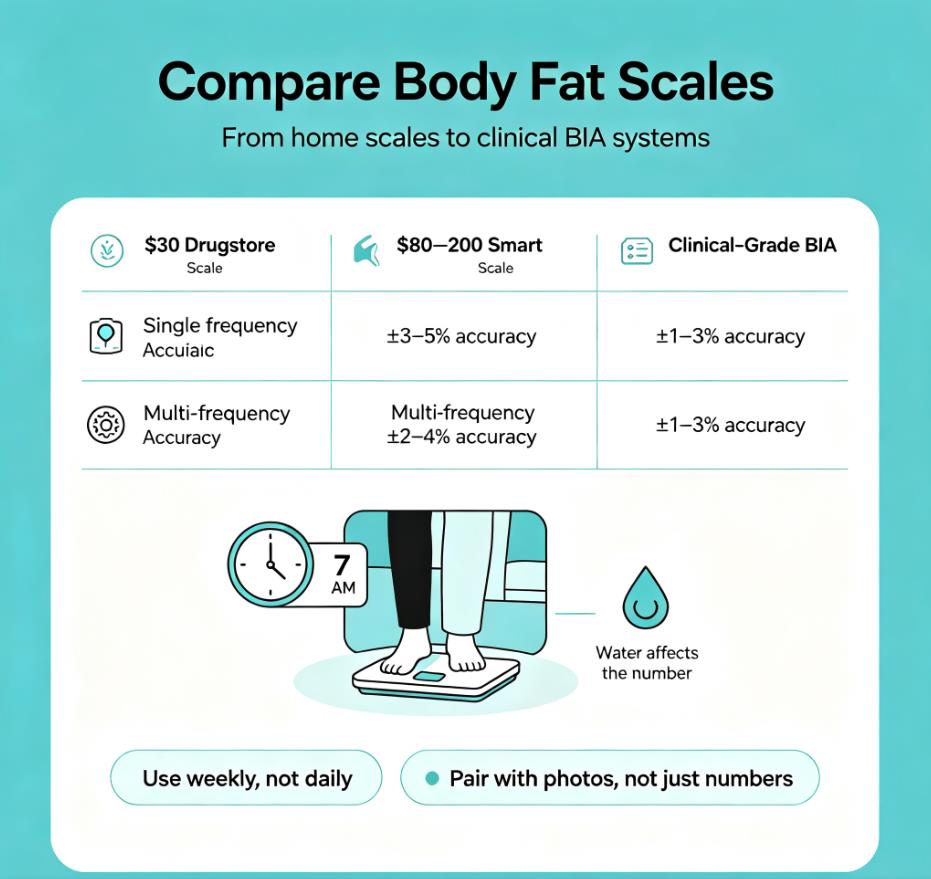
One frequency, through your feet, estimating total body fat with a single data point. Accuracy runs about ±3–5% off from DEXA. These are best for spotting week-to-week trends, not for trusting today's number. Their big weakness: they can't tell you where fat is stored.
A 25% reading might really be 22% or 28%. You won't know the exact figure. But if that 25% drifts down to 22% over three months, you can trust the direction. That's the win.
Multi-Frequency Smart Scales (Type B)
Step up to the kind you see at fitness stores for $80–200 and the readings tighten up a bit. These send currents at different frequencies and claim to separate intracellular from extracellular water. They're still estimates, though — and they still guess at visceral fat, the dangerous kind around organs. Prices run $80–200 for a reason, but no algorithm cracks that nut perfectly.
Clinical-Grade BIA Systems (Type C)
Thousands of dollars. Multiple electrodes on hands and feet. About ±1–3%, closer to DEXA. You'd find these in a research setting or a specialist's office. Even then, they rely on population-based formulas that may not fit your body.
The pattern is clear: more electrodes and frequencies help, but no impedance device directly measures fat. They all estimate. Our body fat calculator uses the same underlying formulas — height, weight, age, sex, plus a few measurements — to give you a consistent reference point.
Why the Number Bounces Around
Many people buy these scales expecting rock-solid daily numbers and end up frustrated. Hydration is the main culprit. After a tough workout you're dehydrated, and your reading might show 2% lower body fat than yesterday. Eat a salty meal, retain water, and it bounces the other way.
One user emailed us about a 5% drop in body fat overnight after a weekend of heavy drinking. She was thrilled — until we explained it was dehydration, not fat loss. Three days later, the number was right back up.
Skin temperature, recent alcohol, menstrual cycle phase, and even a full bladder can shift the result. We've seen users panic over a 4% swing overnight. Almost always, it's water — not fat gained or lost.
The fix is boring but effective: weigh yourself at the same time, in the same conditions. Mornings, after using the bathroom, before eating or drinking. Do that and the noise drops dramatically.
The Systematic Bias Nobody Talks About
Here's what surprised us when we dug into the research. A 2019 study tested three consumer foot-to-foot BIA devices against DXA and MRI in 106 adults (Watanabe et al., PMC6452160). The result: every foot-to-foot device consistently overestimated body fat in lean people and underestimated it in people with obesity. Only about half of individuals landed within 10% of their DXA value.
So if you're muscular or very lean, your scale is probably flattering you with a higher fat number. If you carry more weight, it's likely understating the truth. It's not random — it follows your body type. That's why consistency and context beat any single reading.
Making a $30 Scale Surprisingly Useful
Step 1: Measure weekly, not daily. Daily swings are mostly water noise; a 7-day gap smooths it out. Step 2: Log it and watch the 3-week trend, not today's number. Step 3: Pair it with progress photos and how your clothes fit. A scale can't tell muscle from fat — but your mirror can.
Our online BMI calculator won't give you body fat, but it pairs well with your scale data. BMI stays simple and consistent. Use both and you get a fuller picture than either alone.
Body Fat Scale vs. The Alternatives
DEXA scan: The gold standard. ±1–2% accuracy. Costs $50–150 per scan. Uses radiation, but far lower than a standard X-ray.
Skinfold calipers: Cheap, portable, ±3–4% in trained hands. Useless in untrained hands.
Bod Pod (air displacement): ±2–3%. Expensive and hard to find.
Body fat scale (BIA): Convenient, cheap, ±3–5%. Great for trends.
No method is perfect. The best tool is the one you'll actually use consistently. For most people, that's the bathroom scale.
When to Put Less Stock in It
If you're an athlete with serious muscle mass, BIA will likely overestimate your body fat. The scale reads density, not composition — and dense muscle looks like fat to the algorithm. If you're pregnant, post-surgery, or dealing with fluid retention, readings can be wildly off. The number isn't wrong exactly; it just doesn't mean what you think it means.
Body fat readings from consumer devices are estimates. If you're using these numbers to guide health decisions — like adjusting a nutrition plan or managing a condition — check in with a qualified healthcare provider before making changes. Track the trend, pair it with photos and how you feel, and keep perspective. Numbers are only one piece of your whole-body picture.
Frequently Asked Questions
Are body fat scales accurate?
Accurate enough to track trends — usually within 3–5% of your true body fat. Not precise enough for an exact number. Think "direction," not "destination."
What's the best time to use a body fat scale?
First thing in the morning, after using the bathroom, before eating or drinking. Consistent timing matters more than the time of day itself.
Why does my body fat percentage change so much day to day?
Hydration is the biggest driver. Sweat, salt, water intake, workouts, and your last meal all shift the reading. Track weekly averages, not daily spikes.
Can a body fat scale tell me my visceral fat?
Most can't measure it directly. They estimate total body fat, and some guess at visceral levels. A DEXA or CT scan is needed for a real reading. Don't treat the scale's visceral number as fact.
Do body fat scales work for muscular people?
They tend to overestimate body fat in athletes and others with high lean mass. Muscle conducts electricity like fat does in these devices, confusing the algorithm. Use photos and performance metrics alongside the number.
Is a body fat scale better than BMI?
It gives more detail — body composition instead of just weight-to-height. But it's less consistent day to day. BMI is rock-solid repeatable. Use both for the clearest picture.
Sources
This article is for informational and educational purposes only. It does not constitute medical advice, diagnosis, or treatment. Always consult a qualified healthcare provider regarding your individual health and body composition goals. Individual results will vary. The BMI Calculator Blog Team maintains editorial independence and does not sell health products.