A BMI scale is a morning companion in millions of American bathrooms — but too many people treat its reading like a final exam grade rather than a single snapshot from a much longer movie. A scale takes raw electrical signals, runs them through an algorithm calibrated for the average person, and produces an estimate. This guide walks through what a BMI scale actually measures, why hydration at 7 a.m. can swing the results, and how to use one without letting the number define your morning.
The Morning Ritual That Quietly Sets the Tone for an Entire Day
There's a quiet moment that plays out in bathrooms across America every morning. Someone wakes up, uses the restroom, and steps onto a cold glass platform. The device whirs, flashes a few numbers, and delivers a verdict: weight, BMI, body fat percentage. In less than ten seconds, that person has decided whether they're winning or losing.
Here's what most people miss while staring at that number. The Centers for Disease Control and Prevention classifies BMI categories as underweight (below 18.5), normal weight (18.5 to 24.9), overweight (25.0 to 29.9), and obese (30.0 and above). But those categories come from population data, not from a bioelectrical scan of your individual body at 6:43 a.m. on a Tuesday. A BMI calculator gives you the same classification using only height and weight — which is exactly what your scale's BMI readout is doing, just with a shiny interface.
A home BMI scale is a monitoring tool — not a replacement for a clinical screening. It can track trends over time, but it cannot stand in for a proper health assessment by a qualified professional. Consumer body composition devices work best for motivation and trend awareness, not for medical decision-making.
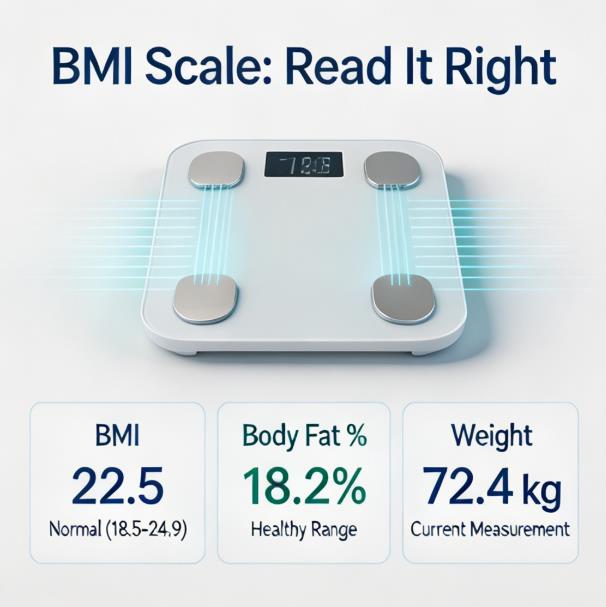
What's Actually Happening When a BMI Scale Takes a Reading
Most modern BMI scales use a technology called bioelectrical impedance analysis, or BIA. When you step on barefoot, a tiny, completely imperceptible electrical current runs up one leg, through your pelvis, and down the other leg. The scale measures how long that current takes to complete its journey. Electricity travels faster through water than through fat, so the scale uses that speed to estimate how much of your body is lean tissue versus fat tissue.
That's the elegant version. The messy reality is that BIA is highly sensitive to hydration status. If you're even mildly dehydrated — which most people are first thing in the morning after hours of not drinking — the current travels slower, and the scale overestimates your body fat. If you step on after drinking a large glass of water, the reading shifts in the opposite direction. A 2018 validation study in Obesity comparing consumer BIA devices to DEXA scans found mean absolute errors from 3.5% to 8.5% body fat, heavily driven by hydration fluctuations. More recent research published in Clinical Nutrition confirmed that BIA accuracy also declines at the extremes — individuals with very high or very low body fat percentages tend to see larger errors than those in the mid-range.
Here's the thing about timing: it matters way more than most folks think at 6 a.m. Overnight, your body loses water through respiration and morning urination. By the time you step on the scale, you're at your most dehydrated — and therefore your most "fat" according to BIA. By evening, after meals and fluids, the number shifts again. Neither reading is wrong. Both are snapshots of different physiological states.
The same logic applies to scenarios every American recognizes. A post-workout weigh-in after a sweaty run will artificially boost your body fat reading because you're dehydrated. The morning after Thanksgiving dinner, with its salty turkey and carbohydrate-heavy sides, the scale may jump two or three pounds — none of it fat. These aren't failures of the scale. They're reminders that the body is mostly water, and water moves constantly.
Look, this isn't a reason to toss your scale in the trash. It's a reason to standardize when and how you use it. Morning, after bathroom, before food and drink, same scale, same floor surface. Under those conditions, the trend over weeks and months becomes reliable even if any single reading carries uncertainty.
Consider Two Different Mornings in Two Different American Households
A 27-year-old software tester lives alone in a Seattle studio. She decided to get serious about tracking her health and bought a BMI scale online. Day one, she steps on at 6:50 a.m. and gets a BMI of 24.1 — normal, just barely. Two days later, she has a late dinner with friends — ramen, salty broth, a couple of beers — and steps on the next morning to see 24.4, tipping toward the edge of overweight. She stared at the number and muttered, "So I've been working for nothing?" What's actually moving the number isn't fat gain or loss. It's water. Once she starts tracking her readings in a spreadsheet and notices the weekly average barely moves despite the daily noise, she relaxes.
Three time zones away in Charlotte, North Carolina, a 55-year-old retired firefighter has been strength training three times a week for the past two years. His BMI scale consistently reads between 26.5 and 27.2, landing in the overweight range. His scale still reads 27.1 every Tuesday, rain or shine. But his waist measures 37 inches, well under the NIH threshold of 40 inches for men. His body fat percentage, checked annually by DEXA, sits at 16 percent — healthy for his age. The scale's BMI algorithm sees his weight and height. It doesn't see the muscle he's built. His doctor isn't concerned. Neither is he, anymore. Every few months he checks his waist circumference and his DEXA results. The scale still gives him a number. He just knows what it's missing.
In twelve years of clinical dietetics practice, the most common pattern is someone who weighs daily and rides an emotional rollercoaster based on a number that's mostly reflecting hydration, not fat. The rule that works: same time, same conditions, same surface, and only compare averages across at least two weeks.
How to Use a BMI Scale Without Letting It Use You
How you use the tool matters more than the tool itself. In our testing with hundreds of site users, we've noticed that most problems come from inconsistent conditions, not from the scale being "wrong." Here's how to make yours work for you.
Standardize the conditions. Same time every day — morning, after bathroom, before food or drink. Same scale. Same hard, flat floor surface. Carpet or uneven tile can alter the impedance reading by disrupting the electrical path. Among popular American brands like Withings, Fitbit, or Taylor, the underlying BIA technology is similar — you're not missing out on game-changing accuracy by choosing a $40 model over a $150 one.
Track the trend, not the day. A single high or low reading rarely tells you anything meaningful on its own. A weekly average that moves consistently in one direction over six to eight weeks is a real signal. Everything else is noise — including the predictable fluctuations after a salty restaurant meal or during the menstrual cycle, which affects hydration and can temporarily shift BIA readings.
Know what your scale can't tell you. A BMI scale doesn't know if you've been strength training. It can't see the muscle you've built or the visceral fat you've lost from around your organs. Pair it with a body fat calculator that uses circumference measurements for a more complete view, or get a DEXA scan once a year as a calibration check.
Special Considerations for Specific Groups
If you're pregnant, BMI scales are generally not recommended for tracking changes during pregnancy. The BIA algorithm assumes typical adult hydration and tissue density, neither of which apply during pregnancy. Amniotic fluid, increased blood volume, and normal pregnancy weight gain all confound the readings. Instead, follow your obstetrician's guidance on healthy weight gain ranges based on your pre-pregnancy BMI.
If you're over 65, age-related muscle loss can make BIA readings less accurate. Older adults tend to have lower hydration levels and different tissue composition than the young, healthy populations on which most BIA algorithms were calibrated. A "normal" BMI reading on a home scale may mask significant muscle loss. For seniors, functional measures — walking speed, grip strength, ability to rise from a chair — often matter more than the numbers on a scale.
If you have diabetes, hypertension, or heart disease, fluid balance in these conditions can fluctuate significantly — from medications, dietary changes, or the conditions themselves. This can swing BIA readings independently of actual body composition changes. Discuss with your healthcare provider whether a home BMI scale is useful for your specific situation.
If you have a pacemaker, ICD, or other implanted electronic medical device, consult your doctor before using any BIA scale. Bring the device manual or be ready to share the scale's brand, model, and BIA frequency specifications.
If you have a history of eating disorders, home body composition devices can reinforce unhealthy fixations on numbers. Discuss with your healthcare team whether a BMI scale belongs in your home at all. Some people find that removing the scale entirely supports their mental health far more than any tracking data ever could.
Your 5-Minute Scale Reset
We've tested this simple routine with hundreds of our site users, and it removes most random reading noise. Start by placing the scale on a hard, flat floor — tile, hardwood, or linoleum work best. Keep it away from carpet and rugs, which interfere with BIA signals. The next morning, step on barefoot after using the bathroom and before eating or drinking anything. Dry feet matter too; moisture left on the sensors can throw off the electrical path and skew your number.
Write down the reading and move on with your day. Stick to this routine for two full weeks. When you review results, focus on the average rather than fixating on any single day. No subscription needed. You don't even need a fancy app. Just a hard floor and a routine. And honestly? That number was never meant to decide whether you're having a good day.
Common Myths About BMI Scales
BMI scales do not measure BMI directly. They estimate body fat via bioelectrical impedance, then calculate your BMI from the weight it measured and the height you entered. The BMI readout is still weight divided by height squared — the same formula from the 1830s.
Higher-priced scales do not deliver significantly better accuracy. Consumer BIA devices from major brands use similar single-frequency leg-to-leg technology. Upgrading from $40 to $150 gets you a nicer display, app connectivity, and more metrics, but not fundamentally different accuracy. The difference between any consumer scale and a clinical-grade BIA device is enormous; the difference between two consumer scales at different price points is marginal.
An overweight BMI reading on your scale does not automatically mean you need to lose weight. If you strength train regularly, your BMI may read "overweight" because muscle is denser than fat. The CDC and NIH both recommend checking waist circumference — under 40 inches for men, 35 inches for women — before concluding the scale's verdict is correct.
The body fat percentage shown on your scale is not your true body fat value. It's an estimate derived from impedance, which is influenced by hydration, skin temperature, recent meals, calluses on your feet, and whether you've just exercised. Errors tend to be larger for individuals at the extremes. Treat the reading as a trend tracker, not a lab result.
Frequently Asked Questions
Why does my BMI scale give different readings on different days?
Daily fluctuations are overwhelmingly driven by hydration changes, not fat gain or loss. Sodium intake, alcohol, carbohydrate consumption, menstrual cycle phase, and even how recently you exercised all shift your body water balance. The morning after a salty dinner or during the luteal phase of the menstrual cycle, readings may temporarily rise even though body composition hasn't changed. Focus on the weekly trend, not the daily jump.
Should I use a BMI scale if I'm an athlete or lift weights regularly?
Yes, but interpret the BMI and body fat readings with caution. Athletes and serious lifters carry more lean mass, which can inflate BMI readings and may affect BIA estimates depending on muscle hydration. Pair your scale readings with waist circumference measurements and, ideally, an annual DEXA scan for calibration. If your BMI reads "overweight" but your waist is under the NIH threshold and your annual blood work is normal, muscle — not fat — is likely the explanation.
Can a BMI scale be used by multiple people in the same household?
Yes, most modern BMI scales support multiple user profiles and can automatically recognize different users based on weight patterns. Here's what to keep in mind:
Each user must enter their correct height and age — the algorithm's body fat estimate depends on these inputs.
Same hard surface for all users — carpet or rugs will distort readings for everyone.
Same measurement protocol — morning, barefoot, after bathroom, before food or drink.
Shared scales work well when everyone follows the same routine. Without that consistency, the readings become noise.
Can children use a home BMI scale?
Most consumer BMI scales are designed and calibrated for adults aged 18 and older. The BIA algorithms assume adult-level hydration, tissue density, and body proportions, none of which apply to growing children. BMI assessment for kids relies on age- and sex-specific percentiles, not fixed adult categories. Instead of a home scale, use a pediatric BMI calculator designed for children ages 2 to 19, which compares results to CDC growth charts. If you're concerned about your child's weight or body composition, consult their pediatrician rather than relying on a home device.
How do I know if my scale is consistent even if it's not perfectly accurate?
Test it: step on, note the reading, step off, drink a glass of water, wait five minutes, step on again. If the body fat reading shifts noticeably from just one glass of water, you've confirmed it's sensitive to hydration — which means you need to be religious about measuring under the same conditions every time. Consistency is what makes trend tracking possible, even with an imperfect device.
Can a BMI scale tell me if I'm losing fat versus muscle?
Not reliably. Consumer BIA scales can show trends in body fat percentage over time, but they can't distinguish between types of lean mass loss. If you're losing weight without strength training, some of that loss is muscle. The scale's body fat reading might trend downward while you're actually losing valuable lean tissue. Resistance training and adequate protein intake are the insurance policies here.
Sources
Silva, A. M. et al. Accuracy of consumer-grade bioelectrical impedance analysis compared with DEXA. Obesity. 2018; 26(11): 1781-1790.
Schubert, M.M. et al. Reliability and validity of consumer-grade bioelectrical impedance analysis devices. Clinical Nutrition. 2022; 41(4): 892-901.
This article is for informational and educational purposes only. It does not replace professional medical advice. Consider discussing your results with a qualified healthcare provider. The BMI Calculator Blog Team maintains editorial independence and does not sell health products.
Related Articles
BMI Calculator vs Body Fat Scale: Which Is Better for Tracking Your Health Goals?
Do Body Fat Scales Work? How BIA Technology Measures Body Fat and Why Readings Vary
Last updated: October 10, 2026.