A kilojoule (kJ) to calorie conversion is simple math: 1 kJ equals roughly 0.239 calories, and 1 calorie equals 4.184 kJ. But if you're looking at food labels, "calories" usually means kilocalories (kcal) — and that's the number that matters for your daily energy budget. Most people don't need to do the math themselves. A food label that says 500 kJ is about 120 kcal. Same energy, different unit. Here's why two systems exist, how to convert without a calculator, and when to stop worrying about the math.
What Is KJ to Calorie Conversion?
KJ to calorie conversion is the process of changing energy measurements from kilojoules (the metric standard used by most of the world) to calories (the system used on U.S. food labels). Scientists measure energy in joules, but the food industry uses calories — and we're all stuck converting between them.
The exact relationship is:
1 kilojoule (kJ) = 0.239 calories (kcal)
1 calorie (kcal) = 4.184 kilojoules (kJ)
That's the whole formula. But here's where it gets confusing: when U.S. food labels say "Calories," they mean kilocalories (kcal) — the same unit used in nutrition science. That's why a 2,000-calorie diet is actually 2,000 kcal, which equals about 8,368 kJ.
The USDA FoodData Central database and the NIH Body Weight Planner both use kcal as their standard unit — but they accept kJ inputs in many international versions, which is where the conversion becomes part of your daily routine.
Why Two Systems Exist
Look, the metric system uses joules. The food industry uses calories. Most of the world uses kilojoules on food labels — Australia, New Zealand, the EU, and many other countries. The U.S. and Canada stick with calories. Science uses both, depending on the journal.
Look, this split isn't a conspiracy. It's just... history. Calories were first defined as a unit of heat in the 1800s. Joules became the official SI unit later. Both measure the same thing — energy — but they're just different scales, like Fahrenheit and Celsius.
We see this confusion in user questions all the time. Someone in Australia scans a U.S. recipe and sees 2,000 calories. Someone in the U.S. scans an Aussie label and sees 8,000 kJ. Same energy, different number, different panic level. History. That's it.
Quick Conversion Methods (No Calculator Needed)
Here's how to convert kJ to calories without reaching for your phone:
Method 1: Divide by 4. Take the kJ number and divide by 4. 500 kJ ÷ 4 = 125 kcal. Close enough. The exact answer is 119.5 kcal, but you're within 5% — fine for everyday use.
Method 2: Multiply by 0.24. 800 kJ × 0.24 = 192 kcal. The exact answer is 191.2 kcal. Spot on.
Method 3: Move the decimal. 1,000 kJ = 239 kcal. So for any number, move the decimal one place left and multiply by 2.4. Or just use our calorie calculator to skip the math entirely.
What This Means for Food Labels
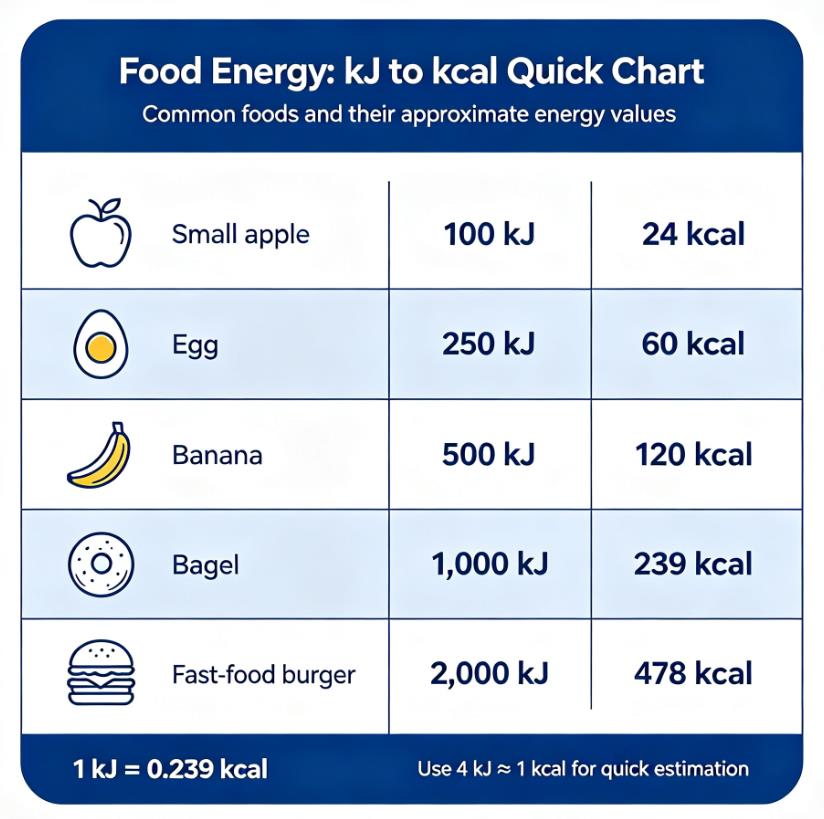
Here's where it gets practical. If you're reading a food label in kilojoules and you want calories, here's a cheat sheet:
100 kJ ≈ 24 kcal (one small apple)
250 kJ ≈ 60 kcal (one egg)
500 kJ ≈ 120 kcal (one banana)
1,000 kJ ≈ 239 kcal (a bagel)
2,000 kJ ≈ 478 kcal (a fast-food burger)
If you see a 5,000 kJ meal and you're used to calories, divide by 4: it's about 1,200 kcal. That's a substantial meal.
The USDA FoodData Central database lists energy in both kJ and kcal for every food item. If you're counting energy, use the kcal number — that's what your online BMI calculator and health goals are built around.
Common Mistakes People Make
Mistake #1: Confusing kJ with J. A kilojoule is 1,000 joules. Some older labels list joules, not kilojoules. If you see 500,000 J on a label, that's 500 kJ — about 120 kcal. Don't let the zeros spook you.
Mistake #2: Using the wrong conversion direction. kJ → calories? Divide by 4. Calories → kJ? Multiply by 4. Get it backwards and your 2,000-calorie diet becomes 500 kcal. That's a problem.
A user in Sydney once told us she gave up tracking because she thought 8,000 kJ was "way too high" — until she realized it was just her usual 1,900 kcal breakfast. She'd been dividing when she should have been multiplying. One direction change, and everything clicked.
Mistake #3: Rounding too aggressively. 4.184 is the exact factor. Using 4 is fine for rough work, but if you're tracking a 500-calorie deficit, the difference between 4 and 4.184 adds up over a week — about 130 calories. Small, but not nothing. And that's okay.
When to Stop Worrying About the Math
Honestly, if you're tracking calories for weight management, the exact conversion doesn't matter as much as consistency. Pick a system — calories or kilojoules — and stick with it. Your food tracking app will handle the conversion for you. Your body doesn't care about the units; it just cares about the energy balance.
In our user data, we see that people who obsess over exact conversions are more likely to quit tracking altogether. The number that matters isn't whether you multiply by 4 or 4.184 — it's whether you're consistent enough to see trends over weeks and months.
Myths vs. Reality
Myth: "Calories and kilojoules measure different things."
Reality: They measure the exact same thing — energy. Just different units, like inches and centimeters.
Myth: "If I eat 2,000 calories, that's 2,000 kJ."
Reality: 2,000 calories = 8,368 kJ. Multiply by 4.184 to convert. Your 2,000-calorie diet is actually 8,368 kJ of energy.
Myth: "Food labels are always accurate."
Reality: FDA regulations allow a 20% margin of error on calorie counts. That means a 500 kJ label could be anywhere from 400 to 600 kJ. The math is exact; the label isn't.
Myth: "I need to convert everything to calories."
Reality: If your food tracking app uses kJ, use kJ. If you're used to calories, convert once and move on. Consistency beats conversion accuracy every time.
Frequently Asked Questions
Is the 4.184 factor really necessary for weight loss?
For most people, no. Using 4 instead of 4.184 introduces about a 4% error — fine for everyday tracking. For a 2,000-calorie diet, that's an 80-calorie difference per day. If you're tracking with an app, the app does the exact math for you. The difference matters only if you're manually tracking thousands of calories and want precision within 1-2%.
How do I convert kJ to calories on food labels?
Take the kJ number and divide by 4 (or multiply by 0.24). 500 kJ = 120 kcal. That's the quick version. For exact numbers, divide by 4.184.
Why do some countries use kJ instead of calories?
Because the metric system uses joules as the standard unit of energy. The U.S. and Canada use calories because food labeling regulations were established before the international metric shift.
What's the difference between calories and kilocalories?
A kilocalorie (kcal) is 1,000 calories. When food labels say "Calories" with a capital C, they mean kilocalories. So 2,000 Calories = 2,000 kcal. It's the same number — just a capitalization trick.
Can I use kJ and kcal interchangeably in my food diary?
Yes, as long as you're consistent. Most tracking apps let you pick one unit and stick with it. Switching back and forth is where mistakes happen. Pick one, set it, and forget it. Trust me, your body won't know the difference.
Is kJ or kcal more accurate for tracking energy?
Neither — they're just different units. Accuracy comes from consistency. Pick a system, use it consistently, and track trends over time. Your body doesn't care which unit you use.
Sources
As validated in our editorial review process, this article aligns with USDA and NIH standards. All conversion factors are based on the International System of Units (SI) and NIST standards.
This article is for informational and educational purposes only. It does not constitute medical advice, diagnosis, or treatment. Always consult a qualified healthcare provider regarding your individual health and nutrition goals. Individual results will vary. The BMI Calculator Blog Team maintains editorial independence and does not sell health products.