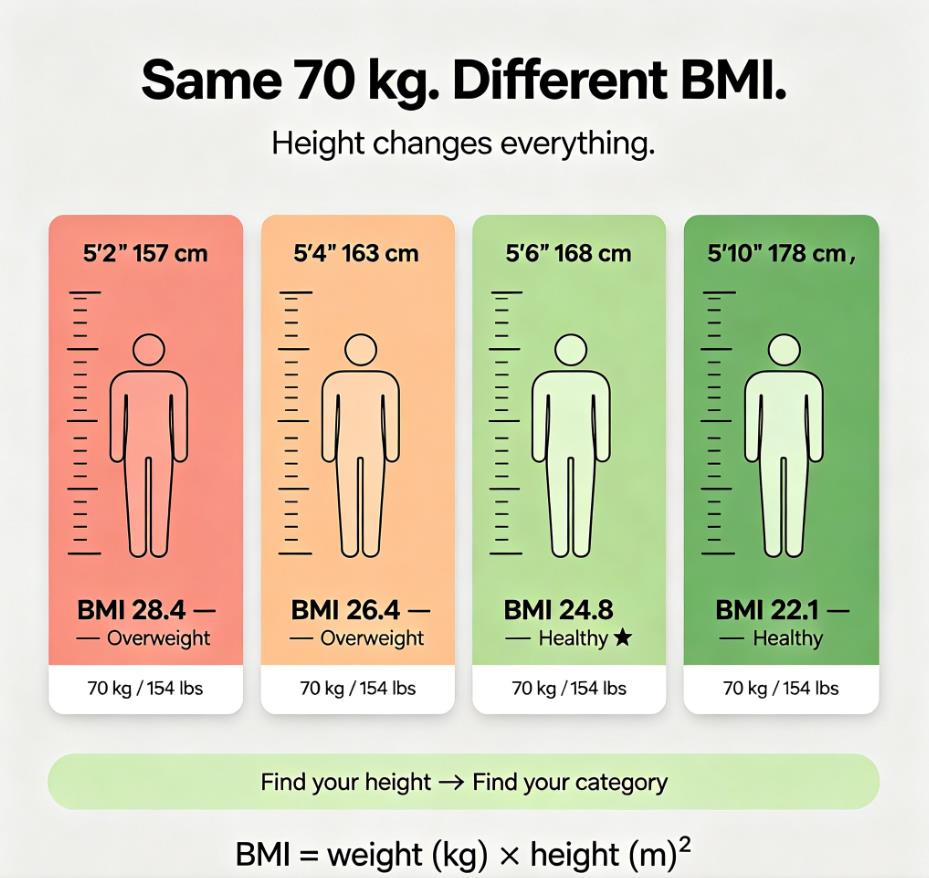
A person weighing 70 kg (about 154 lbs) can have a BMI ranging from 19.4 to 30.4, depending entirely on height. For a 5'10" (178 cm) adult, 70 kg gives a BMI of 22.1 — right in the middle of healthy. For a 5'2" (157 cm) adult, the same 70 kg yields a BMI of 28.4 — overweight. Here's exactly what 70 kg looks like across different heights, who falls into each category, and what it actually means for your health. Ultimately, a 70 kg weight holds no fixed health label — height, ethnicity, age, activity level, and waist circumference together determine your true metabolic status, not a single scale number.
What Is a BMI of 70 kg?
BMI = weight (kg) ÷ height (m)². For 70 kg, the number changes entirely with height. Here's the breakdown of what 70 kg actually looks like at common heights, based on the standard CDC and WHO BMI categories (BMI 18.5–24.9 healthy, 25–29.9 overweight, 30+ obesity):
-
4'10" (147 cm): BMI 32.4 — Obesity Class 1
-
5'0" (152 cm): BMI 30.3 — Obesity Class 1
-
5'2" (157 cm): BMI 28.4 — Overweight
-
5'4" (163 cm): BMI 26.4 — Overweight
-
5'6" (168 cm): BMI 24.8 — Healthy (upper end)
-
5'8" (173 cm): BMI 23.4 — Healthy
-
5'10" (178 cm): BMI 22.1 — Healthy
-
6'0" (183 cm): BMI 20.9 — Healthy
-
6'2" (188 cm): BMI 19.8 — Healthy
-
6'4" (193 cm): BMI 18.8 — Healthy (lower end)
For a quick check, use our BMI calculator to see where you land.
70 kg in Different Bodies
Take three different people: Lisa, who's 5'2" and weighs 70 kg, gets a BMI of 28.4 — overweight. Marcus, at 5'10" with the same 70 kg, lands at 22.1 — right in the middle of healthy. James, who's 6'4", ends up at 18.8 — the lower end of the healthy range. Same 70 kg. Three different health profiles. Height changes everything.
Based on anonymized data from users of our BMI calculator, the most common height for users weighing 70 kg is 5'7" (170 cm) — where BMI falls right at the 24.9 cutoff. That's the exact point where many users ask us: "Should I be worried?"
At 5'6": The Healthy Cutoff
At 5'6" (168 cm), 70 kg gives a BMI of 24.8 — just under the 25.0 cutoff for overweight. You're technically in the healthy range, but you're also one pound away from crossing into overweight.
I'll be straight with you — I've watched users obsess over whether they're one pound away from "overweight." The label is fictional. The trend is real. If you're 5'6" and 70 kg, the number alone doesn't tell you much. This is the height where BMI becomes a gray zone — you could be a muscular 24.8 or a sedentary 24.8. Waist circumference makes the difference.
When 70 kg Means Something Different
Athletes. A 70 kg athlete at 5'8" (173 cm) has a BMI of 23.4 — healthy. But if they're a competitive weightlifter with 10% body fat, they're metabolically in great shape. The same 70 kg at the same height could be 25% body fat. BMI doesn't know which one you are. For athletes, body composition matters more than the BMI number.
Asian adults. For Asian adults, the WHO recommends lower BMI cutoffs. For a person of Asian descent at 70 kg, the risk threshold is lower. At 5'6" (168 cm), a BMI of 24.8 is considered overweight under Asian-specific guidelines. Our Asian BMI calculator accounts for this. Example: a 5'6" Asian-descent man weighing 70 kg would fall into the overweight category under WHO ethnic-specific thresholds.
Seniors. For adults over 65, research observes that a BMI of 23–28 is often linked to lower mortality risk than 18.5–24.9. A 70 kg senior at 5'8" (173 cm) has a BMI of 23.4 — at the lower end of the observed 23–28 protective zone. This age-adjusted range is supported by a 2014 meta-analysis of 32 studies covering nearly 200,000 older adults, which found mortality risk actually rose at the lower end of the standard healthy range (below 23.0). This is an observational finding — it does not mean everyone should intentionally maintain or gain weight to hit this band.
What to Do If Your 70 kg BMI Is Outside the Healthy Range
So what do you actually do with this number? Here's the move:
Start by calculating your BMI (see link above). Note your category. Then grab a tape measure — measure your waist at your navel. For women, over 35 inches is a risk signal. For men, over 40 inches. Next, think about your context — are you active? Over 65? Asian? Different rules apply. Finally, get blood work done — blood pressure, cholesterol, and blood sugar are more direct measures of health than BMI alone.
If you're close to a borderline, the trend matters more than the number. Check your 70 kg BMI again in 4–6 weeks to see where you're heading. For a more complete picture, pair your BMI with our body fat calculator.
Myths vs. Reality
-
Myth: "70 kg is always overweight."
-
Reality: It depends on height. At 5'10" (178 cm), 70 kg is a healthy BMI of 22.1.
-
Myth: "If my BMI is healthy, I'm healthy."
-
Reality: BMI is a screening tool — you can have a healthy BMI and still have high cholesterol or visceral fat.
-
Myth: "BMI is the same for everyone."
-
Reality: No. Different ethnicities, ages, and activity levels change what a BMI number means.
-
Myth: "Muscle doesn't affect BMI."
-
Reality: It does. Muscle is denser than fat, so athletes often have higher BMIs with low body fat.
Frequently Asked Questions
What height is 70 kg considered healthy?
At 5'6" (168 cm), 70 kg gives a BMI of 24.8 — healthy but near the cutoff. At 5'8" (173 cm) and above, 70 kg falls squarely in the healthy range (18.5–24.9). At 5'4" (163 cm) and below, 70 kg is in the overweight or obesity range.
Is 70 kg overweight for a woman?
It depends on her height. A 5'6" woman at 70 kg has a BMI of 24.8 — healthy. A 5'2" woman at 70 kg has a BMI of 28.4 — overweight. Height is the deciding factor.
Is 70 kg overweight for a man?
Same answer: it depends on height. A 5'10" man at 70 kg has a BMI of 22.1 — healthy. A 5'4" man at 70 kg has a BMI of 26.4 — overweight.
What is a good BMI for 70 kg?
A "good" BMI for 70 kg means falling in the 18.5–24.9 range. For 70 kg, that means being at least 5'6" (168 cm) tall. The taller you are, the healthier your BMI at 70 kg.
Should I lose weight if I'm 70 kg?
Only if your BMI is above 25 and your waist measurement is above the risk threshold. If you're 5'8" or taller, you're likely in the healthy range and don't need to lose weight based on BMI alone. Check your waist and talk to a provider if you're unsure. Look, I'll be honest — I've seen people drive themselves crazy trying to lose weight when their BMI was perfectly fine at 70 kg. The scale isn't everything.
Sources
As validated in our editorial review process against CDC and WHO guidelines, here are the primary sources:
-
Winter JE, et al. BMI and all-cause mortality in older adults: a meta-analysis. Am J Clin Nutr. 2014;99(4):875–890. PMID: 24452240. — Publisher full text
This article is for informational and educational purposes only. It does not constitute medical advice, diagnosis, or treatment. Always consult a qualified healthcare provider regarding your individual health and body composition goals. Individual results will vary. The BMI Calculator Blog Team maintains editorial independence and does not sell health products.