CDC adult BMI categories put healthy weight at 18.5–24.9 — a clean line on paper, but not one that fits every body. Overweight begins at 25.0, obesity at 30.0, and the same digit means something different after 65 or for Asian adults. Add waist circumference and body fat, and the category starts to tell a useful story instead of ending the conversation.
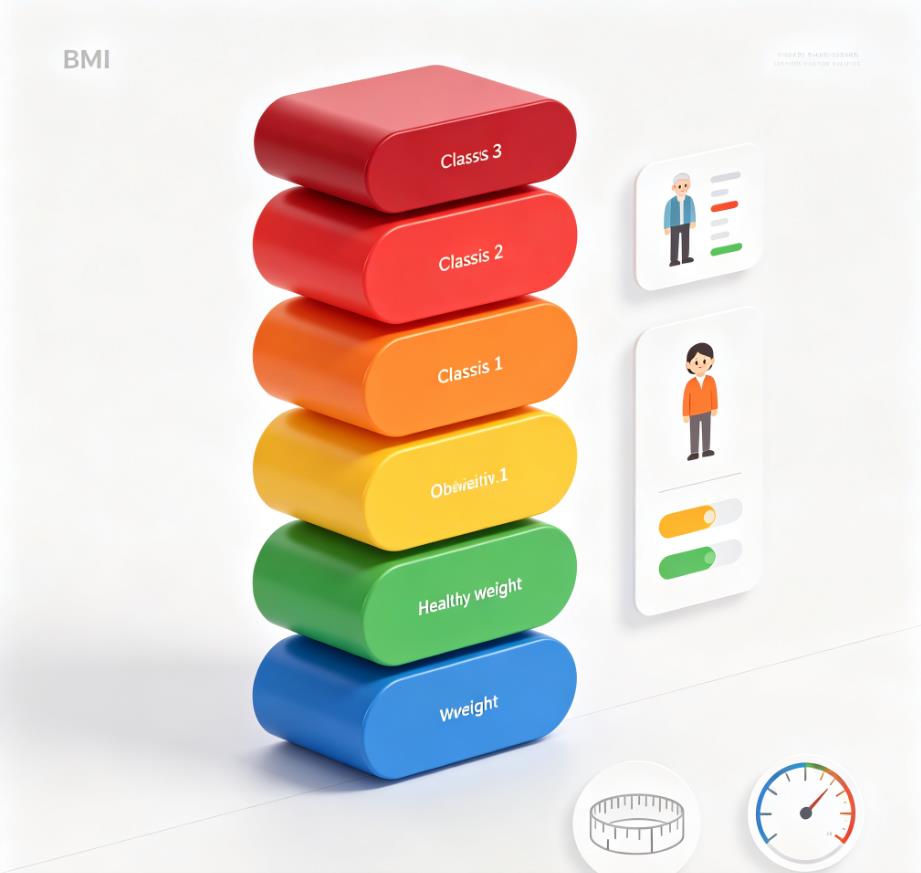
What Are the CDC Adult BMI Categories
The CDC uses BMI — weight in kilograms divided by height in meters squared — to group adults into population-level risk bands. The cutoffs below apply to most non-pregnant adults aged 18–64.
| BMI Range | Weight Category |
|---|---|
| Below 18.5 | Underweight |
| 18.5–24.9 | Healthy weight |
| 25.0–29.9 | Overweight |
| 30.0–34.9 | Obesity class 1 |
| 35.0–39.9 | Obesity class 2 |
| 40.0 and above | Obesity class 3 (severe) |
Inside 18.5–24.9 is the CDC healthy-weight band for the general adult population. What the number flags is population-level risk; it does not measure body fat, fitness, or where fat is stored.
Why Waist Circumference Changes the Reading
BMI treats muscle and fat as the same thing. A 5'4" woman at 145 lbs may read "overweight" yet carry most of that weight as muscle, with a 32-inch waist and strong lab results. Flip the scenario: a 22 BMI with a 38-inch waist and 31% body fat is not the picture of health the chart implies.
Waist circumference catches what BMI misses. The NHLBI flags elevated metabolic risk above 40 inches (102 cm) for men and 35 inches (88 cm) for non-pregnant women, independent of BMI. Pair your result with a body fat estimate tool to see whether the number reflects lean mass or excess fat.
Seniors 65+: The Healthy Band Shifts Up
The 18.5–24.9 range was built on younger and middle-aged adults. After 65, a slightly higher BMI is often protective: a 2019 meta-analysis of 44 cohort studies placed the lowest mortality in the 23.0–28.0 band, while unintentional weight loss raised frailty and fall risk. Below 23, undernutrition and bone loss start working against you.
Sarcopenia and the inch or two of height lost over a lifetime make a "normal" BMI misleading in older adults. An age-adjusted senior BMI tool applies the higher band so you are not judged against a chart built for 30-year-olds.
Asian Adults: Lower Action Points, Not a Different Definition
Many Asian populations develop visceral fat and insulin resistance at lower BMIs, so WHO's Asia-Pacific expert consultation set extra public-health action thresholds: overweight concern starts at 23.0 and obesity action at 27.5. The global WHO baseline definitions (25 for overweight, 30 for obesity) stay intact for international reporting.
Practically, that means the overweight action point sits at 23.0 and the obesity action point at 27.5 — not the 25.0 used in the standard chart. Waist limits tighten too: above 35.4 inches (90 cm) for Asian men or 31.5 inches (80 cm) for Asian women signals added risk. Check your result on the Asian BMI calculator before deciding what the standard table means for you.
How to Use the Categories Without Misreading Them
Accurate assessment begins with morning measurements taken under consistent conditions — barefoot, light clothing, same scale. Measure your waist at navel level after a normal exhale, without sucking in. Then read your category against the table above, adjusting for age and ethnicity only when either applies. A BMI screening tool handles the math; interpretation still needs context.
From reviewing anonymized calculator logs, the most common error is treating a borderline number as a verdict. A 24.9 and a 25.1 are often the same body a day apart — hydration and last night's sodium move you across the line. As Dr. Sarah K. Johnson emphasizes in her editorial review of this content, these logs consistently show that borderline shifts reflect measurement noise, not health status. Track the trend over weeks; a single decimal is not a diagnosis.
What People Get Wrong About BMI Categories
25 is not an illness code. A muscular adult at BMI 25 with a safe waist and good labs may be lower risk than a sedentary adult at 22. BMI is a screening alert, not a diagnosis, and the line between categories is a gradient rather than a cliff.
Lower stops being better after 65. For seniors, being underweight is often more dangerous than being modestly over. The protective band sits around 23–28, because reserves cushion illness, support bone density, and reduce frailty.
In practice, most visitors treat this chart as universal. It is not. Asian groups follow lower action thresholds, seniors use a shifted protective band, and athletic people need body-composition context before drawing conclusions from a single BMI value.
Frequently Asked Questions
What are the CDC adult BMI categories?
Underweight is below 18.5, healthy weight spans 18.5–24.9, overweight is 25.0–29.9, and obesity starts at 30.0. Obesity splits into class 1 (30.0–34.9), class 2 (35.0–39.9), and class 3 (40.0+). These are screening bands for adults 18–64, not verdicts on any individual.
Is a BMI of 25 overweight?
On the standard CDC scale, yes — 25.0 is the overweight threshold. But BMI ignores body composition. A 25 with low body fat and a waist under the risk cutoff is not the same as a 25 with high visceral fat, so the number needs company before it means much.
Why do seniors use a higher BMI range?
Mortality risk in adults 65+ is lowest at a slightly higher weight. Pooled cohort data places the protective band at 23.0–28.0, because modest reserves protect against malnutrition, bone loss, and illness-related weight drops. Chasing a 22 at 75 can do more harm than good.
Do Asian adults have different BMI cutoffs?
The international classes stay at 25 and 30, but many Asian health bodies add action points at 23.0 (overweight concern) and 27.5 (obesity action). Waist limits also drop to 90 cm for men and 80 cm for women.
How should I combine BMI with other measurements?
Don't let BMI stand alone. The three signals below work together, and a mismatch between them is usually where the real information sits.
BMI — the population-level screen from the CDC table above.
Waist circumference — elevated risk above 40" for men / 35" for women, per NHLBI thresholds cited earlier.
Body fat percentage — tells lean mass from stored fat when the BMI number looks ambiguous.
If all three line up to show low risk, your screening picture is reassuring. If only one marker signals concern, focus your follow-up on that individual measurement.
Sources
This article is for informational and educational purposes only. It does not constitute medical advice or replace professional health assessment. BMI and body-composition measures are screening tools, not diagnostic instruments. Always consult a qualified healthcare provider regarding your individual health and weight goals. Individual results will vary.
Related Articles
WHO Adult BMI Classification: What 18.5, 25 and 30 Actually Mean for You
BMI Normal Range: A Complete Guide for Every Age, Ethnicity, and Life Stage
Last updated: October 24, 2026.