For men, body fat percentage by age is the real health metric — not the BMI. A healthy range for a 30-year-old is 12–16% (fitness), while a 55-year-old can sit at 15–19% and still be in excellent shape. Waist under 40 inches fills the gap BMI misses. This guide breaks down the decade-by-decade ACE standards, why visceral fat accelerates after 40, and how to measure what matters.
A 5'11" man can weigh the same at 30 and 50 yet gain 7% body fat and lose significant muscle — the scale never warns you, body fat percentage does.
ACE healthy ranges rise with age: fitness is 11–14% in your 20s, 14–17% in your 40s, and 16–20% after 60.
Waist above 40 inches is an independent red flag — even if your total body fat looks acceptable.
Two to three resistance sessions per week plus adequate protein beats any crash diet for men over 40.
The Number Your Bathroom Scale Won't Show You
A man at 5'11" and 185 pounds may have a BMI of 25.8, but his body fat could have crept from 19% to 26% over five years — a shift from the fitness zone into overfat territory — while his lean muscle quietly declined. The scale never warned him. His BMI chart stayed flat. Body fat percentage told the truth.
The Centers for Disease Control and Prevention (CDC) acknowledges that BMI doesn't distinguish between fat and lean mass, but for men over 35 this distinction becomes the entire story. As testosterone gradually declines and muscle protein synthesis slows, body fat redistributes from subcutaneous storage toward the abdominal cavity. This shift — sarcopenic obesity, or losing muscle while gaining fat — can unfold over years without a single pound of weight gain. A body fat calculator using circumference measurements catches this shift. The standard BMI chart does not.
The American College of Sports Medicine (ACSM) position stand on body composition is clear: body fat percentage — not weight or BMI — should be the primary metric for assessing metabolic health in active and aging populations. The number on the scale offers a rough estimate at best. Body fat percentage reveals what actually matters.
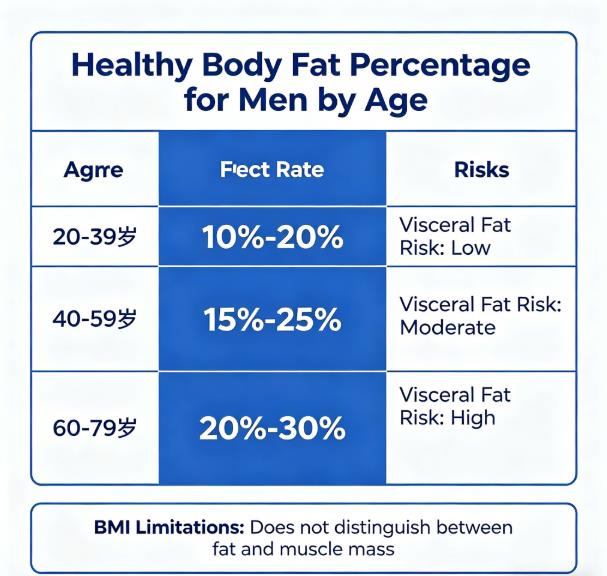
Healthy Body Fat Ranges for Men, Decade by Decade
Body fat isn't inherently bad. Men need essential fat — roughly 2–5% — for hormone production, temperature regulation, and organ protection. Beyond that baseline, where you carry the fat and how much you carry relative to your age matters enormously. The American Council on Exercise (ACE) publishes validated body fat percentage norms that adjust for age, and these benchmarks tell a far more nuanced story than the single "healthy weight" BMI category ever could.
| Age Group | Athletes | Fitness | Acceptable | Overfat | Obese |
|---|---|---|---|---|---|
| 20–29 | under 11% | 11–14% | 15–20% | 21–25% | over 25% |
| 30–39 | under 12% | 12–16% | 17–21% | 22–26% | over 26% |
| 40–49 | under 14% | 14–17% | 18–23% | 24–28% | over 28% |
| 50–59 | under 15% | 15–19% | 20–24% | 25–29% | over 29% |
| 60+ | under 16% | 16–20% | 21–25% | 26–30% | over 30% |
Two patterns stand out from this table. First, healthy ranges rise with age — not because gaining fat is harmless, but because the benchmark for what's typical and metabolically acceptable shifts as muscle mass naturally declines. Second, a man who maintains the same body fat percentage from age 30 to 55 is actually becoming healthier relative to his peers. His composition is holding steady while the average man his age is losing muscle and gaining fat.
Why Visceral Fat Becomes a Risk Factor Worth Watching After 40
Not all body fat is equal. Subcutaneous fat — the kind you can pinch just under the skin — is metabolically quiet. Visceral fat — packed deep in the abdominal cavity around the liver, pancreas, and intestines — is metabolically active in harmful ways, releasing inflammatory compounds that raise the risk of heart disease, type 2 diabetes, and certain cancers.
Men are genetically predisposed to store fat in the abdominal region, and this tendency intensifies with age. A 2020 study in the Journal of Clinical Endocrinology & Metabolism (Visser, M. et al. 2020; 105(4): dgz278) found that men's visceral adipose tissue increased by an average of 24% between ages 40 and 60, even among those whose total body weight remained stable. This explains why waist circumference — not just body fat percentage — becomes an essential metric for men over 40. The National Institutes of Health (NIH) identifies a waist measurement above 40 inches for men as an independent risk factor for metabolic disease, regardless of BMI or total body fat percentage.
If your body fat is within the acceptable range but your waist is above 40 inches, visceral fat is the likely culprit. If both numbers are high, the risk compounds. If both are in check, your metabolic foundation is solid regardless of what the BMI chart might suggest.
A Story That Plays Out in Midlife Checkups Across the Country
Consider two men at the same height, 5'10". One weighs 210 pounds with a BMI of 30.1 — technically obese by the standard chart. His body fat is 19%, squarely in the fitness range for his age. His waist is 37 inches, well under the 40-inch threshold. His cardiometabolic risk is low. The "obesity" label from his BMI disappears the moment body composition enters the conversation.
Now look at the opposite case. Another man at the same height weighs 175 pounds with a BMI of 25.1 — comfortably normal. He doesn't exercise. His waist measures 42 inches. His body fat percentage comes in at 28% — overfat for his age, despite his "healthy" BMI. His metabolic panel shows elevated triglycerides and fasting glucose creeping toward prediabetic range. The BMI chart gave him a clean bill of health. His body fat percentage and waist circumference told the real story.
Clinical guidance from the American College of Physicians (ACP) on adult preventive health agrees: assessing cardiometabolic risk in middle-aged men should incorporate waist circumference and body composition analysis rather than relying on weight or BMI alone. Combining body fat percentage with waist measurement constructs a picture that often reveals health trends long before a single number would.
How to Measure Your Body Fat at Any Age
You don't need a DEXA scan to get a reliable estimate, though it's the gold standard if you can access one annually. Here are the practical options, ranked by accessibility:
Tape measure method (Navy formula): Measuring your neck and abdomen at the navel, plus your height and weight, can estimate body fat within 3–5 percentage points of DEXA. Cost: a $3 tape measure. A body fat calculator using this formula does the math for you.
Skinfold calipers: Pinching skin at three to seven body sites, then converting the sum to a body fat estimate. The Jackson-Pollock formulas, recommended by ACSM, have been validated against hydrostatic weighing. Accuracy depends on the skill of the person using them — practice consistency over pursuing perfect numbers.
Bioelectrical impedance (BIA) scales: Most smart scales use BIA, sending a tiny current through your body. Readings fluctuate significantly with hydration, so measure first thing in the morning, after bathroom, before food. Track the trend over months, not the daily number.
DEXA scan: The clinical gold standard, available at imaging centers and some gyms for $75–150. Best used as an annual calibration check to confirm your home measurements are tracking in the right direction.
What to Do if Your Body Fat Is Higher Than You'd Like
Discovering your body fat percentage is higher than expected isn't bad news — it's information you can act on. The approach for men, especially those over 40, isn't extreme dieting. The goal is body recomposition: preserving or building muscle while gradually reducing fat.
Prioritize protein. A general starting point: roughly 0.7 grams per pound of body weight daily. Spread it across three to four meals. Individual needs vary — activity level, age, and health status all play a role. Protein preserves muscle during fat loss and has the highest thermic effect of any macronutrient.
Resistance train consistently. Two to three sessions per week of resistance training — whether bodyweight, bands, free weights, or machines — signal your body to hold onto muscle. You don't have to train like a competitive bodybuilder. The goal is simply sending a signal to your body to preserve muscle tissue.
Walk more. NEAT — non-exercise activity thermogenesis — accounts for more of your daily expenditure than formal exercise for most people. Park farther away, take stairs, walk during phone calls. These small movements add up to hundreds of calories daily without feeling like exercise.
Track your waist circumference alongside your body fat percentage every two weeks. When the waist drops or stays the same while body fat declines, you're gaining muscle and losing fat — the ideal recomposition pattern.
Your Body Fat Check Start
Today: Measure your waist at the navel. Calculate your body fat percentage using a tape measure or online calculator. Write both numbers down.
This month: Add one resistance training session per week if you aren't already doing any. Aim for two. If you already train, check your protein intake — most men undereat protein when trying to lose fat.
This quarter: Re-measure your waist and body fat percentage. Compare to today's numbers. Look for trends, not perfection.
Ready to start? Use a body fat calculator now to get your baseline number — then take the first step today.
Common Myths About Body Fat and Aging in Men
Myth: Gaining fat is inevitable as men age. Fact: Hormonal shifts make fat gain easier and muscle maintenance harder, but body composition changes are driven far more by lifestyle than by age alone. Men who maintain resistance training and adequate protein intake can keep body fat in the fitness range well into their 60s and beyond.
Myth: A "normal" BMI means your body fat is fine. Fact: Normal-weight obesity — a BMI in the healthy range with body fat in the overfat or obese range — affects roughly 24% of American adults. For men over 40, this condition is especially common because muscle loss masks fat gain on the scale.
Myth: You need to lose weight to improve body fat percentage. Fact: Body recomposition — losing fat while gaining muscle at roughly the same weight — is achievable, especially for beginners, men returning to training after a break, and those with higher body fat percentages. The scale may not move while your body composition transforms.
Myth: Waist circumference doesn't matter if your body fat percentage is fine. Fact: Waist circumference is an independent risk factor. A man with a waist above 40 inches faces elevated metabolic risk even if his total body fat percentage is within range. Visceral fat is metabolically dangerous regardless of total body fat.
Sources
Visser, M. et al. Visceral adipose tissue accumulation during aging. Journal of Clinical Endocrinology & Metabolism. 2020; 105(4): dgz278.
Frequently Asked Questions
What is a healthy body fat percentage for a man in his 40s?
According to the American Council on Exercise, a body fat percentage of 14–17% falls in the fitness range for men aged 40–49, while 18–23% is acceptable. The healthy range shifts upward with age, but men who maintain resistance training and a balanced diet can stay in the fitness range well into midlife and beyond.
Why does body fat percentage increase with age even if my weight stays the same?
This is due to sarcopenia — age-related muscle loss — combined with a gradual increase in fat mass that doesn't register on the scale. From age 30 onward, men who don't resistance train lose roughly 3–5% of their muscle mass per decade. The scale stays the same because lost muscle weight is replaced by fat weight, pound for pound.
Is body fat percentage more important than BMI for men over 50?
Yes, and the gap between the two metrics widens with age. BMI doesn't account for muscle loss or visceral fat gain. A 55-year-old man can have a "normal" BMI while carrying dangerously high visceral fat and low muscle mass. Body fat percentage, combined with waist circumference, provides a far more meaningful picture of metabolic health for men in this age group.
How often should I check my body fat percentage?
Every month is sufficient for most men using a tape measure or calipers. If using a BIA scale, track weekly under consistent conditions — morning, after bathroom, before food — but only compare month-over-month averages. DEXA scans can be done annually as a calibration check against your home measurements.
Can I lower my body fat percentage without losing weight?
Yes, through body recomposition. By combining adequate protein intake with progressive resistance training, you can build muscle while gradually reducing fat mass. The scale may stay the same or even increase slightly as muscle is denser than fat, but your waist circumference and how your clothes fit will reflect the positive change in body composition.