At a Glance: Excess weight drives joint pain and chronic arthritis through two separate routes: mechanical force and systemic inflammation. Each extra pound adds 3–4 pounds of stress on the knees with every step, while fat tissue releases cytokines that break down cartilage even in joints that never bear weight.[1] CDC and WHO research confirms that losing just 5–10% of body weight can cut knee pain by up to 50% and meaningfully lower long-term arthritis risk.[2] Below, we explain the exact mechanisms, the data that matters, and the joint-safe actions you can start this week.
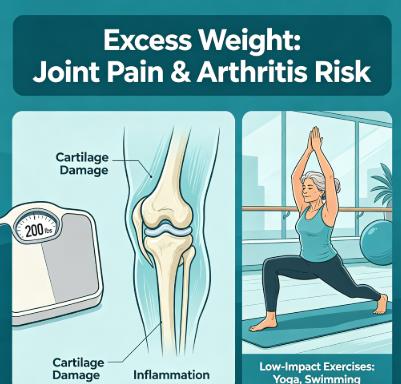
Two Ways Excess Weight Attacks Your Joints — Mechanical vs Inflammatory
Most people assume joint pain from excess weight is purely physical — too much load on the hinges. That is half the story. The other half happens at the cellular level, and it is just as damaging.
The Mechanical Pathway: Every Pound Multiplies
Weight-bearing joints — knees, hips, ankles, and the lower spine — distribute force within limits. NIH biomechanics research shows that each pound of body weight creates 3–4 pounds of extra compressive force across the knee joint during walking.[1] For someone carrying 50 extra pounds, that equals 150–200 additional pounds of stress per knee, per step. Over 10,000 daily steps, the cumulative overload is massive.
Cartilage has almost no blood supply and very limited regenerative capacity. Once it thins or cracks under chronic overload, the damage is largely permanent. This is the direct pathway to osteoarthritis, the most common form of arthritis, affecting over 32 million U.S. adults according to the CDC.[3] Understanding your current weight status with a online BMI calculator is the simplest first step to gauge your mechanical joint risk.
The Inflammatory Pathway: Fat Tissue as an Active Organ
Adipose tissue is not a passive storage depot — it is metabolically active. Excess fat, especially visceral fat around internal organs, secretes pro-inflammatory cytokines including interleukin-6 (IL-6) and tumor necrosis factor-alpha (TNF-α).[1] These molecules enter the bloodstream and travel throughout the body. This inflammation is systemic, not localized. It irritates joint linings and accelerates cartilage breakdown even in joints that never support body weight.
That is why people with a BMI over 30 face higher risk not only for knee and hip osteoarthritis but also for hand and wrist arthritis. A body fat calculator helps distinguish whether your weight comes from metabolically active fat tissue or lean mass, which matters for assessing inflammatory risk.
The Joint Risk Data
The epidemiological picture is clear. A meta-analysis cited by the WHO indicates that individuals with a BMI in the obese range (≥30) are 2.5 to 4 times more likely to develop knee osteoarthritis than those in the healthy weight range.[2] Even being in the overweight category (BMI 25–29.9) roughly doubles the risk.
CDC surveillance data shows that nearly 1 in 4 U.S. adults reports arthritis symptoms, and among those, approximately half say their weight worsens their condition. The connection between BMI obesity related diseases — with osteoarthritis among the most disabling — grows stronger with each additional year spent at an elevated weight.
| BMI Category | BMI Range | Relative Risk of Knee Osteoarthritis |
|---|---|---|
| Healthy Weight | 18.5–24.9 | 1.0 (reference) |
| Overweight | 25.0–29.9 | ~2.0× |
| Class I Obesity | 30.0–34.9 | ~2.5–3.0× |
| Class II+ Obesity | ≥35.0 | ~4.0–4.5× |
These numbers are risk gradients, not destiny. Moving down even one category through sustained weight loss shifts the odds meaningfully in your favor.
Note for Asian populations: Due to higher visceral fat accumulation at lower BMI levels, joint protection benefits begin at proportionally smaller weight losses (3–7% of body weight) compared to Western populations. Many East and South Asian adults experience meaningful joint symptom relief with weight reductions of just 5–10 lbs (2.3–4.5 kg), even when their starting BMI falls within the standard "healthy" range by WHO definitions.
Why 5–10% Weight Loss Delivers Disproportionate Joint Relief
The most encouraging finding in weight-joint research is that benefits begin well before you reach an "ideal" weight. The CDC and NIH both highlight the 5–10% threshold as the tipping point where measurable pain reduction starts.[3]
For a 200 lb person: losing just 10–20 lbs reduces knee compressive force by 30–80 lbs per step and cuts systemic inflammatory markers by 15–25%.
Clinical pain reduction: multiple NIH-funded trials show that 5% weight loss reduces knee pain scores by 25–30%, and 10% loss pushes that reduction to 40–50%.[4]
Why not more? Rapid, extreme weight loss often strips muscle mass alongside fat. Muscle acts as the shock absorber that protects joints from ground impact. Losing muscle can undercut the mechanical benefit of weighing less. A sustainable pace of 1–2 lbs per week preserves lean tissue while shedding adipose.
Question: How much weight do I need to lose to feel a difference in my knees?
Answer: Clinical data shows measurable pain reduction begins at 5% of body weight. For a 200-pound person, that's just 10 pounds — about 1–2 months of sustainable changes.
One reader, a 58-year-old elementary school teacher with a BMI of 32, described her knee pain as "the reason I started dreading Monday mornings." Climbing the stairs to her classroom felt like a chore. She made two changes: a 15-minute walk after dinner and swapping her afternoon soda for sparkling water. Over several months she lost 12 pounds — about 6% of her body weight. Her pain score dropped from 7/10 to 3/10. Three months later, she was back on the playground with her students. Many people overlook this key difference: it's not about reaching a "goal weight" — it's about the first few pounds that change how you move.
The broader context of high BMI health risks shows that joint damage rarely occurs in isolation — it is often accompanied by metabolic changes that compound over time. Addressing weight addresses multiple risk pathways simultaneously.
Joint-Safe Movement: What Helps vs What Hurts
Exercise is essential, but joint type matters enormously. The wrong activity can accelerate cartilage wear; the right one strengthens the support structures around vulnerable joints. A CDC review found that physical activity can reduce arthritis pain and improve function by about 40% — without any weight loss at all.[3]
| Recommended Activities | Why They Help | Activities to Limit or Modify | Why They Pose Risk |
|---|---|---|---|
| Swimming, pool walking | Zero impact with resistance; ideal starting point | Running, plyometrics | 3–8× body weight per foot strike |
| Stationary or outdoor cycling | Builds quadriceps without compressive loading | Basketball, tennis (pivoting sports) | Impact plus rotational torque on knee |
| Gentle yoga (modified poses) | Improves mobility, reduces stiffness | Heavy deep squats, leg press with max load | Excessive compressive force on cartilage |
| Strength training 2×/week | Builds muscular scaffold around joints | High-impact group fitness classes | Uncontrolled landing forces |
In real practice, starting with just 10 minutes of pool walking twice a week is the most sustainable way to build a habit without triggering pain. The goal is consistency the joint can tolerate, not intensity that provokes a flare-up.
The Inflammatory Connection Beyond the Joint
Because excess fat releases inflammatory cytokines into circulation, the effects extend beyond any single joint. The same TNF-α and IL-6 molecules that degrade cartilage also contribute to systemic low-grade inflammation linked to insulin resistance, endothelial dysfunction, and elevated cardiovascular risk.
This is why the WHO classifies obesity as a modifiable risk factor not just for osteoarthritis but also for a cluster of interconnected conditions.[2] The common denominator is inflammation, and the most effective intervention for reducing it — before any medication — is weight reduction through sustainable dietary and activity changes. The relationship between BMI and chronic disease risk underscores that joint health does not exist in a silo; it is part of a broader metabolic picture.
Joint-Safe Actions to Start This Week
In our experience working with individuals managing joint pain, the biggest mistake is trying to do too much too soon. The most successful journeys start with one small change that sticks. We have seen individuals who lost just 8 pounds and were able to stop relying on over-the-counter pain medication entirely. Here is a ramp-up that respects your joints and your schedule.
Week 1 — Get your baseline numbers. Use a reliable calculator to check your current BMI and body fat percentage. Record your weight and waist circumference. Rate your typical joint pain on a simple 1–10 scale after walking or daily activity.
Week 1–2 — Make one dietary swap you can sustain. Love soda? Try swapping one can for sparkling water with a squeeze of lime. A 150-calorie daily reduction adds up to roughly 1 lb of fat loss every 23 days.
Week 2–4 — Add one low-impact activity. Ten minutes of walking after your largest meal of the day, 15 minutes of stationary cycling three times per week, or a weekend swim session. Focus on consistency, not intensity.
Month 2–3 — Reassess. Check your weight, body fat trend, and joint pain score. A 5% weight reduction is a milestone worth celebrating. Joint pain often improves noticeably before the scale number looks dramatic.
Movement Snacks for Joint Health: Quick Daily Actions
Do not have 30 minutes for a workout? No problem. Try these "movement snacks" — 2–5 minute bursts of joint-friendly activity sprinkled throughout the day. These micro-sessions improve synovial fluid circulation and strengthen supporting muscles without requiring a gym visit.
Morning: 10 body-weight squats holding onto a countertop for support, plus 10 standing calf raises.
Midday: A 3-minute walk around the office or block, plus 5 seated leg extensions per leg.
Evening: 5 minutes of gentle hamstring and hip flexor stretching while watching TV.
These are not workouts. They are joint maintenance. Done daily, they accumulate meaningful benefit without joint stress.
Frequently Asked Questions
How does extra weight damage joints over time?
Through two independent pathways. Mechanically, each extra pound adds 3–4 pounds of force on the knees with every step. Biochemically, excess fat tissue releases inflammatory cytokines that degrade cartilage even in joints that do not bear weight. Both pathways improve with weight loss.
Can losing 10–20 pounds really make a difference for joint pain?
Yes. A 5–10% body weight reduction — 10–20 lbs for a 200 lb person — reduces knee compressive forces by 30–80 lbs per step and cuts pain scores by 25–50%. The benefit is disproportionate to the weight lost because both mechanical loading and inflammatory signaling decrease at the same time.
Does excess weight cause arthritis in hands and fingers?
Yes. The inflammatory chemicals released by excess visceral fat travel through the bloodstream and can irritate joint linings anywhere in the body. This explains why people with obesity have elevated rates of hand osteoarthritis — joints that never carry body weight.
What types of exercise are safe for joint pain?
Water-based activities eliminate impact while providing resistance. Stationary cycling strengthens the quadriceps — the main knee-stabilizing muscle — without compressive loading. Gentle yoga improves mobility. Avoid running, jumping, and pivoting sports, especially if your BMI is above 30 or you have existing joint symptoms.
Is osteoarthritis inevitable if I've been overweight for years?
No. The WHO classifies obesity as a modifiable risk factor. Cartilage damage already present cannot be reversed, but further progression can be slowed or halted through weight loss, joint-safe exercise, and reduced systemic inflammation. Benefits begin at 5% weight loss.
Sources
NIH National Institute of Arthritis and Musculoskeletal and Skin Diseases: Osteoarthritis Overview
WHO: Musculoskeletal Conditions — Obesity as a Modifiable Risk Factor
This article is for informational and educational purposes only. It does not replace professional medical advice, assessment, or care. Always seek the advice of a qualified healthcare provider with any questions regarding your weight, joint pain, or arthritis risk. Individual results will vary. The BMI Calculator Blog Team maintains editorial independence and does not sell health products.