Quick answer: Perimenopause changes body composition — estrogen's drop moves fat toward the abdomen and muscle loss slows your metabolism — so BMI can stay flat while your waist climbs.
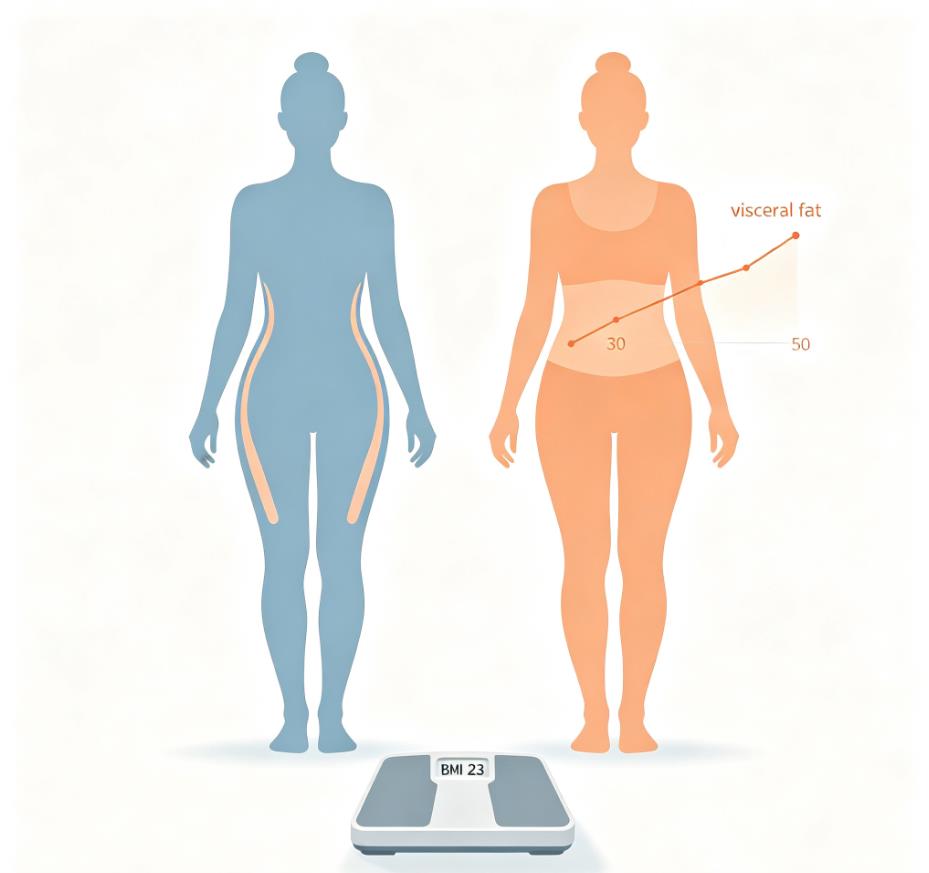
The scale still works. It's just measuring total weight — not where that weight sits or what it's made of. Two women, both 5'5" and 140 lb, can have BMI 23 — one stores fat on her hips, the other carries it around her organs. After 40, that second pattern becomes far more common, and BMI alone will not show it.
Why your body composition shifts in perimenopause
Through this transition, three separate shifts happen at once. None of them requires a single pound of weight gain to do real damage.
The first domino: estrogen drops, and fat follows a new path
Estrogen used to direct fat storage toward hips and thighs. As levels dip in your 40s, that priority moves toward the abdomen. Visceral fat — packed around the organs — rises while subcutaneous fat stays put. Research on the menopausal transition shows exactly this: increased visceral fat and decreased energy expenditure, year over year, before the final menstrual period. The difference matters because visceral fat drives insulin resistance and inflammation; the fat under your skin largely does not.
Meanwhile, muscle is slipping away
Adults lose roughly 3–8% of muscle per decade starting around 30. Less muscle means a lower resting metabolic rate, so the same meals that held your weight steady at 32 can add fat at 42. This is body recomposition in reverse, and the scale misses every gram of it.
Fat tissue itself changes when estrogen is low
Declining estrogen alters how fat tissue operates — remaining fat becomes more prone to expansion, and the metabolic signals that once limited storage go quiet. The drivers are hormonal, not behavioral. That distinction changes what actually works for managing weight in your 40s and 50s.
Why BMI stops being a reliable read
BMI is a height-to-weight ratio. WHO calls it "a surrogate marker of fatness" — useful as a screen, insufficient as a verdict. In perimenopause, two blind spots converge:
Normal-weight obesity. A 5'5" woman at 140 lb has a "healthy" BMI of 23, yet elevated body fat and a 36-inch waist carry real metabolic risk.
The hidden swap. You can gain 5 lb of fat and lose 5 lb of muscle at the same total weight — identical BMI, worse health.
Ethnic differences. Women of Asian descent accumulate visceral fat at lower BMI thresholds than the standard cutoffs suggest, so a "healthy" 23 may already carry risk.
| What changes | What BMI shows | What is actually happening |
|---|---|---|
| Fat redistributes to abdomen | Nothing | Visceral fat rising year over year |
| Muscle declines 3–8% per decade | Nothing | Resting burn drops |
| Total weight holds steady | Stable | Fat up, lean mass down |
What to track instead
A Gender Adjusted BMI Calculator still gives a useful screening baseline, but pair it with two numbers that actually move when composition does.
Waist circumference first. Stand relaxed, tape at the navel, normal exhale — don't suck your stomach in, that defeats the purpose. For women, 35 inches (88 cm) is the NHLBI threshold where visceral fat starts driving risk upward regardless of BMI. Measure monthly, same conditions.
Body fat percentage second. A body fat calculator gives a practical estimate from height, weight, age, and waist. For women in their 40s, the meaningful range is roughly 21–27%, widened from the younger 21–24% band.
Strength work third. Resistance training twice a week is the most direct counter to muscle loss. It preserves the tissue that keeps your resting burn up — which is exactly what estrogen used to do for you.
If you are over 65, of Asian descent, pregnant, or an athlete, standard cutoffs need adjustment. Use a population-specific tool and speak with your provider before changing how you eat or train.
Frequently Asked Questions
Does perimenopause really change where fat goes?
Yes. Falling estrogen shifts storage from hips and thighs toward the abdomen, and research on the menopausal transition shows visceral fat rising as energy expenditure falls.
Why does my BMI look normal but my waist keeps growing?
Because BMI cannot distinguish fat from muscle or see fat location. Abdominal fat can rise while total weight — and BMI — stays put.
At what age does this shift usually start?
Perimenopause often begins in the 40s, though it varies by several years. The changes build gradually rather than arriving overnight.
Can you lose the belly fat after 40?
A modest 200–300 calorie daily deficit with twice-weekly strength training and adequate protein (about 1.2–1.6 g per kg) reduces fat slowly while protecting muscle.
Is BMI still useful at all?
As a screening index, yes — just not alone. Combine it with waist size and body fat, and the three together catch what each misses.
Does the BMI number itself change during menopause?
The number does not change on its own, but the drivers behind it do — hormone shifts and muscle loss. That is why the same BMI at 45 can mean a very different body than at 30.
Sources
This article is for informational and educational purposes only. It does not constitute medical advice, diagnosis, or treatment. Always consult a qualified healthcare provider regarding your individual health and body composition goals. Individual results will vary. The BMI Calculator Blog Team maintains editorial independence and does not sell health products.